
Online volleyball betting 2026 — choosing a licensed bookmaker for the sport most punters overlook
 Available in US
Current as of 26 October 2026 — verified against the UK Gambling Commission’s public register.
Volleyball sits in an odd position on a British betting app. It is rarely a headline sport, but the world calendar runs almost continuously through the indoor and beach seasons, and almost every licensed British bookmaker quotes the top divisions somewhere in the programme. The page that follows covers how the market is built in Great Britain — who is licensed, what the law actually requires, how a price is constructed, where the live markets sit, and how the sign-up offers behave when a bettor applies them to volleyball markets rather than the football markets they were written for.

The ten reviewed bookmakers
The ten names below each hold a remote operating licence from the Gambling Commission and accept customers in Great Britain. The list is not a ranking from best to worst — it is the order in which the cards are reviewed below. Each entry names the licence holder, the Commission’s account number, and the one feature that distinguishes the brand’s terms from the others on the list. The free-bet language that follows describes the headline welcome offer as the brand’s own terms state it; what those offers settle into once a volleyball selection is added depends on the bonus rules discussed later in this article.
| Brand | Gambling Commission account | Licence holder | What sets it apart |
|---|---|---|---|
| BetTom | 64959 | Bet Tom Limited | A two-product welcome that pairs the sports free bet with a matching slot-bundle, separately ring-fenced |
| BetGoodwin | 2927 | Goodwin Racing Limited | Racing-led welcome offer issued as three distinct £5 free bets rather than a single credit |
| Tote | 54779 | TDCO Limited | Tote-style pool pricing and Best Odds Guaranteed on UK and Irish racing from 8 AM |
| Betfred | 39544 | Petfre (Gibraltar) Limited | Broad multi-product coverage with twenty-one sports and over two thousand casino-style games in one app |
| BetMGM | 39198 | LeoVegas Gaming PLC | Welcome paid as four separate £10 free bets, each tied to a specific market type and seven-day clock |
| Kwiff | 44448 | Eaton Gate Gaming Limited | A brand flagged for “surprise” stake multipliers applied to settled bets |
| Bet600 | 44731 | Tyche Tech Limited | Best Odds Guaranteed on horse racing paid at the larger of the SP and the early or show price |
| QuinnBet | 61011 | QuinnBet (Gibraltar) Limited | BOG on UK and Irish racing from 10:00 daily on singles, multiples and system bets, capped at £150 per race |
| Spreadex | 8835 | Spreadex Limited | A combined fixed-odds and FCA-regulated spread-betting account with one book, one balance |
| Sky Bet | 67370 | SBG Sports Limited | Free bets valid on single or each-way markets only and time-limited to thirty days |
The table reads as a single glance because that is what a punter wants: the licence number, the company behind the brand, and the feature that makes one of them worth opening before the others for a particular kind of customer. The verdict under each reviewed card picks up that question — who the brand actually suits — in the prose that follows. Two operators, Spreadex and Kwiff, score on different terms entirely; the table makes that obvious without discussing it.
What online volleyball betting is, and where it fits in a British betting app
Volleyball betting in Great Britain means putting money on indoor or beach volleyball through a bookmaker licensed to take remote bets from customers in England, Scotland and Wales. There is no British statute that names volleyball as a permitted or restricted sport — the Gambling Act 2005 covers all forms of betting the Commission licenses — so volleyball is a routine part of the betting programme wherever the operator chooses to offer it. On most major British apps that means coverage of the FIVB World League, the national leagues of Italy, Brazil, Poland, Russia and Turkey, the four Olympic-class European national competitions, and the global beach tour between May and October.
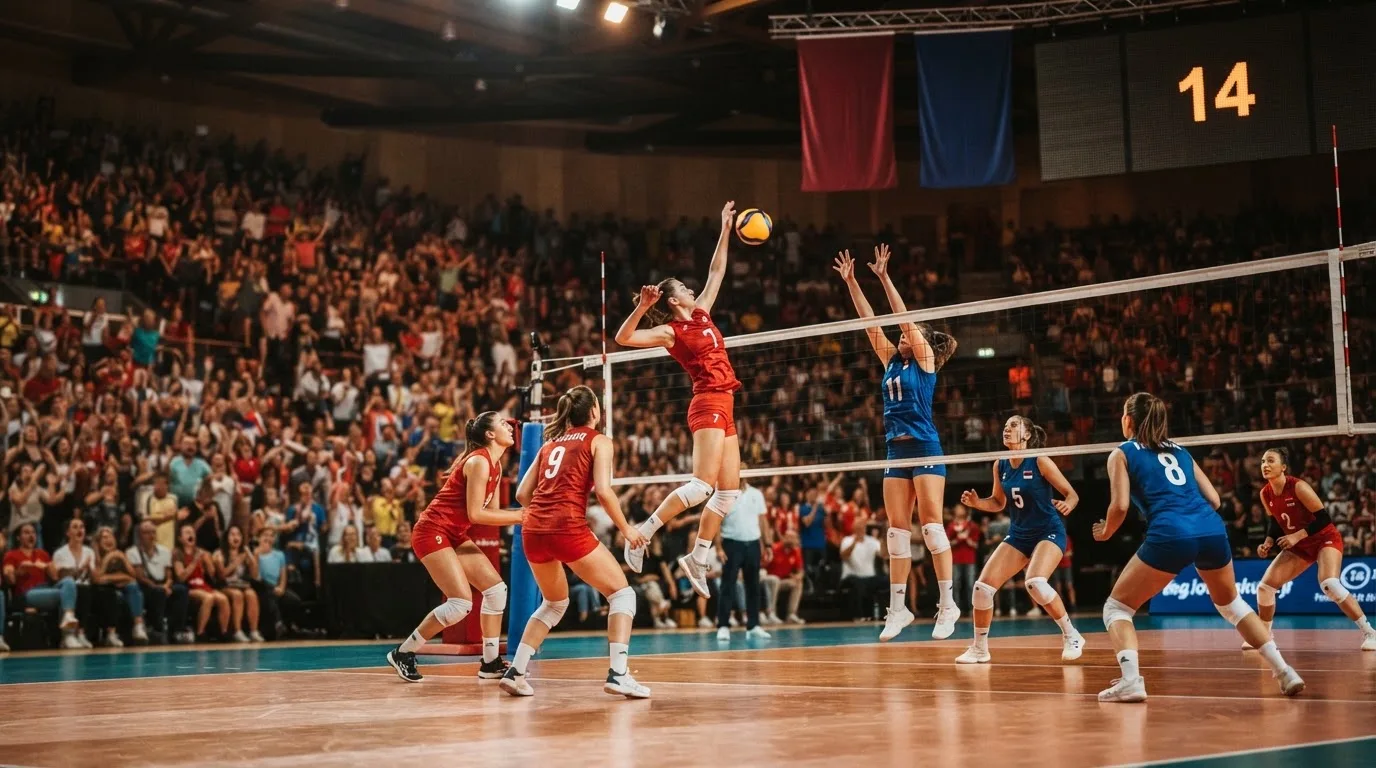
The sport itself shapes the market. Six players per side, a net at 2.43 metres for men and 2.24 metres for women, a 9 m × 18 m court, and matches decided by the best of five sets with the deciding set played to fifteen rather than twenty-five. Beach volleyball is two-a-side on a smaller court played to three sets of twenty-one. Three things follow for the betting:
- Set betting is granular. With five sets and a fixed-points structure, the bookmaker’s programme lists not just match winner but set score (3-0, 3-1, 3-2 for the indoor game), total sets in the match, and the handicap line on each set. A bettor used to football’s three-way 1X2 finds five or six markets on the same fixture.
- Live markets tilt on momentum. Volleyball sets turn on runs of three or four points. The in-play book, when a licensed operator publishes one, moves fastest during those runs and slows down between them.
- Tournament betting runs to the calendar, not the weekend. Volleyball club seasons in Europe overlap with the FIVB national-team windows; Olympic volleyball has been on the Summer programme since Tokyo 1964 and beach volleyball since Atlanta 1996. A bettor wants a bookmaker that prices through the season, not one that only lists football-friendly weekends.
Most British punters meet volleyball as part of a wider bookmaker’s programme rather than a dedicated bookmaker like the racing-only firms that exist for horse racing. That is the structural difference: a betting exchange user on football is also likely to see volleyball priced for the same reason — a thin but liquid market, published by the same engine — but a bookmaker that specialises in volleyball, the way some specialise in horse racing, is not a thing in the British market.
The legal frame: the Gambling Commission licence and what it actually buys a customer
A bookmaker serving customers in Great Britain needs a Gambling Commission remote operating licence — there is no exemption by size, sport or country of origin. Since the Gambling (Licensing and Advertising) Act 2014, the licence is required wherever the operator is based if its remote facilities are used in Great Britain; a Curaçao, Maltese or Gibraltar licence is not a substitute. The categories the Commission issues matter for what an operator can offer: remote general betting standard (real events) is the one that covers sports betting on real fixtures; remote general betting standard (virtual events) is a separate category and a separate licence; pool betting and betting exchange activity are their own categories.

The Commission’s public register is the test. It can be searched by business name, trading name, domain or account number, and it tells the customer three things at once: that the operator holds a remote general betting standard licence, the name of the licensee, and the date the licence was issued. A licence number should be quoted in full as it appears on the register, including any suffix, but the test of legitimacy is the live register entry, not the number printed on the operator’s home page. That distinction catches the kind of case where an operator’s marketing carries an old licence number from a previous corporate restructure.
Two points routinely lost:
- Licensed operators use
.comas well as.co.uk. The domain proves nothing. The Commission register does. - Several brands can run under one licensee. Where this is the case the brands are not independent operators for licensing purposes. Every card on the reviewed list names the actual licensee so the connection is plain if the reader checks.
The age and identity rules are also statutory. Eighteen is the minimum age for any gambling product, and the operator must verify the customer’s name, address and date of birth before the first deposit or bet, including with a free bet or bonus where no money changes hands initially. That identity check is the reason there is no anonymous play at a licensed British site; an offshore platform might offer a sign-up in seconds, but a licensed operator cannot. Players on the receiving end of that friction tend to find it tiresome; players who later need a payout tend to be glad of it.
In-play betting — placing a bet while the match is running — is offered by GB bookmakers and is governed by the operator’s own licence conditions and the customer-protection duties in the LCCP, not by any separate statute. There is no statutory “in-play is restricted” rule and there is no statutory “in-play is unrestricted” rule; what the law does is require the operator to manage the markets and have the technical capacity to settle them. A bettor checking an in-play product before settlement reads the operator’s terms rather than a clause of the Gambling Act.
A separate register should be mentioned because it often comes up alongside the licence register: the GAMSTOP register, which every online operator in Great Britain is required to integrate. Registering with GAMSTOP self-excludes the customer from every GB-licensed online betting site for a minimum period (six months, one year, five years or five years with auto-renewal, then a further seven years after the minimum) and is a condition that an operator is required to enforce.
The licence does not make any operator the safest or best — it sets a regulatory floor. A bettor who values the protection (and the customer-protection rules under it) chooses to bet on a licensed site; a bettor who chooses an offshore site trades that protection for a different proposition, with no GAMSTOP coverage, no Commission complaints route, no approved alternative-dispute-resolution service, and no recourse through British consumer law if funds are withheld. The page does not moralise about that choice — it describes it.
Where player protection lives: the customer-facing rules every licensed brand must apply
Three rules attach to every GB-licensed remote bettor and matter when an offer is being claimed or a deposit being set.
Identity verification. Name, address and date of birth are verified before the first deposit or gamble, including with a bonus or free bet. A bettor who tries to skip this at a licensed site is asked to provide documents anyway.
Self-exclusion. GAMSTOP is the national multi-operator online self-exclusion scheme and a mandatory licence condition. Periods are six months, one year, five years, or five years with auto-renewal, and after the minimum period the exclusion stays in place for a further seven years unless the customer asks GAMSTOP to remove it. Betting shops use a separate service. Every one of the ten brands on the reviewed list is a GAMSTOP member, including those that have only recently secured their GB licence.
Deposit limits and affordability. Operators must offer a gross deposit limit on a fixed time frame, and the licence conditions on financial vulnerability checks apply to a customer whose deposits minus withdrawals exceed £150 in a rolling thirty days. Above that threshold the operator runs a public-record check — for example, a register of county court judgments — but not an income check or a credit-reference search. The wider affordability checks announced by the Commission are staged and have no published start date.
Help exists, and a player who needs it does not have to use the brand they bet with to reach it. GamCare runs the National Gambling Helpline, GambleAware funds treatment and research, the NHS runs gambling clinics in several English regions, and Gamblers Anonymous runs local groups. Fitzwilliam Sports, for instance, makes all four visible from its home page. A bettor who finds a betting app hiding these links behind a settings menu should treat that as the brand’s working culture rather than the law — every licensed operator must offer them, but the prominence is the operator’s choice.
Crypto and anonymity: what does, and what does not, exist at the licensed end
Volleyball betting with bitcoin and other cryptocurrencies is a real product at offshore operators; at GB-licensed brands it is the opposite of the case. A licensed remote betting operator must verify the customer’s identity before the first deposit, including with a free bet or bonus, and it must be able to identify the source of funds where the spend reaches the customer-protection threshold. Both rules are incompatible with anonymous play in any meaningful sense — a cryptocurrency deposit at a licensed operator would still be tied to a verified identity under UK anti-money-laundering rules. There is no GB-licensed bookmaker on the reviewed list that publishes a cryptocurrency deposit route as a primary option.
A bettor looking for crypto deposits, or for the kind of pseudonymous play that an offshore operator offers, finds one of two things:
- A licensed site that excludes cryptocurrency deposits entirely, even where it accepts debit cards and bank-based transfers.
- An offshore site that accepts cryptocurrency but does not hold a Gambling Commission remote licence, which removes every piece of the protection set out in the previous two sections — no GAMSTOP coverage, no Commission complaints, no approved dispute resolution, and no British consumer-law recourse if funds are withheld.
The honest framing on the second option is not “legal to use” and not “illegal to use” — the offence under section 33 of the Gambling Act 2005 is aimed at the operator that provides the unlicensed facilities, not at the customer who uses them. The cost is the loss of the British customer-protection set, which is the only thing a GB licence guarantees a customer that an offshore site does not. A bettor who values speed and pseudonymity above the protection is using a different product; the page does not adjudicate that choice, but it would be wrong to describe it as equivalent.
How the welcome offers work on a volleyball selection
Every name on the reviewed list runs a welcome offer of some kind, and the offers read very differently once a volleyball selection is added to the betslip. The mechanics below are what the offers actually settle into; the headline figures and bonus codes are not the story.
BetTom. A 50% back as a free bet up to £50, with a matching 50% back as free slot funds. The sports leg is the relevant one for volleyball: a 50% return means a £10 first bet that loses returns £5 as a free bet; a £10 bet that wins pays only the winnings of the sports bet. The free-bet stake is not paid back on a win. The casino leg is ring-fenced and not usable on sports markets at all.
BetGoodwin. A £10 sports bet returns £15 in free bets, paid as three distinct £5 tokens (a £5 sports bet, a £5 acca, a £5 Sub-Cover bet). Each token is a separate restricted free bet: the £5 sports token is the one usable on a single volleyball selection, the £5 acca token requires a multi, and the Sub-Cover token is a brand-specific market. Mixing them or staking them on restricted markets voids them.
Tote. Tote welcome offers are pool-pricing based rather than fixed-odds free bets — relevant on horse racing primarily; for volleyball the offer structure reads more conservatively.
Betfred. Betfred’s sports welcome is generally expressed as a free-bet refund; the broader app covers twenty-one sports and over two thousand casino-style games, which means a bettor on a volleyball selection is one of several markets the offer applies to rather than the focus of it.
BetMGM. Four £10 free bets on deposit of £10 or more, conditional on a first sports bet within seven days: two football accumulators of four or more selections, two sports multiples of two or more. The first two are football-only on the football accas of four-plus selections, and the multiples leg allows volleyball only in combination, not as a single. The four tokens expire after seven days, on separate clocks.
Kwiff. The Kwiff brand is best known for the “surprise” stake multiplier a settled bet sometimes receives — the headline welcome is a more conventional free-bet structure than the in-app surprise mechanic.
Bet600. Racing-focused welcome in practice; the brand’s distinguishing feature on the list is Best Odds Guaranteed on horse racing settled at the larger of the starting price and the price taken earlier.
QuinnBet. Best Odds Guaranteed on UK and Irish racing from 10:00 daily on singles, multiples and system bets, capped at £150 per race. The welcome offer is structured around a refund-on-first-bet.
Spreadex. Spread betting on sports at this brand is FCA-regulated and carries losses that can exceed the deposit. The fixed-odds welcome is the relevant one for a single-match volleyball selection; the spread leg is a different proposition entirely.
Sky Bet. Sky Bet free bets expire thirty days after crediting, can be used only on single or each-way markets (not multiples), excluding virtuals, are non-withdrawable and do not return the stake with winnings. A volleyball match winner is a single; a set-correct-score bet is also single; an acca on volleyball is not a permitted use and the bet would be rejected.
The pattern: every operator routes the welcome through at least one restricted token rather than a single usable free bet, and every one of them applies to the sports leg of the offer rather than across the suite. A bettor who reads the headline number without reading the token rules on the back of the welcome finds out the difference when settlement arrives.
Live betting on volleyball, and how cash out sits with it
In-play volleyball markets are offered by every major GB-licensed bookmaker, but the depth varies. The book for a top-flight Brazilian or Italian match on the night of a fixture often opens with moneyline, set handicap and total sets, then adds set score, race-to-X-points and team-total-sets at the end of set one. Beach volleyball markets are thinner because the fixture list itself is thinner outside the summer. Live streaming of volleyball is rarer than live streaming of football or tennis; few British bookmakers hold the rights, so the in-running book is what the bettor gets rather than a picture.
The cash-out feature — the button that settles a bet before the match is over — is offered on most major apps and behaves like this on a volleyball bet: the offer is the bookmaker’s mid-market price on the bet at that moment, deducted by their margin; accepting it ends the bet then. A bettor should treat the cash-out figure not as a fair settlement but as a quoted one; for a deeper bench where the bet is heading to settlement, the offered price often lags the open market by a wider margin than it does on football because there are fewer competing bookmakers on the in-play volleyball side.
A specific bet-builder product on a single volleyball match is offered by most of the reviewed list; Spreadex, fixed-odds and spread combined, has the most fully featured builder because the spread side lets a bettor pick from a wider selection of micro-markets per point of the live feed. Most other brands limit the builder to the standard match-result set: match winner, total sets, set handicap. Multi-fixture volleyball accas are priced by most brands with a maximum number of legs and a cap on the maximum boosted percentage; William Hill’s wider acca insurance, where each leg is at 1/5 or bigger, is a separate product that applies broadly across the app’s acca programme.
Predictions, tipsters and what a strategy can and cannot do
Volleyball betting tips are sold online by tipsters, and volleyball betting predictions turn up in social channels ahead of every World League weekend. A bettor who pays for either is buying the tipster’s analysis, not an outcome — a quick look at any tipster’s settled record shows that strike rates vary and that winning months and losing months alternate. The honest framing of a “strategy” is that it is a staking discipline (flat staking, percentage staking, Kelly fractions and the like) and a market-selection discipline (limiting bets to fixtures with liquid books rather than the long tail), and neither of those touches which team wins.
There are also free data sources. The FIVB publishes fixtures, results and tournament brackets. National federations publish squad lists and official statistics. Most of that information is on the public web and is what the tipsters and the betting models both work from; a bettor who wants to do the work themselves has the same starting material as anyone selling the analysis. The dishonesty in the tipster market is the framing rather than the data: a tipster’s “best bets of the week” posted without a settlement record reads like a tip sheet, not a forecast.
What a strategy can do is reduce the variance of bad decisions. A staking plan that limits a single bet to one percent of the bankroll, a market-selection discipline that prices only tournaments the bettor has followed, and a settlement-record habit that closes the loop at the end of every week — those are genuine edges on the bettor’s own behaviour, not on the sporting event. A “system” that promises wins does not exist; what exists is a discipline that makes losing weeks survivable.
The bet types and how the odds are made
Moneyline. The simplest market: team A to win, team B to win. In a five-set match the favourite is priced shorter because the underdog has more sets to take one.
Set score (correct score). Settles on the final set score: 3-0, 3-1 or 3-2 in the indoor game; 2-0 or 2-1 in beach volleyball. Higher odds than the moneyline because more outcomes.
Total sets. Under or over a number of sets in the match, usually 3.5 for indoor (over 3.5 means four or five sets; under 3.5 means three) and 2.5 for beach. A bettor who has a view on how competitive the match will be has a clean way to express it.
Set handicap. A line like Set 1 handicap +1.5 to team B means team B is given a one-and-a-half-set head start for the purposes of the bet; the favourite is priced shorter than the moneyline because the handicap shifts the line of probability.
Race to / team total. A bet on which team reaches a certain points threshold first, or how many total points a team scores in a set or match.
The odds in a British bookmaker are in fractional form by default (5/1, 11/4, even money at 1/1) and the same book offers decimal form (6.00, 3.75, 2.00). The conversion a/b → a/b + 1 in decimal is exact: 5/1 becomes 6.00, 11/4 becomes 3.75, 1/1 becomes 2.00. The margin sits inside every price and is what makes two operators quote 13/8 and 7/4 on the same outcome.
What the margin looks like in the odds
Take an illustrative two-way market at decimal odds 1.90 / 1.90. The implied probabilities on both sides are 1/1.90 + 1/1.90 = 1.0526, which is the bookmaker’s book as a share of the unit bet: 105.26 %. The margin — the portion of every pound staked that the bookmaker keeps on average — is the difference between that 105.26 % and 100 %, which is 5.26 %.
In other words, on this two-way market, the bookmaker keeps roughly one pound in twenty of every unit staked across the whole market before any settlement cost. If the market were priced tighter, as football 1X2 often is on a top-flight match between two evenly matched teams, the margin might come in at three or four per cent; on a lower-liquidity market, or a market where the bookmaker is taking more risk on one side, the margin might come in higher. The band one should expect to see is roughly three to eight per cent on a well-priced volleyball match and somewhat higher on a long-tail fixture, but the conclusion that matters is that no bookmaker pays out the full economic price — the margin is the price the punter pays for the convenience of a settled bet.
The lesson is the same one applies to any market, but it bites harder on a long-tail market. A volleyball match in a small European league with limited liquidity is priced with a wider margin than a Champions League fixture in midweek; the same stake on the same kind of bet pays back less on average in the long-tail market. A bettor using the deeper book pays a fairer price in margin terms; a bettor using the thinner book pays the operator more for the pleasure of having a bet on that fixture at all.
The volleyball calendar: where the betting volume actually sits
The FIVB World League runs the men’s national-team calendar through the summer; the FIVB World Grand Champions Cup runs a parallel women’s event; the women’s World Grand Prix runs the equivalent of the World League for women. At club level, the Italian Serie A1, the Brazilian Superliga, the Polish PlusLiga, the Russian Superliga and the Turkish Efeler Ligi pull most of the betting volume outside the national-team windows. Beach volleyball runs from May to October on the global tour, peaking at the European Championships and the World Tour Finals. Olympic volleyball has been on the Summer programme since Tokyo 1964 (men’s and women’s indoor) and Atlanta 1996 (beach).
The programme is one of the reasons a bettor wants a bookmaker that quotes volleyball year-round rather than only when football goes quiet. The bookmaker that opens a volleyball market for the World League and then closes it again at the end of August is not the same as the bookmaker that prices every round of the Italian and Brazilian leagues through the autumn and into the new year. Both exist; only one of them is what a regular volleyball punter actually wants.
Each reviewed bookmaker: what it offers and who it suits
The ten reviews below pull the licence, the welcome offer and the feature that distinguishes the brand from the rest of the list into one place. The verdicts are judgements, not the conclusions the licences themselves draw — a licence is a regulatory floor and tells the reader nothing about which customer the bookmaker is best for.
BetTom — two-product welcome with separate ring-fencing
BetTom runs a two-product welcome: 50% back as a free bet up to £50 on the sports leg, with a matching 50% back as free slot funds for the casino. The licensee is Bet Tom Limited on the Commission’s public register, account 64959, holding a remote general betting standard (real events) licence. The sports free bet is a refund-on-first-bet structure; the slot funds are a separate, non-sports balance. A bettor who enjoys keeping the sports and casino ledger separate will read this as a feature; a bettor who wants the entire welcome usable on volleyball will read it as two small offers rather than one large one, because the casino leg cannot be redeemed on sports markets. The acca builder is on the app and works across most major sports; Best Odds Guaranteed and the racing acca insurance common elsewhere are not the brand’s distinguishing features.
*Verdict.* The standalone-sportsbetting punter who treats casino as a different product finds this welcome more honest than most; the casino-curious punter sees two restricted offers instead of one generous one.
BetGoodwin — racing-led welcome paid as three £5 tokens
Goodwin Racing Limited runs BetGoodwin under Commission account 2927. The welcome is “Bet £10 & Get £15 in Free Bets”, paid as three distinct £5 tokens (a £5 sports bet, a £5 acca and a £5 Sub-Cover bet). Each token has its own market restriction. A volleyball match-winner single consumes the £5 sports token; an acca with at least three legs and minimum prices at the brand’s specified threshold consumes the £5 acca token; the Sub-Cover token applies to a brand-specific market that is not the standard volleyball programme. A bettor who reads the headline figure and treats the three tokens as a single £15 free bet finds out the difference at staking. The brand carries Best Odds Guaranteed on racing from the usual morning time and the in-running book on football is deeper than on volleyball.
*Verdict.* A racing-first customer who wants the welcome usable on a Saturday card picks this brand; a volleyball-only customer picks it for the £5 sports token rather than the headline.
Tote — pool pricing on racing, conservative on volleyball
TDCO Limited runs Tote under Commission account 54779. Tote is a pool-betting brand rather than a fixed-odds-only operator, and its welcome and customer promotions tend to be expressed in pool terms — a dividend on a winning pool rather than a fixed free-bet amount. The Best Odds Guaranteed on UK and Irish racing from 8 AM is the headline feature on that side. The volleyball book is published, though the brand prioritises its pool-betting racing products. For a bettor focused on fixed-odds volleyball, other operators may offer a broader suite of match-winner and handicap markets.
*Verdict.* A pool-pricing convert who wants the racing dividend gets the welcome they expect; a volleyball punter gets the line but not a brand-led programme around it.
Betfred — broad multi-product coverage rather than depth on volleyball
Petfre (Gibraltar) Limited runs Betfred under Commission account 39544. The brand’s defining feature is the broad coverage in a single app — twenty-one sports plus over two thousand casino-style games. The sports welcome is a free-bet-refund structure on the first qualifying bet; the free-bet stake is not returned on a win. Best Odds Guaranteed on racing applies across singles and multiples. The football acca insurance with each leg at the brand’s minimum price is a popular in-app boost and on long accas of twenty-plus legs a 200% boost applies, capped at £10,000 per online bet through to 30 May 2027. Volleyball fixtures are available, yet they sit behind the brand’s primary focus on high-volume sports like football and horse racing. A specialist volleyball punter might find the market depth lighter here than at some other firms.
*Verdict.* The multi-product customer who wants sports, casino and gaming in one balance gets a single wallet and a single search; the volleyball specialist gets a competent line without a volleyball-led programme around it.
BetMGM — four distinct £10 tokens, each on a seven-day clock
LeoVegas Gaming PLC runs BetMGM UK under Commission account 39198. The sports welcome for new UK customers who deposit £10 or more and place a sports bet within seven days is four £10 free bets: two football accumulators of four-plus selections, and two sports multiples of two-plus. All four tokens expire seven days after credit and require minimum prices. A volleyball line can be used inside a two-plus sports multiple but not as a single, which means the headline “four £10 free bets” figure on a volleyball-focused customer amounts to a more restricted setup than it first reads. The minimum-odds condition and the seven-day window together set the time pressure higher than on brands with longer-running tokens.
*Verdict.* A football-focused multiple customer who plays accas of four-plus uses all four tokens; a volleyball single punter reads the four-token headline as two usable tokens, with two excluded, and has to decide whether the brand is worth it on that.
Kwiff — the surprise stake multiplier as a brand mechanic
Eaton Gate Gaming Limited runs Kwiff under Commission account 44448. The Kwiff brand is best known for “surprise” stake multipliers on settled bets — a random multiplier applied to the winnings of a winning bet. The headline welcome is a more conventional structure than the in-app mechanic suggests; a bettor who selects Kwiff for the surprise feature should treat it as a layer on top of the welcome rather than the welcome itself. The 17+ App Store age rating reflects the brand’s communication style for the surprise mechanic more than a higher age threshold. Volleyball is published in the programme; the brand’s distinguishing feature is the in-app randomiser, not a volleyball-specific depth.
*Verdict.* A customer who reads the surprise stake multiplier as the reason to choose Kwiff picks the brand for that and treats the welcome as a bonus; a volleyball-first customer picks it because the line is there, not because the brand builds around the sport.
Bet600 — Best Odds Guaranteed on horse racing, settled at SP or earlier price
Tyche Tech Limited runs Bet600 under Commission account 44731. The brand’s distinguishing feature on the reviewed list is Best Odds Guaranteed on horse racing, settled at the larger of the starting price and the early or show price. The welcome is structured around a refund on the first qualifying bet. The volleyball book is in the programme but the brand’s commercial lead is on racing. The brand integrates volleyball into its wider programme, but the primary commercial incentive remains horse racing via its BOG scheme. It suits the mixed-betting customer better than a dedicated volleyball specialist.
*Verdict.* A racing-BOG customer who also bets on volleyball uses the same wallet for both; a volleyball specialist picks a brand with a stronger volleyball programme.
QuinnBet — Best Odds Guaranteed on racing from 10:00, capped at £150 per race
QuinnBet (Gibraltar) Limited runs QuinnBet under Commission account 61011. The brand publishes Best Odds Guaranteed on UK and Irish horse racing bets from 10:00 daily on singles, multiples and system bets, with a maximum benefit of £150 per customer per race. The welcome offer is structured around a refund on the first qualifying bet. Volleyball is in the programme but the BOG is a racing feature only. A bettor reading the BOG as the main reason to register keeps the brand for racing use and treats volleyball as a side benefit.
*Verdict.* A racing system-bet punter picking QuinnBet for the £150 BOG cap will not find another brand offering the same structure; a volleyball-only customer is using the brand for the line, not the BOG.
Spreadex — fixed odds and FCA-regulated spread betting in one account
Spreadex Limited runs the fixed-odds betting under Commission account 8835; spread betting on sports and financials is regulated by the Financial Conduct Authority. The brand combines fixed-odds and spread betting in one app with one balance, and the Bet Builder extends across both fixed odds and spread. Losses on the spread leg can exceed the deposit, which is the structural fact about spread betting — a winning spread bet can pay many multiples of the stake, but a losing one is settled at the loss figure, not at the original stake. Live streaming covers UK and Irish horse racing, greyhounds, tennis, NFL and selected football; volleyball streaming is not part of the listed catalogue. The one-click, auto and partial cash-out features work across both the fixed-odds and spread legs.
*Verdict.* A punter who actively wants the spread-betting product under the same FCA framework gets a single integrated account; a volleyball punter uses the fixed-odds leg only and ignores the spread product entirely.
Sky Bet — free bets on singles or each-way markets only
SBG Sports Limited runs Sky Bet under Commission account 67370. Sky Bet free bets expire thirty days after crediting, can be used only on single or each-way markets (not multiples), excluding virtuals, are non-withdrawable and do not return the stake with winnings. A volleyball match-winner bet is a single and qualifies; a set-correct-score bet is also a single; an acca on volleyball is rejected. The thirty-day window is generous against the seven-day tokens some rivals issue, but the singles-only restriction rules out the most popular use of a multi-leg free bet. The brand also runs an each-way product on selected markets that fits the volleyball model well because each-way settles on the place terms.
*Verdict.* A customer who plans to use a free bet on a single volleyball match rather than an acca finds Sky Bet’s thirty-day clock more generous than most; an acca customer finds the brand unhelpful.
Where to check a bookmaker’s licence yourself
The Commission’s public register is searchable by business name, trading name, domain or account number. The tests are:
- The licence is current. The register entry reads “Licence active” against the licence number the brand markets.
- The licence category covers the product. For sports betting on real fixtures, the relevant category is remote general betting standard (real events).
- The licence holder matches what the brand’s own site names as the licensee. Discrepancies between the brand’s stated corporate entity and the register entry are a reason to write to the operator before depositing.
- The account number is quoted on the brand’s home page or in its footer. If it is, the entry can be cross-checked; if it is not, the register search is by business name.
- The brand does not claim a GB licence but has a Curaçao, Maltese or Gibraltar licence. The brand is offshore; no GAMSTOP coverage, no British dispute resolution, no Commission complaints route.
A bettor who runs these checks once before depositing — and who repeats them if the brand restructures or switches its licensee — has already done the only thing a customer can usefully do. The rest of the protection set (GAMSTOP, the bonus cap, the financial vulnerability check) is automatic at every licensed brand.
Frequently asked questions
Is online volleyball betting legal in Great Britain?
Yes, provided the operator holds a remote betting licence from the Gambling Commission. All licensed bookmakers are regulated by the UKGC and must meet mandatory standards for financial security, identity verification and customer protection, including mandatory integration with the GAMSTOP national self-exclusion scheme.
Do licensed bookmakers offer bonuses on volleyball markets?
Most licensed bookmakers include volleyball in their general sports bonuses, though specific terms apply. Welcome offers often come as free bets or deposit-related rewards, and the conditions regarding wagering requirements and stake exclusion will differ between brands. Always check the individual promotion terms before placing a bet.
Can I bet on volleyball using cryptocurrency?
Licensed British bookmakers do not support cryptocurrency deposits. Regulations require that operators verify the customer’s identity and source of funds to prevent money laundering, which is incompatible with the anonymity of crypto transactions. Licensed sites typically support debit cards and other mainstream banking methods.
What is the advantage of betting with a licensed bookmaker?
Choosing a GB-licensed bookmaker guarantees access to Commission-mandated customer protections, including GAMSTOP self-exclusion, a clear dispute-resolution path and mandatory identity checks. These protections do not exist at offshore, unlicensed sites, where funds deposited may be withheld without recourse to British consumer law.
How do betting margins affect my volleyball returns?
Betting margins are the built-in fees operators charge to guarantee a profit over time, effectively reducing the actual odds offered on an event. A higher margin means a lower payout for the punter, so checking the odds across multiple licensed sites helps you identify better value for the same outcome.
Closing word on what to take from the page
Online volleyball betting in Great Britain is a real product offered by every major licensed British bookmaker, but it is one of several sports in their programme rather than the headline one. A punter choosing a bookmaker for a volleyball line is choosing one for the welcome terms, the in-play depth, the bet-builder capability and the racing-best-odds product alongside volleyball rather than for volleyball alone — most of the brands reviewed here would not describe themselves as volleyball-led.
The law sets the floor. A licence is mandatory, age and identity are verified before the first deposit, GAMSTOP self-exclusion is integrated, the bonus wagering cap is in force and the financial vulnerability check applies above the £150 rolling-thirty-day threshold. An unlicensed brand has none of those, and the cost of using one is the loss of those protections rather than any criminal liability on the customer. A bettor who values the protections chooses a licensed brand; a bettor who does not chooses an offshore brand, and pays for that choice in dispute resolution and consumer recourse that no longer exist.
The arithmetic the page works is the same arithmetic every betting market is built on: a margin inside every price, a free-bet value at average when the stake is not returned, and a turnover requirement on every bonus. The numbers attached to each are the size of the deductions a bettor pays for the convenience of a settled bet, and reading them is what turns a punt into a measured decision. None of the above predicts who wins the next World League weekend, and the page does not try to — what it does is give the reader the equipment to read the price list that already exists.
US & other team sports – Accumulator
Content created by the «Accumulator» team
