
esports betting odds in 2026: how bookmakers price them
 Available in US
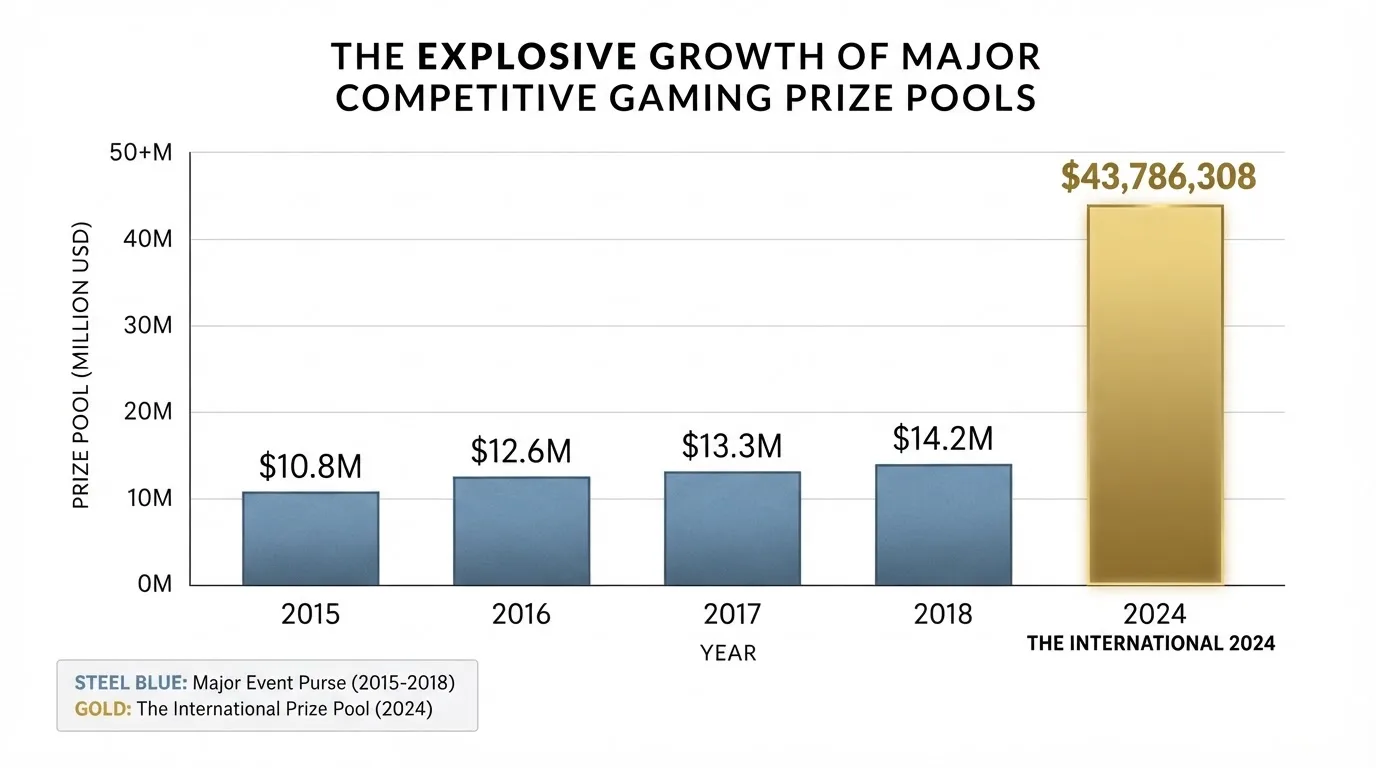
Esports betting, in plain English, is real-money wagering on organised competitive video gaming. The games are recognisable: League of Legends, Dota 2, Counter-Strike, Valorant, Overwatch, Call of Duty, Fortnite, Rocket League, StarCraft, and a long tail of fighting and sports titles that bookmakers add as their audience grows. Tournaments are stage-managed, sponsored and broadcast. League of Legends’ World Championship and Dota 2’s The International have paid prize pools that dwarf most traditional sports — The International 2021 cleared US$40 million on its own, the highest the scene had seen at that point, and the Esports World Cup — held in Paris from 6 July to 23 August 2026 across 24 games and a US$75 million purse — sits above every event that came before it. A bettor who skipped the culture and read only the prize numbers might assume they are looking at a niche sport; the prize money quietly says otherwise.
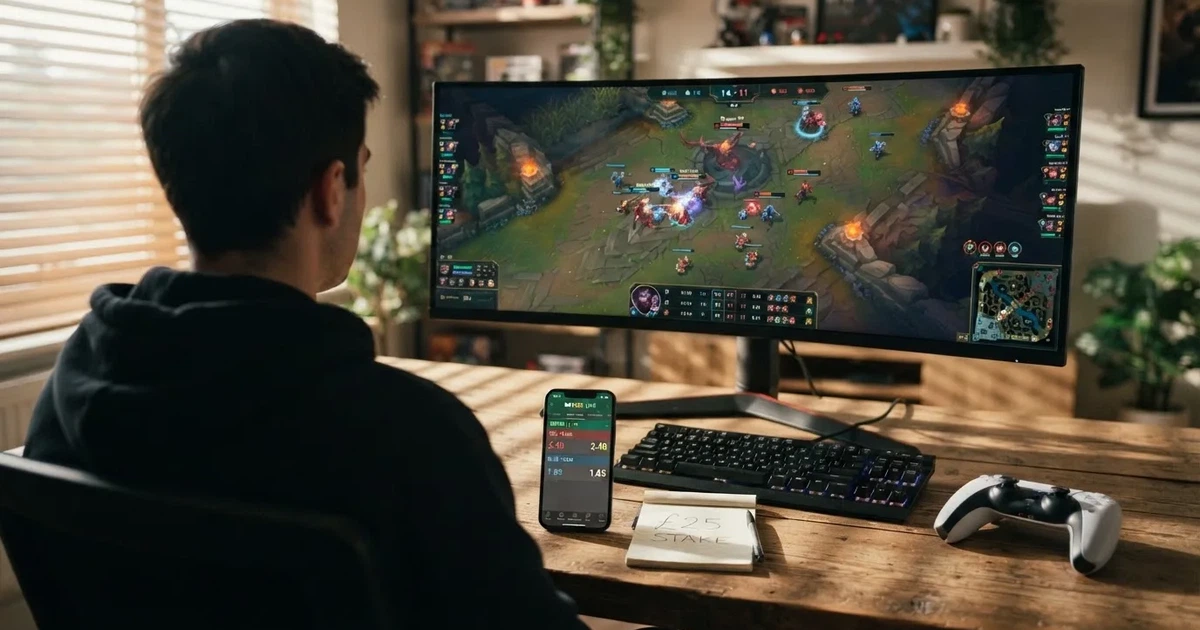
This page is built around a single question: when you walk up to a UK-licensed bookmaker and look at the price on a League of Legends match, what are you actually looking at, and what does it cost to play? The licensed UK market treats esports like any other event — no special permission, no separate statute. What shapes the experience is the operator’s own trading desk, the markets it decides to offer, and the cut it builds into every price. Reading that cut is the skill this guide is built around. Everything below is written for someone choosing between ten licensed UK operators on esports; the practical advice runs alongside the explanation rather than at the end of it.
Currency stamp: data current as of 26 October 2026, prices and licence claims verified against the Gambling Commission’s public register and each operator’s published terms.
Live esports betting and the cash-out mechanic
In-play esports betting is the bet that is placed after the match has started. In fighting games and certain mobile titles the rounds are short, sometimes two or three minutes, so prices update on a near-continuous loop. A League of Legends match can run forty minutes plus and offer four or five points where a deliberate team-fight changes the shape of the game; the price on the underdog swings as those fights resolve. Counter-Strike and Valorant rounds move even faster. The bookmaker that handles this well is the one whose traders are watching the same streams a punter is watching, and whose delay between in-game event and price update is short enough to feel like reflection rather than reaction.

Cash out is the second pillar of live play. It is a button the bookmaker offers mid-match that lets you settle your bet early at a price it sets, derived from the live market and your original odds. The framing in marketing often reads like a gift: lock in profit, cut your losses, control your exposure. The mechanic itself is real and useful — a multi-leg acca that has four legs won and a fifth looking shaky is a different proposition at kick-off than at half-time — but the price the bookmaker pays on cash out is its own quote, not the market’s. The wider its margin on the in-play market, the worse the cash-out number. A bettor who wants to use cash out as a real tool, rather than a surrender button, needs an operator whose in-play margin is tight, and the only way to know that is to watch prices on a market the result of which is publicly known within minutes — an esports match fits, because the result is final the moment the last round ends.
The licensed UK operators that carry esports in-play with usable cash out sit at a familiar set of names: bet365, Betfair, Coral, Unibet’s UK site, BetVictor and 888sport form the depth of the field. Sporting Index overlays fixed-odds and spread betting on the same app for those who want both formats in one ticket. Kwiff, by contrast, leans into a model where the odds on any given market are randomised up to a ceiling above the published price — the marketing promise is surprise payouts, and the trade is a wider base margin in exchange for the chance of a bigger one.
A pragmatic guide: live esports is a fast market, and fast markets reward bettors who know what a fair line looks like before the price moves. The choice for that reader is between bet365 and Betfair for the deepest market depth, between Coral and BetVictor for the cleanest price ladder, and between Unibet and 888sport for a balance of all three with a brand they are likely to recognise.
esports betting predictions, bankroll and the strategy that does not exist
Anyone marketing “esports betting tips” or “esports betting predictions” is selling a forecast. The forecast is interesting in the way any forecast is interesting — to be weighed, not obeyed. A model that predicts match outcomes needs data: rosters, recent form, patch updates, draft phase, map pool, head-to-head history on specific stages. The serious analysts publish rosters of tournaments and post-match win-rate updates; the trade press weighs in on coaching changes; the bookmakers themselves run their own desks and price to those inputs. A tipster who claims a hit-rate worth following has to publish their record over hundreds of picks, with the methodology held constant, and even then the variance on individual games is large enough to swallow a thousand-pick sample.
Bankroll management is a different subject and the one this guide can usefully speak to. The job is to size each bet as a fraction of the bank you walked in with — somewhere between 1% and 5% per pick for the disciplined, lower for the volatile, higher only for the exceptional edge — and to track every bet as if it were a sample point in a longer series. The mechanic is the same for a casual punter spending £20 a week and a semi-pro moving £2,000. Where the amateur’s discipline breaks down is sizing up after a loss (the chase), sizing up after a win (the overconfidence), and betting on markets they have no edge on (the boredom). All three collapse a bank faster than any losing streak does.
The most useful generalisation about esports is one the in-depth guides reach quickly: the markets on best-of-five matches between established teams are efficient, the markets on best-of-three are not far off, and the markets on best-of-one — the format many smaller events adopt — are where a sharp reader’s edge sits, if it sits anywhere. The same is true of the first map of a best-of-three. Handicap markets (the favourite concedes maps or rounds) move on smaller moves of form than moneyline markets do. Total map handicaps and total kills over rounds give a line on team-level pace, and totals at an esports event settle on rounds and kills the way totals in a basketball match settle on points.
The honest statement about esports betting strategy is that no public strategy has a verified long-run edge, and the people who claim one are usually selling either a tip subscription or a stake-sizing discipline. The stake-sizing discipline is the part that works. The pick itself is the part that does not.
Bet types: how bookmakers settle esports wagers
Esports mirrors the sports book rather than the casino. The fundamental bet is the moneyline: you back one of two (or three) teams to win the match, and that is the bet. Below it sit the markets that turn a match into a tradable object — total maps over or under a line, map handicap, first blood, first to ten kills, total kills, map winner, correct score. The depth varies by operator, with the bigger books carrying the better tournaments at deeper depth. A bettor who wants totals and handicaps needs an operator who lists them; a bettor who only needs the match winner can use almost any operator in this guide.
A bet builder is a single bet that combines markets from one match into one price. The price is the multiplication of the legs, the same way an accumulator multiplies, with the difference that all of the legs are inside one event — a League of Legends bet on the winner plus total maps over 3.5 plus first blood on a specific team, all under one ticket. The risk profile is identical to a parlay in that one leg voids the whole thing. Bet builders make sense on matches the bettor has watched enough to think several markets at once on; on matches they have not, they are a multiplier on uncertainty. bet365 markets its product as Bet Builder+, available pre-match and in-play with related markets bundled; BetVictor markets its racing version as BetFinder. 888sport and Betfair carry their own variants. Each bookmaker’s builder is its own product with its own leg list, and the comparison is more useful than the marketing.
Odds on esports are written in fractional or decimal form by licensed UK bookmakers, and the calculation is identical to odds on any sport. A bet of £10 at decimal odds 2.50 returns £25 if it wins, of which £15 is profit. Fractional odds 6/4 mean the same: profit of £6 for every £4 staked, decimal price 2.50. The bookmaker’s price does not vary by event type; what varies is the margin it builds in. A market at 1.90/1.90 with no margin would sum to 1.00 across both sides; with a margin, the sum is below 1.00, and the gap is the bookmaker’s take. The next subsection carries the worked example.
The margin that lives inside every price
The arithmetic of the margin is what the rest of this page is built on, so it sits here rather than buried in a footnote. Picture a two-way esports match priced at decimal 1.90 on either side (fractional 9/10 on each). Convert each price to its implied probability: 1 ÷ 1.90 = 0.5263, or 52.63%. Both sides sum to 1.0526, or 105.26%. Strip the over-round — the 5.26 percentage points above 100% — and the marginal take comes out to a band of about 4.8% to 5.3%, depending on rounding. Hold the price: that is the band the operator keeps of every unit bet on this market, before any stake limits, free-bet structure or house edge sits on top.
The realistic band, for a well-priced two-way esports market at a major UK bookmaker, sits in the high 4% to low 6% range for top-tier matches, wider for smaller events, wider again for in-play markets where the book is slower to move. Comparison matters more than the headline number: a 4.8% margin is materially better for the bettor than a 5.3% one over hundreds of bets. Expressing this in pounds: a bettor turning over £10,000 over a season pays roughly £480 to £530 in bookmaker take at the tighter end, and roughly £530 to £630 at the wider end. The arithmetic is the same as the percentages — the pounds are just the percentages carried out over a year of betting at modest stakes.
The point of knowing the margin is not to eliminate it — bookmakers always keep something — but to compare operators on a like-for-like basis. Two bookmakers offering odds on the same match at 1.95 and 1.85 are not offering the same product; the bookmaker at 1.95 keeps less of every bet placed with it. Across a season of betting, that difference compounds into real money. A reader who shops the line across two or three operators before each bet pays materially less margin than one who picks one bookmaker and stays there.
esports sports, tournaments and the calendar
esports is not one sport. It is several. The bookmakers price them all, but the markets differ: a League of Legends match has the longest format at top level, best-of-five, with map handicaps and map totals as the natural derivatives. A Counter-Strike match is best-of-three, with round totals and pistol-round props as the natural derivatives. A Dota 2 match is best-of-three or best-of-five, with kill totals as the natural props. A fighting-game tournament like EVO runs best-of-three throughout the bracket, often best-of-five in the final, with rounds-per-set totals as the props. A Rocket League match is short, often best-of-seven, with goal totals as the derivative. A StarCraft map is a clean head-to-head, frequently best-of-three in group play, best-of-five in the bracket, with map and race handicaps as the props. The market the operator offers is governed by what the format allows: a bookmaker cannot offer over 3.5 maps on a best-of-three match, only on a best-of-five.
The tournament calendar matters because some events move the betting market and most do not. Major events — League of Legends World Championship, The International, EVO, the Esports World Cup, Intel Extreme Masters stops — draw the deepest coverage at every major UK bookmaker and have live streaming tied to the bigger operators’ apps (bet365, Betfair, Unibet’s UK site). Smaller tier-two events draw prices but few derivatives: a moneyline and map totals at most. Tier-three events are sometimes covered, sometimes not, and a brand-by-brand comparison matters here. A reader whose interest is solely in tier-one events can use any major bookmaker; a reader whose interest spans tier-two and tier-three needs a bookmaker with a broad coverage promise.
The fixtures anchor for every operator: League of Legends and Dota 2 are the two that almost every licensed UK operator prices. Counter-Strike is the third that almost every operator prices. Valorant is widely covered at the bigger books and patchily elsewhere. Call of Duty, Overwatch, Fortnite and Rocket League vary by operator, generally well-priced at bet365, Betfair, Unibet UK, BetVictor and 888sport, occasionally priced at smaller books. The betting on smaller esports has a longer tail at a smaller number of operators, and the right answer for a fan of those titles is the operator whose coverage of them is reliable.
A practical list for the calendar: the major events a bettor planning a year of wagers will want to know — League of Legends World Championship (annual, autumn), The International (annual, summer/fall in recent years), EVO (annual, summer), Intel Extreme Masters Katowice (annual, late winter), and the Esports World Cup (annual since 2024, summer). Between those, dozens of regional leagues and online cups run week-in, week-out and form the bulk of the betting calendar. A reader mapping out a year of play looks at the major events as anchors and the regional leagues as the running market.
The landscape of licensed UK esports bookmakers
Several practical observations shape it.
Licensed operators only. The bookmakers reviewed on this page are ten brands whose domain appears on the Gambling Commission’s public register against a remote general betting standard licence for Great Britain. The licence categories are not interchangeable: a remote general betting standard (real events) licence covers betting on real esports competitions and tournaments; a remote general betting standard (virtual events) licence covers computer-generated outcomes, which is a separate category. Every operator in this guide holds the real-events licence. Every GB-licensed online operator takes part in GAMSTOP, the national multi-operator self-exclusion scheme.
Sister brands run together. Ladbrokes and Coral share a parent; Paddy Power and Betfair share a parent. A reader who sees all four on the Commission’s register should know that the four list only two independent operating businesses, even though the brands are marketed separately. Coral, in this guide, is one of those sister brands; Betfair is another. Treating each as independent is a mistake a casual reader makes and a comparison does well to avoid.
Licences are best read in a specific way. A bookmaker’s account number on the Commission’s register is the search term that returns the row; a licence number is the formal identifier printed on the brand’s own footer. The two usually look different. The account number is the one a reader uses to verify a brand by searching the public register; the licence number is the one a reader will see printed in the small print. Both refer to the same entry. The Commission’s register can be searched by business name, trading name, domain or account number, and the test of a brand’s licensed status is that the search returns a current, valid licence. Brands run on .com and .co.uk, and the domain style proves nothing; a .com is just as likely to be Commission-licensed as a .co.uk, and a .co.uk is no guarantee of one.
A note on offshore: not every operator that accepts UK customers is Commission-licensed, and not every Commission-licensed operator accepts all UK customers. The brands in this guide are licensed; offshore brands are not covered here, and the protections that come with a licence — GAMSTOP coverage, the Commission’s complaints route, an approved dispute-resolution body, the 10x wagering cap, the financial vulnerability check — apply only at licensed operators. Offshore play loses those and offers no British consumer redress if funds are withheld.
The full comparison: licences and esports coverage side by side
The table below sets the ten reviewed operators against two pieces of practical information a bettor needs before signing up. The first column carries the brand. The second carries the Gambling Commission’s account number and the formal licence holder named on the register. The third carries what each operator’s own terms say about the esports subject this page focuses on. Empty cells mean the operator’s own terms do not state a position on that subject; readers check the terms page for the current position before betting.
| Brand | Gambling Commission account number and licence holder | What the operator’s terms say on esports |
|---|---|---|
| Coral | 54743 — LC International Limited | Covers UK racing and football heavily; esports markets available; full welcome offer subject to the operator’s own sports terms |
| Betmaster | 65699 — BM Solutions GB Ltd | Lists football, cricket, horse racing, NFL and esports (League of Legends, Dota 2) in its published app description |
| Sporting Index | 27343 — Sporting Index Limited | Offers fixed-odds betting and financial spread betting side by side, with in-play betting, auto cash-out and Multi-Markets |
| Betfair | 39439 — PPB Counterparty Services Limited | Carries in-play betting, a Bet Builder, free in-app live streaming of UK and Irish racing and football, and a 90 Minute Payout market |
| Fitzdares | 400 — Fitzdares Limited | Specialises in horse racing, football, tennis, rugby, cricket, golf and American football with cash out, accumulators, Lucky 15s, specials and antepost markets |
| BetGoodwin | 2927 — Goodwin Racing Limited | Sports welcome offer of £15 in free bets (£5 sports, £5 acca, £5 Sub-Cover) for a qualifying £10 bet |
| Kwiff | 44448 — Eaton Gate Gaming Limited | Operates a “super-charged” odds model where prices on individual bets can be multiplied up to a ceiling above the published price |
| bet365 | 55148 — Hillside (UK Sports) ENC | In-play, live streaming worldwide, Bet Builder+ combining markets from one event pre-match and in-play, Super Boosts, Winnings Boosts and Bet Boosts, Bet Track, Match Live and a Live Golf Tracker; official global betting partner of the UEFA Champions League |
| BetVictor | 39576 — BV Gaming Limited | Best Odds Guaranteed on UK and Irish horse racing, enhanced live race streaming, BetFinder and Smart Stats, plus a deep sports book |
| 888sport | 39028 — 888 UK Limited | Pre-match and in-play betting, Cash Out, Bet Builder, racing streams, BetFinder, live bet feed and daily boosted odds |
The brands split into clear bands on esports depth once the table is read alongside the live-betting section. bet365, Betfair, Coral, Unibet’s UK site, BetVictor and 888sport are the operators that price a wide range of esports at multiple market depths. Kwiff and Sporting Index are stronger on the live-betting mechanics than on esports-specific coverage. Fitzdares is a racing-led bookmaker with esports at the thinner end of its coverage. BetGoodwin and Betmaster sit in the middle, with esports on the bet list but not as the headline focus.
esports betting in Great Britain: who licenses it
The legal picture is simpler than the marketing makes it sound. esports is not a separately regulated sport in Great Britain; it sits under the same regime as every other betting event. The Gambling Commission licences the whole commercial market under the Gambling Act 2005, which covers Great Britain — England, Scotland and Wales. Northern Ireland has its own older law, so a “Great Britain licence” or “GB-licensed” is the right phrase, never a UK-wide claim. Since the Gambling (Licensing and Advertising) Act 2014, an operator whose remote facilities are used in Great Britain needs a Commission licence wherever the operator itself is based — a Curaçao, Maltese or Gibraltar licence is not a substitute, and an offshore licence alone means a brand is offering to British customers without the licence the Act requires.
What that means in practice for a bettor:
Minimum age 18. Identity verification before the first deposit. Name, address and date of birth are verified before a customer can deposit or gamble — since 7 May 2019 this has included deposits funded by a free bet or bonus. Anonymous play is not the offer at any Commission-licensed site.
No statutory list of permitted markets. The statute does not name what can and cannot be bet on. The Commission issues licences by category — remote general betting standard (real events), remote general betting standard (virtual events), remote general betting limited, remote pool betting, remote betting intermediary — and the operator offers markets under its own rules and the Licence Conditions and Codes of Practice. esports is treated like betting on any other real event.
In-play betting is licensed but not unrestricted. GB bookmakers offer in-play on esports; the controls are the operator’s licence conditions and its customer-protection duties, not a statute.
Financial spread betting is regulated by the Financial Conduct Authority, not the Commission. Where an operator offers spread bets on esports under its FCA-side authorisation, it carries a different regulatory framework and a different tax regime; losses on a spread bet can exceed the deposit, which is true of any spread product, and the brand’s own risk warning is worth reading before opening the position.
Financial checks at licensed operators. A financial vulnerability check applies to licensed remote betting once a customer’s net deposits (deposits minus withdrawals) cross a £150 rolling-30-day threshold. The check is a public-record check, not an income check and not a credit check; it pulls court judgments and bankruptcies. Financial risk assessments — the affordability checks the press describes — are announced in a staged plan with no confirmed start date; the position is “announced, staged, no start date”. Operators do not generally advertise when they will run a check.
Deposit limits (RTS 12) sit with the customer. The first changes have applied since 31 October 2025; a second phase was postponed to 30 September 2026; the published framework gives the operator a duty to set a gross deposit limit on a fixed time frame and to act when a customer’s play exceeds it. There is no state-set ceiling for betting deposits or losses.
Bonus rules since 19 January 2026. Wagering requirements on bonuses are capped at 10x — a £10 bonus at 50x would have required £500 of qualifying bets; under the cap, no bonus may require more than £100 of qualifying bets. Mixed-product promotions — an offer that requires gambling across two or more product types such as betting and casino — are banned. Whether the cap applies to free bets with no wagering condition, and any cap on the money value of a bonus, are not established in the public guidance.
GAMSTOP coverage. Every GB-licensed online operator takes part in GAMSTOP, the national multi-operator self-exclusion scheme. Periods are six months, one year, five years, or five years with auto-renewal; after the minimum period the exclusion runs a further seven years unless the customer asks GAMSTOP to remove it. GAMSTOP covers online sites and apps; betting shops use a separate service.
Credit cards banned. Credit cards are not accepted for gambling in Great Britain (since 14 April 2020), including credit-card-funded payments through an e-wallet. Debit cards and bank-based payments are not covered by that ban.
Advertising codes. The Commission does not license advertising; the CAP Code (non-broadcast) and BCAP Code (broadcast), enforced by the ASA, run alongside the LCCP. The CAP Code’s section 16 demands that marketing is socially responsible, is not of strong appeal to under-18s, and does not feature anyone who is or seems to be under 25 (with a narrow exception for marketing placed where a bet can be made directly). The “whistle-to-whistle” rule keeps betting ads off TV from five minutes before a live sporting event to five minutes after, before the 9pm watershed, with horse and greyhound racing excluded. The Premier League clubs’ voluntary withdrawal of gambling sponsorships from shirt fronts (from 2026/27) is voluntary, not law; sleeves and hoardings remain.
Player tax. The player pays no tax on betting winnings in Great Britain. General Betting Duty is the operator’s tax on gross profits; the current rate is 15% on most bets, with a new remote rate of 25% taking effect from 1 April 2027 on remote bets not on UK horse racing. Whether operators pass duty on through odds is not established and is not the bettor’s tax. A professional gambler should ask HMRC or an adviser — general information is not tax advice.
Responsible gambling in esports: the practical framework
esports moves fast. The matches are short, the calendar is dense, the markets keep updating. Responsible gambling in that environment is the same discipline as responsible gambling on any other market, with the cadence turned up. The framework that licensed UK operators run is the following.
Self-exclusion by GAMSTOP. Anyone who wants to step away from online play can register with GAMSTOP for a period of six months, one year, five years, or five years with auto-renewal. After the minimum period, the exclusion runs a further seven years unless the customer asks GAMSTOP to remove it. A GAMSTOP exclusion blocks sign-up and play at every operator licensed by the Commission; it covers online sites and apps, not betting shops. The exclusion is free.
Deposit limits, time-outs and reality checks at the operator. Every operator licensed by the Commission offers deposit limits on a fixed time frame — daily, weekly or monthly — and a time-out of between one day and six weeks for customers who want a short break. Reality checks summarise session time and net position at intervals. Activating any of these is in the customer’s account page.
Financial vulnerability and risk checks. Once a customer’s net deposits (deposits minus withdrawals) cross £150 in a rolling 30-day period, the operator runs a public-record check — court judgments, bankruptcies — under the LCCP. Financial risk assessments, the more involved process the press describes, are announced but not yet in force; the position is “announced, staged, no start date”. A customer does not have to ask for a check; it is the operator’s trigger.
Help lines and clinics. GamCare runs the National Gambling Helpline (a free, confidential service available 24/7); GambleAware funds treatment and education; NHS gambling clinics operate in several regions; Gamblers Anonymous runs local meetings. The Fitzdares and Fitzwilliam sites link to GamCare, GamStop and Gamblers Anonymous in their footer — the practical link that an operator with a serious stance places on every page.
A practical list for any reader:
- Set a deposit limit before the first deposit, not after. The setting is reversible later, but raising it is a deliberate act; the default protects you.
- Use a single payment method for gambling. Splitting deposits across cards and wallets obscures the running total.
- Track bets as a spreadsheet, not a memory. The arithmetic is the discipline.
- If a session ends with the bettor anxious about the next one, that is the signal to take a 24-hour time-out.
- A genuine loss-chasing pattern is the moment to step into a more involved help framework: a one-month time-out, a longer GAMSTOP registration, contact with GamCare.
- Friends and family who notice changes are the first line of help on a habit the customer cannot see — listen to them.
Crypto and anonymity at licensed UK esports bookmakers
Crypto deposits are a live feature at offshore operators, but the picture at Commission-licensed UK operators is different. The Commission’s identity-verification rule, in force since 7 May 2019, runs before the first deposit and again whenever a deposit threshold or behaviour triggers a check. The rule names name, address and date of birth as the verification subjects; a deposit in cryptocurrency has to clear the same checks before it can be wagered, in practice, which means a customer at a licensed operator is not anonymous to that operator.
What is established: licensed UK operators do not run a state-set list of permitted payment methods, but Bitcoin and Ethereum are not the standard payment methods at Commission-licensed operators in 2026. Most operators in this guide take Visa and Mastercard debit, bank transfer and a small set of e-wallets (PayPal, Skrill, Trustly at the bigger books), and do not list cryptocurrency as a deposit option. Where a licensed operator does accept cryptocurrency, the verification rules apply before any withdrawal, and the customer is not anonymous.
What is not established: a British named-account rule, a state list of permitted payment methods, and any rule for or against cryptocurrency deposits at licensed operators. The honest framing is to check the operator’s own cashier page rather than assume; the licensed side of the market moves slowly, and a licensed operator’s terms page is the source of truth on the methods it accepts.
Offshore esports betting that runs on cryptocurrency without a GB licence offers a different trade: pseudonymous deposits and a different regulatory framework. The downsides sit in the same place they always sit offshore: no GAMSTOP coverage, no Commission complaints route, no approved dispute-resolution body, no British consumer redress if funds are withheld, and the offer is not subject to the 10x bonus cap or the £150 vulnerability check. A reader tempted by the speed and the privacy should weigh those against the loss of the protections the licensed UK market offers.
Bonuses and free bets on esports
The marketing language is loud and the underlying arithmetic is what actually governs the offer. Two patterns cover almost every promotion a UK-licensed bookmaker runs.
A welcome offer is a deposit-gated package: deposit and bet £X, receive £Y in free bets. Coral’s sports welcome offer is “Get £40 in Free Bets when you bet £20”: a deposit and sports bet of £20 or more at minimum odds of 2.0 (1/1), with £40 in free bets issued within seven days and expiring seven days after issue, for new GB customers who opt in. BetGoodwin’s sports welcome offer is “Bet £10 & Get £15 in Free Bets”, split into a £5 sports bet, a £5 acca and a £5 Sub-Cover bet. Other operators have their own versions, and every licensed UK welcome offer sits inside the 10x bonus cap the Commission introduced in January 2026.
Two details earn attention. First, the free bet stake is usually not paid back with a win — a £5 free bet at 4.00 wins £15 of profit, not £20 of return — and the wagering requirement the offer carries is calculated on the bonus amount. A £10 free bet with no rollover other than the single qualifying bet is a different offer from a £10 free bet with a 5x rollover at minimum price 1.50. Read the small print. Second, the wagering cap means no operator may require more than £100 of qualifying bets to clear a £10 bonus, and the rule applies to every bonus a licensed operator runs, not only the welcome offer. A market where offers are large but rollovers are tight is the licensed market in 2026.
The “free bet” framing is itself something to read carefully. A free bet refunded as a free bet on a stake the customer has paid is closer to a second attempt at the same bet than it is to a refund in cash. A price boost on a fixture that has clear favourites is a closer offer to the cash equivalent than the headline price suggests, because the boost is on a market where the margin was already low. Boosted accas and acca insurance each carry their own logic, and a reader new to them should walk through one with a small stake before sizing up.
Payments, payout speed and the cashier mechanics
Payout speed at a licensed UK operator is governed by the operator’s own processing times and the rail of the payment method. Most operators run automated approval on withdrawals, with manual review when an anti-money-laundering flag fires. The standard times, with operator variability: debit-card withdrawals in one to three working days, e-wallet withdrawals inside twenty-four hours once approved, bank transfers in one to three working days. Some operators run a faster internal approval on first withdrawals — fewer minutes rather than a longer review — once verification is complete. Where an operator offers instant withdrawals to a verified payment method, it is the operator’s own processing time that determines the speed; the rail’s contribution is rounding.
PayPal, Skrill, Trustly and Apple Pay are all widely supported at the bigger operators in this guide. Some operators restrict bonus eligibility when a deposit is made via Skrill or Neteller; the small print lists the restrictions where they apply. A bettor who cares about both bonus access and payout speed should compare the two and pick a payment method that does both — for many operators that is the debit card or PayPal.
Lottoland’s UK app is the operator in this guide that bundles casino, lottery betting, sports betting and scratchcards in one app. Its terms state it is licensed by the Gambling Commission for customers in Great Britain; the cashier section is the place to verify the payment-method list for the current season.
A practical guide on payout speed: complete verification on day one. Upload the documents the operator asks for before the first deposit. Set a named payment method as the default for both deposits and withdrawals. Verify the deposit before going for the welcome offer — many operators cancel the offer if the deposit is rolled back. Withdrawals to a verified debit card or e-wallet then run on the operator’s processing time, which at the bigger operators is hours rather than days.
Mobile apps and the choice between handheld and desktop
Every licensed UK operator in this guide runs a native app on iOS and Android. The app is a stake-placement tool first and a viewing tool second; the live-streaming player is built into most of them, and the live-data feed (price updates, cash-out offers, score ticks) is consistent with what the desktop screen shows. Sporting Index’s published app carries fixed-odds betting, financial spread betting, in-play betting, Bet Builder for football, auto cash-out and Multi-Markets. Betfair’s published app carries in-play betting, Bet Builder, free live streaming of UK and Irish horse racing and football and a 90 Minute Payout market. bet365’s app is the one consistent evidence point on being the most downloaded sports betting app in the UK. Kwiff runs its “super-charged” odds model inside the app. BetVictor runs Best Odds Guaranteed, live race streaming, BetFinder and Smart Stats. Fitzdares runs cash out, accumulators, Lucky 15s, specials and antepost markets. BetGoodwin runs its welcome offer in-app, alongside its markets. Lottoland runs casino, lottery betting, sports betting and scratchcards. Betmaster’s published app carries football, cricket, horse racing, NFL and esports (League of Legends, Dota 2).
The browser version covers every product an app carries. Apps add a one-tap stake-placement shortcut and push notifications on selected matches, both useful, neither essential. A reader who places most bets at home on a larger screen and watches the live market from the sofa gets the full experience from the browser; a reader who places bets away from home and wants stake alerts gets most of the value from the app.
The choice between apps, for a reader who wants depth on esports, bet builders and live markets, is bet365 or Betfair first, BetVictor or 888sport second, with the rest of the field carrying everything an esports bettor needs but not the headline product pushes.
Coral — large racing-heavy bookmaker with esports on the bet list
Coral’s app and desktop both carry a large racing and football product, with esports on the bet list and at a reasonable depth on major tournaments. The licensed operator is LC International Limited under Gambling Commission account 54743, with a remote general betting standard (real events) licence and a remote betting intermediary licence. The sports welcome offer carries a £20 qualifying bet at minimum odds of 2.0 (1/1) for £40 in free bets issued within seven days and expiring seven days after issue, for new GB customers who opt in.
esports markets on Coral are at their deepest on League of Legends, Dota 2, Counter-Strike and Valorant; smaller titles are priced but at thinner depth. The in-play product is solid on the major tournaments, and cash out is supported. Coral’s wider strengths — UK racing, football, bet builders on football — are not the strength that pulls an esports reader in, but they keep the rest of the betting week alive when no major esports event is on. Verdict: a strong fit for a bettor whose bets span esports and football rather than sit exclusively on esports.
Betmaster — broad coverage with esports on the published app
Betmaster’s published iOS app carries football, cricket, horse racing, NFL and esports (League of Legends, Dota 2) under one roof, with the esports side listing two of the major titles cleanly. The licensed operator is BM Solutions GB Ltd under Gambling Commission account 65699, and operates under the same remote general betting standard (real events) licence. The app’s framework is conventional: deposit, bet, cash out, follow markets, watch streams.
esports coverage is at its best on the two named titles; the rest of the field is thinner than at the bigger books. In-play is offered but not at the depth of the leading operators. Cash out is available on selected markets. The value proposition is breadth — one app for football, cricket, racing, NFL and esports — rather than depth on any one of them. Verdict: a good fit for a casual esports bettor who values having several sports in one app and is happy with thinner derivatives.
Sporting Index — fixed-odds and spread betting under one roof
Sporting Index offers fixed-odds betting and financial spread betting under one account, with the published iOS app carrying in-play betting, a football Bet Builder, auto cash-out and Multi-Markets. The licensed operator is Sporting Index Limited under Gambling Commission account 27343, and operates under the same remote general betting standard (real events) licence. Spread bets are FCA-regulated where they are financial products, and the operator’s own risk warning sits at the head of the spread-bet interface.
The spread product is a single-feature addition that few UK bookmakers run inside the same app as fixed-odds betting. esports on Sporting Index is at the wider end of the operator’s product — the wider offer is racing and football. A reader interested in spread bets on esports should check the operator’s terms page for current availability. Verdict: a fit for the bettor who wants fixed-odds and spread betting under one account, racing and football are the headline products, and esports is one of several markets rather than the headline.
Betfair — exchange sportsbook plus deep in-play and streaming
Betfair Sportsbook carries in-play betting, a Bet Builder, free in-app live streaming of UK and Irish horse racing and football, and a 90 Minute Payout market on football. The licensed operator is PPB Counterparty Services Limited under Gambling Commission account 39439, and operates under the same remote general betting standard (real events) licence. The sportsbook is the licensed side of Betfair in the UK; the exchange runs as a betting intermediary under the same licence family.
esports markets are at their deepest on the major titles, with the exchange carrying a separate market on the same events for the bettor who wants to lay rather than back. In-play and cash out are well-developed, and the live-streaming library is broad. The 90 Minute Payout product sits as a football feature; an esports analog is the early-cashout on settled rounds. Verdict: one of the strongest fits for the esports reader who also wants exchange access and is comfortable backing and laying.
Fitzdares — premium racing-led bookmaker with broader sport
Fitzdares markets itself as a premium racing-led bookmaker, with horse racing, football, tennis, rugby, cricket, golf and American football in the headline list and accumulators, Lucky 15s, specials and antepost markets running across them. Fitzdares holds a Gambling Commission licence (account 400). Cash out and in-play live odds are supported in the app.
esports is at the thinner end of Fitzdares’ coverage; the operator is one of the racing-led books for which esports is a side market rather than a main one. A bettor whose primary interest is racing and whose interest in esports is supplementary will find Fitzdares good for the racing side and lighter on esports than the larger multi-sport books. Verdict: a clear fit for the racing-first bettor with a side interest in esports; an awkward fit for the esports-first reader who wants depth on the bet list.
BetGoodwin — sports-led welcome offer worth a closer look
BetGoodwin’s sports welcome offer is “Bet £10 & Get £15 in Free Bets”, split into a £5 sports bet, a £5 acca and a £5 Sub-Cover bet. BetGoodwin operates under Gambling Commission account 2927. The welcome offer sits inside the 10x wagering cap the Commission introduced in January 2026 and is the operator’s headline acquisition product.
The bet list is sports-led and includes esports at the smaller end of the bigger books’ depth. The Sub-Cover leg of the welcome offer is a specific product that mirrors a racing-led operator’s comfort zone, and a reader using the free bet on racing will get more out of it than a reader using it on esports. Verdict: a fit for the bettor who values a sports welcome offer structured around small denomination free bets, and who weighs esports as one of several markets.
Kwiff — the “super-charged” odds model
Kwiff runs a distinctive model where any given bet’s price can be multiplied up to a ceiling above the published odds — the “super-charged” odds marketing promise. Kwiff holds a Gambling Commission licence, account 44448. The published app carries a 17+ age rating, set by the App Store.
esports is priced at Kwiff, but the headline product is the odds multiplier rather than the depth of coverage. The trade-off matters: a reader attracted by the super-charged odds accepts that the published price on a typical esports market carries a wider base margin in exchange for the chance of a much larger one on any individual bet. Variance is the headline, not the underlying margin. Verdict: a fit for the bettor who values the multiplier mechanic and accepts the wider base margin; an awkward fit for the esports reader who wants the tightest line every time.
bet365 — the benchmark licensed UK sportsbook
bet365 is the benchmark licensed UK sportsbook: in-play betting on a global scale, live streaming of events worldwide, Bet Builder+ combining markets from one event pre-match and in-play, Super Boosts, Winnings Boosts on Bet Builders and selected singles, daily Bet Boosts, Bet Track, Match Live and a Live Golf Tracker. bet365 operates with Gambling Commission account 55148. The published app is the most downloaded sports betting app in the UK; the operator is the official global betting partner of the UEFA Champions League.
esports coverage is broad and deep, with the major and several tier-two titles priced, derivatives including map handicaps, totals, first blood and round totals at the deeper markets, and live streaming on selected events. The product push is constant — Super Boosts, Winnings Boosts, Bet Builder+ — and the depth of the menus makes the bet builder an esports tool as much as a football one. Verdict: the strongest fit for the esports reader who wants the deepest market coverage, the most developed in-play product, and the bet builder mechanics that the operator has invested most in.
BetVictor — racing-led sports book with esports on the deeper end
BetVictor offers Best Odds Guaranteed on UK and Irish horse racing, enhanced live race streaming and a BetFinder feature for finding racing bets, alongside Smart Stats, plus a wider sports book. BetVictor is an operator with Gambling Commission account 39576. The mobile app carries the full sports book, with in-play and bet builders on the bigger sports.
esports markets at BetVictor are deeper than at Fitzdares and BetGoodwin and reach most major titles; the headline focus is racing, but the wider sports book is well-developed. Smart Stats is a form tool that fits the racing audience more directly than the esports audience, and a bettor using BetVictor for esports gets a strong book rather than a feature-led esports experience. Verdict: a fit for the bettor who wants Best Odds Guaranteed on racing and a deep sports book that includes esports at a competent level.
888sport — deep book with cash out, Bet Builder and racing streams
888sport carries pre-match and in-play betting, Cash Out, a Bet Builder, racing streams, BetFinder form tools, a live bet feed and daily boosted odds. 888sport carries Gambling Commission account 39028. The mobile app is mature and covers the full sports book.
esports markets at 888sport are at a similar depth to Coral and BetVictor — most major titles priced, in-play and cash out supported, with the headline push on Bet Builder and racing streams. Daily boosted odds are the operator’s promotional backbone; the offers change frequently and the bettor who follows them can pick competitive prices on selected events. Verdict: a fit for the bettor who values Cash Out and Bet Builder mechanics as core product, daily boosts as a routine feature, and racing streams for parallel betting.
Summing up: which bookmaker for which reader
The ten brands in this guide split into a few groups.
For the esports-first reader with a budget for a deep book: bet365 is the headline choice, with Betfair close behind for exchange access.
For the bettor whose bets span esports and football: Coral, BetVictor and 888sport carry a strong sports book with esports at depth and the headline product pushes on football.
For the racing-first reader with a side interest in esports: BetVictor and Fitzdares both fit, with BetVictor carrying esports at a deeper level than Fitzdares.
For the operator whose model is the bet mechanic rather than the market: Kwiff and Sporting Index each offer something distinctive, and the right reader is the one who values that mechanic over the tightest line.
For the bettor who wants one app for everything: Betmaster and Lottoland both run the broad-sports bundle with esports on the list.
For the bettor who wants the welcome offer’s structure to suit the rest of the betting: Coral and BetGoodwin both have offer structures that depend on the brand’s wider book.
The arithmetic in the working-out section above — the margin at the 1.90/1.90 example — is what carries across the whole guide. Pick the operator whose market carries the tightest line on the events the bettor actually wagers on, and the long-run difference compounds into real money. The rest is preference.
Frequently asked questions
How do I bet on esports?
Pick a licensed UK bookmaker with esports coverage and open an account; verify your name, address and date of birth before depositing (this is required since 7 May 2019 at every Commission-licensed operator). Deposit through a permitted payment method — debit card and most e-wallets — and place your first bet on a market the operator offers. The markets mirror traditional sports: moneyline, map handicap, total maps, total rounds/kills, correct score, first blood, and sometimes more event-specific props.
What is esports betting?
esports betting is real-money wagering on organised competitive video gaming. The games are recognisable titles like League of Legends, Dota 2, Counter-Strike, Valorant, Overwatch, Call of Duty, Fortnite, Rocket League and StarCraft. Tournaments like League of Legends’ World Championship, The International for Dota 2 and the Esports World Cup move the betting market and have prize pools that rival traditional sports; tier-two and tier-three events run continuously and form the bulk of the betting calendar.
Where can I bet on esports in Great Britain?
At any bookmaker licensed by the Gambling Commission for remote general betting on real events. The brands reviewed on this page — Coral, Betmaster, Sporting Index, Betfair, Fitzdares, BetGoodwin, Kwiff, bet365, BetVictor and 888sport — are ten such operators. Verify the licence on the Commission’s public register by searching the brand, the licence holder or the account number; the search returns the licence entry directly.
How can I check that a bookmaker holds a Gambling Commission licence?
Use the Commission’s public register at the regulator’s site. Search by the brand name, by the licence-holder company name, by the domain, or by the Commission’s account number (the number printed on the brand’s own footer or in its terms). The search returns the licence entry, the licence type, the licence holder’s name, and the licence status. Brands run on .com and .co.uk; the domain proves nothing. The test of licensed status is what the public register returns, not what the brand’s footer says.
How is the return on a bet worked out from the stake and the odds?
The arithmetic is straightforward. For decimal odds, multiply the stake by the odds to get the return (stake × odds), and subtract the stake to get the profit (stake × (odds − 1)). A £10 stake at decimal odds 2.50 returns £25 with £15 profit. For a combination bet (an accumulator), the odds of the legs multiply into one price, and the calculation runs the same way against the combined odds.
What is the bookmaker’s margin and how does it show up in the odds?
The margin is the slice the bookmaker keeps of every unit bet on a market. In a two-way market at decimal 1.90 on both sides, each price implies a probability of 1/1.90 = 52.6%, which sums to 105.3% across the two outcomes; the 5.3 points above 100% is the bookmaker’s edge — a margin in the high 4% to low 6% band for a well-priced major esports market. A wider sum across both sides is a wider margin; a tighter sum is a tighter margin, and the difference compounds across many bets.
US & other team sports – Accumulator
Content created by the «Accumulator» team
