
How to bet on rugby league: a guide to value, markets and the rules behind the odds
 Available in US
Data current as of 26 October 2026 and checked against the Gambling Commission’s public register.

A rugby league weekend is short, dense and unforgiving. Eight fixtures, six-tackle counts, set restarts, a sin-bin, a tackle-count controversy in the seventy-third minute — and a betting slip that has to be right before any of it settles. The pages that chase tips every Friday tend to share two habits: they pick a winner, then dress the pick in a forecast. The reverse works better. Work out what a price is really saying, then decide whether you agree with the bookmaker more than the rest of the market does. That decision is the tip, and everything before it is preparation.
This guide walks through that preparation. It covers the fundamentals of how a rugby league match is played and settled, the shape of the main competitions, the legal frame in Great Britain, the safer-gambling tools every operator must offer, the offers that look generous until the small print is read, the in-play markets, the bet types and odds formats, and ten operators that hold a Gambling Commission remote licence. It closes with a worked example of a bookmaker’s margin and a short FAQ. No picks, no predicted scorelines, no certainty. The point is to read a market, not to be told what it will do.
How rugby league works, in the parts the betting slip leans on
A rugby league team has thirteen players on the pitch and a match lasts eighty minutes, in two forty-minute halves. Possession is structured in a way that has no real equivalent in union: the attacking side gets the ball for a maximum of six tackles before it must hand it over, and a tackle is counted down from the moment the ball-carrier is brought to ground. That countdown is the heartbeat of the sport. A side that goes forward on the first three tackles and kicks on the fifth is playing a different game from the side that runs on tackle one and is buried on tackle four.
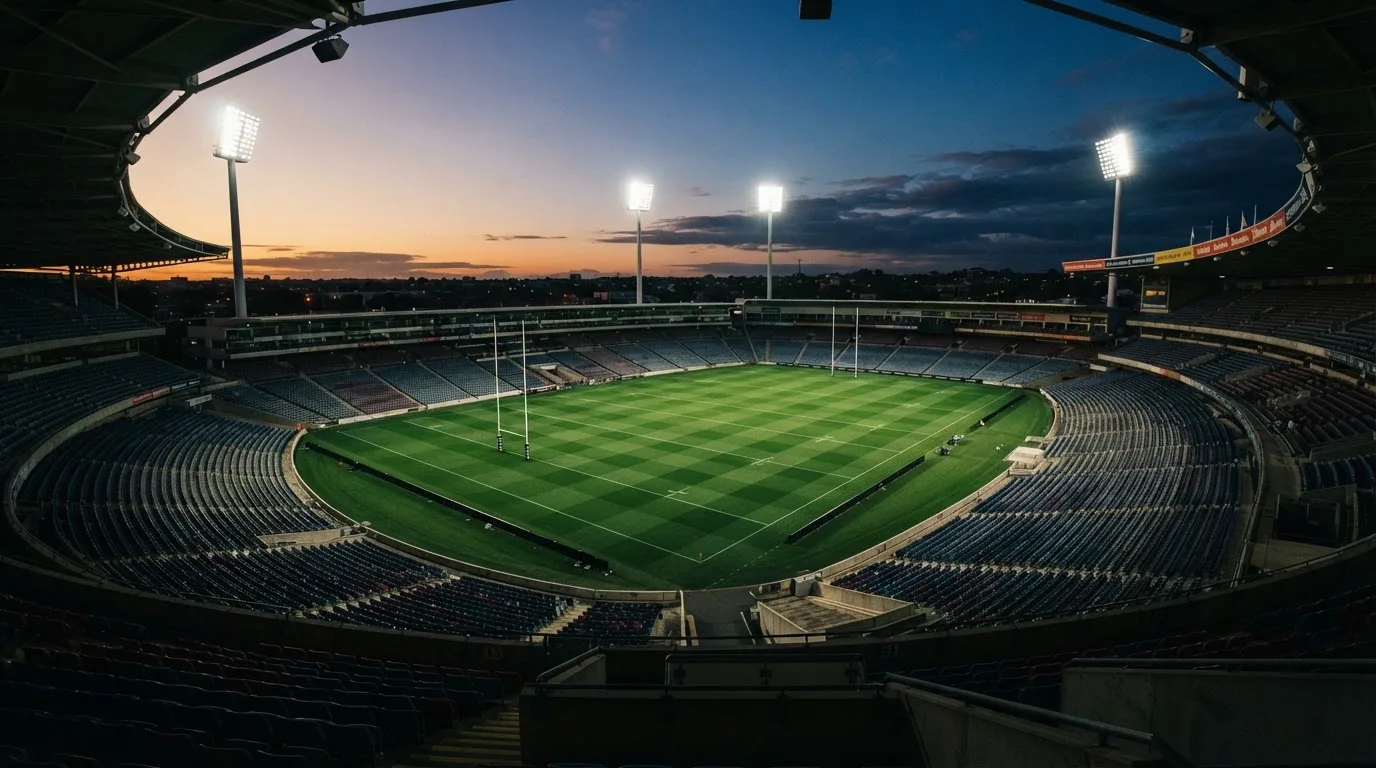
The scoring fits on a postcard. A try is worth four points. A conversion, kicked from in front of the posts after a try, adds two. A penalty goal at the posts is two. A drop goal in general play is one, and a drop goal kicked from beyond the forty-metre line is worth two. The two-point drop goal exists because the attacking side that is close to the line but not over it still has a way to score, and a team trailing by one in the last set of six has a route through the posts as well as through the in-goal area. None of this is decoration. A two-point drop goal turns a five-point loss with five minutes to play into a one-point loss with the kick still to come, and the betting market prices that route every weekend.
The rules that settle a slip live in the same neighbourhood. One major British bookmaker settles Super League and NRL Match Betting and Handicap Betting on eighty minutes of play, and most other markets on the official result including extra time. A whole-number handicap line that lands exactly refunds every stake on that line. A postponed match stands for forty-eight hours from the original kick-off and then becomes void. None of these rules is exotic; each of them has ended a betting slip that would otherwise have been a winner.
The competitions that matter to a bettor are short enough to learn. Super League is the main European club competition, the NRL is the Australian and New Zealand club competition, and International Rugby League governs the international game including the Rugby League World Cup. State of Origin sits alongside the NRL as the Australian state-of-state series and pulls its own betting handle. Championship and League One feed Super League from below. A bookmaker’s match list will lean on the top two competitions and on Origin in the southern winter; the rest of the calendar pads out the week.
Where a price comes from: the bookmaker’s margin
Every decimal odds line on a rugby league fixture hides a number that the bookmaker would prefer the punter not to dwell on. That number is the margin, sometimes called the overround. It is the slice of every pound staked that the bookmaker keeps on average across the market, no matter which side wins, and it is the reason a “fair” coin never pays 2.00 on both sides.

Take a two-way market priced at 1.90 against 1.90 — fractional nine-to-ten, the kind of line a bookmaker will publish on a Super League favourite at roughly even money. The implied probabilities are one divided by 1.90 on each outcome, which is a touch over 52.6 percent. Two of those added together come to 105.26 percent. The two percent and a bit above 100 is the margin. A market at 1.80 and 1.80 would imply 55.6 percent on each side, adding up to 111.1 percent — a margin above eleven percent, the kind of line a sharp bettor walks past.
Worked the other way around, the payout share is one divided by the sum of the reciprocals of the odds. For 1.90 and 1.90 that is 1 divided by 0.5263 plus 0.5263, which gives a payout share of about 95.0 percent and a margin of about 5.0 percent. That is the band a serious rugby league bookmaker lands on for a Match Betting line on a televised Super League fixture. Anything appreciably higher than five percent on a headline market is a signal to check whether the same fixture is available elsewhere at a better price, or to bet smaller.
The same arithmetic on a three-way market (home, draw, away) produces a thicker margin, because the bookmaker has to load an extra outcome. A 1.50 home, 4.00 draw, 6.00 away line implies 66.7, 25.0 and 16.7 percent on the three outcomes, summing to 108.3 percent — an eight percent margin, which is normal for a three-way football-style line. The point is not the precise figure but the habit of seeing it. A bettor who reads the implied probabilities before placing the bet is reading the same thing the bookmaker’s traders read. The edge, where there is one, lives in the difference between what the price implies and what the bettor believes the true chance to be.
This is also why a tip is a value call, not a pick. A team tipped at 1.50 is not a “good bet” because it should win; it is a good bet only if the true chance of winning is higher than the 66.7 percent the price implies. The price is the bet; the pick is decoration. Across a season the only way to come out ahead of the bookmaker’s margin is to find prices that understate the chance of what you have spent time studying. Most prices will not. That is the market working as designed.
The legal frame in Great Britain
Every bookmaker that takes a bet from a customer in Great Britain needs a Gambling Commission licence. That is the whole test, and it has been the whole test since the Gambling (Licensing and Advertising) Act 2014 brought remote betting inside the regime of the Gambling Act 2005 — sections 33 and 36, as amended. The licence is at the point of consumption: an operator whose servers sit in Malta, Gibraltar or Curaçao still needs a Commission licence to take a GB customer’s stake, and a Maltese or Curaçao licence is not a substitute.
The Commission publishes a public register that can be searched by business name, trading name, domain or account number, and that register is the only place that settles who holds a licence and under which categories — remote general betting standard for real events, remote general betting standard for virtual events, remote general betting limited, remote pool betting and remote betting intermediary for exchanges. The register does not list a state count of brands. Quote no count without an access date, and never call a single brand the only licensed one; the register holds far more names than any article can feature.
Northern Ireland sits outside the Gambling Act 2005 and has its own older law, so a Great Britain licence is a Great Britain licence — never write that it regulates there. A British named-account rule, a state list of permitted payment methods and any rule for or against cryptocurrency deposits at licensed operators are not established by the regime, so describe payments from each operator’s own terms rather than from statute. Financial spread betting is regulated by the Financial Conduct Authority, not the Commission, and losses on a spread bet can exceed the original deposit.
Advertising is not licensed by the Commission. The CAP Code governs non-broadcast marketing and the BCAP Code broadcast marketing, both enforced by the ASA, alongside the Commission’s Licence Conditions and Codes of Practice. Marketing must be socially responsible, must not be of strong appeal to under-18s, and no one who is or seems to be under 25 may be featured gambling or play a significant role, with a narrow exception for marketing at the point of sale. That rule is about who appears in the advertisement, not who may place a bet. The minimum age to bet is eighteen, and licensed operators verify name, address and date of birth before a customer can deposit or gamble, including with a free bet or bonus, since 7 May 2019.
Promotion rules in force since 19 January 2026 cap wagering requirements on bonuses at ten times the bonus amount, and ban mixed-product promotions that require gambling on more than one product type such as betting, casino, bingo and lottery in the same offer. “Whistle-to-whistle” — the absence of betting advertisements on television from five minutes before a live sporting event to five minutes after it, before the 9 pm watershed — is an industry code rather than statute. The Premier League clubs’ withdrawal of gambling sponsorship from the front of matchday shirts from the 2026/27 season is voluntary, not law.
The player pays no tax on betting winnings in Great Britain — a general statement, not advice, and a reader whose betting looks like a trade should ask HMRC or an adviser. General Betting Duty is the operator’s tax on gross profits, currently 15 percent, with a remote rate of 25 percent from 1 April 2027 within the existing regime on most remote bets while pool betting and in-person bets stay at 15 percent; whether operators pass duty on through odds is not established, and never write that the player is charged it. Spread betting has its own rates, 3 percent financial and 10 percent other.
Operating without the licence the Act requires is an offence under section 33 of the Gambling Act 2005, aimed at the operator. No offence aimed at the customer who simply bets on an unlicensed site was found. State the loss of protection rather than reach for the word “legal”: no GAMSTOP coverage, no Commission complaints route, no approved dispute-resolution body, no British consumer redress if funds are withheld, and none of the bonus or vulnerability-check safeguards the regime imposes. Enforcement is disruption, cease-and-desist notices, work with registrars, hosts and payment providers, search-engine referrals, and court-order DNS blocking powers that have been granted or are about to be granted, not a complete block.
Safer gambling: the tools and the checks
GAMSTOP is the national multi-operator online self-exclusion scheme and a mandatory licence condition for online operators since 31 March 2020. Self-exclusion periods are six months, one year, five years, or five years with auto-renewal, and after the minimum period the exclusion stays in place for a further seven years unless the customer asks GAMSTOP to remove it. GAMSTOP covers online sites and apps; betting shops use a separate service. Every GB-licensed online operator takes part.
A financial vulnerability check (LCCP condition 3.4.4, in force since 30 August 2024) applies to licensed remote betting when a customer’s deposits minus withdrawals exceed £150 in a rolling thirty-day period, since 28 February 2025. The check is a public-record check, looking at things like bankruptcy orders and county court judgments; it is not an income check and it is not a credit reference check. Financial risk assessments — what the press calls affordability checks — were announced in a staged plan, with no start date as of the Commission’s article of 7 July 2026. Write that they are announced and staged, not that they are in force.
Deposit limits are a customer-set tool, not a state ceiling. Operators must offer a gross deposit limit on a fixed time frame under Remote Technical Standard 12, with first changes applied since 31 October 2025 and a second phase postponed to 30 September 2026; whether the second phase is live is not established. There is no state-set deposit or loss ceiling for betting. Credit cards are banned for gambling in Great Britain since 14 April 2020, including credit-card-funded payments through an e-wallet; debit cards and bank-based payments are not covered.
The named organisations a reader can turn to are GamCare, which runs the National Gambling Helpline, GambleAware, the NHS gambling clinics network, and Gamblers Anonymous. Unibet’s site links to GamCare, GamCare’s wider family including Gambling Therapy and the Betting and Gaming Council, and GAMSTOP as standard; most GB-licensed operators do something similar. The point of the toolset is not that it makes betting safe — nothing does — but that it gives a customer who is worried about their own play somewhere to go before the worry becomes a loss. A reader who is using any of these tools is not a reader who should be following tips.
Bonuses and free bets: what the offer actually costs
A bookmaker’s welcome offer is the most visible number on the page and the least informative. The headline says one thing; the terms say another. Three numbers decide whether an offer is worth taking: the qualifying bet, the minimum price, and the wagering requirement that turns bonus funds into withdrawable cash.
A qualifying bet is the bet a new customer must place to unlock the offer. A £5 qualifying bet at minimum odds of 2.0 (evens) is a smaller commitment than a £10 qualifying bet at the same minimum, and a £10 qualifying bet at 1.5 is a much smaller commitment in real terms than a £10 bet at 2.0 because the qualifying bet at 1.5 is closer to a coin-flip than a value call. Read the minimum price, not the stake.
A free bet that is paid out as bonus funds almost always carries a wagering requirement — a multiple that says how many times the bonus must be turned over before it can be withdrawn. The cap of ten times the bonus applies to GB-licensed offers from 19 January 2026, so a £25 free bet needs no more than £250 of qualifying bets to clear. A £30 free bet at ten times needs £300. Multiply the bonus by the multiple, divide by the stake you intend to play, and the result is the number of bets the offer takes to clear. None of those bets is a free lunch. Each one is a bet on a margin-loaded market, which costs on average the margin over the long run.
A free bet whose stake is not paid back is the kind of offer that markets itself as a free bet and reads as one. A £10 free bet at 5.00 returns £50 if it wins; the punter keeps £40 of profit, not £50, because the £10 stake is not refunded with a free-bet win. The expected value of that free bet, on a market with a 5 percent margin, is the free-bet amount times the odds minus one, divided by the odds, times the payout share of the market — roughly the free-bet amount times a small factor that depends on the price. A £10 free bet at 5.00 on a 95 percent payout-share market is worth a little under £8 on average over many bets, not £50 and not £40. That is what the offer is worth.
A stake-back offer as a free bet on a first losing accumulator is a different shape. Hollywoodbets’ welcome is the example: a £10 deposit, a £10+ accumulator with three or more legs at minimum odds of 4/1, settled within seven days, and a free bet of up to £30 if the first qualifying acca loses. The free bet is a fresh stake that carries its own terms; it is not cash, and it does not turn a losing week into a winning one. The deposit is.
An accumulator insurance offer refunds stakes as free bets when one leg of an accumulator lets the slip down. The refunded stake is usually a free bet, not cash, and the refund is usually capped. Read the cap, read the minimum number of legs, and read the minimum price per leg before judging the offer.
The general rule is the same on every offer. The headline price is what the marketing team wrote. The cost is what the small print says. Most welcome offers look expensive in the small print and cheap in the headline. The arithmetic works the other way around.
Live betting and cash out
In-play betting on rugby league is offered by every major GB-licensed bookmaker, and the markets are thinner than the pre-match list but the prices move faster. The 80-minute clock and the six-tackle count give the in-play trader a lot of information to price off; a side that goes four tackles into a set and kicks on the fifth is signalling the shape of its next set, and a side that goes four tackles into a set and runs on the fifth is signalling the same. The bookmaker reads the same signal; the bettor has to be quicker, or to have done the work before the match started.
Cash out is a feature that lets a punter settle a bet before the event has finished, at a price the bookmaker recalculates in real time. The price reflects the current state of the event and the bookmaker’s margin, not the punter’s original expected value. Cash out is useful when a punter wants to lock in a profit before the last ten minutes, when the live market is moving against an open position, or when a multi-leg accumulator has one leg to run and the live price of that leg has drifted through the cash-out offer. Cash out is unhelpful when the punter is using it to chase a loss; that is a stake-management problem, not a market feature.
Bet Builder and same-game multi markets let a punter combine several selections from one match — first try-scorer, total points, handicap, race-to-twenty — into one slip at multiplied odds. The multiplied odds look generous and the margins are larger than the same selections priced as singles, because the bookmaker is loading the combined line, not the individual ones. A bet builder at 6.00 is not two singles at 2.45 and 2.45; the singles at 2.45 would each have their own margin and the combined line is a third margin on top. Read the singles, then read the combined price, then decide.
Live streaming of UK and Irish horse racing and football is offered inside the apps of several major bookmakers, including Betfair. Rugby league coverage is sparser: Betfair’s free live streaming applies to selected events and the catalogue changes; Betvictor’s enhanced live race streaming is horse-racing focused; Bet Ahoy’s stream is horse and greyhound. A punter who plans to bet in-play on rugby league should check the streaming catalogue before relying on the in-play graphics.
Bet types and odds formats
The odds on a rugby league fixture come in two formats. Fractional odds are the British form: 5/1, 11/4, evens. Decimal odds are the form most online slips price in: 6.00, 3.75, 2.00. The conversion is decimal = a ÷ b + 1, so 5/1 is 6.00 and 11/4 is 3.75 and evens is 2.00. A punter who wants to compare prices across bookmakers converts both sides to one format, usually decimal, and reads the decimal number.
The main bet types are a short list. A single is one selection, one stake, one outcome. A double is two selections, both of which must win for the bet to pay. A treble is three. An accumulator, sometimes called an acca, is four or more, with the odds of each leg multiplying into one combined price. Each-way betting is two bets of equal stake — one on the win, one on the place — and the stake doubles; place terms vary by race and by operator and the place part pays at a fraction of the win odds.
Multiple bet systems combine selections into structured portfolios of singles and accumulators. A Trixie is three doubles and a treble from three selections, four bets. A Patent is three singles, three doubles and a treble, seven bets. A Yankee is six doubles, four trebles and an accumulator from four selections, eleven bets. A Lucky 15 is four singles, six doubles, four trebles and an accumulator, fifteen bets. A Canadian or Super Yankee is twenty-six bets from five selections. A Heinz is fifty-seven bets from six. A Goliath is two hundred and forty-seven bets from eight. The total stake is the unit stake multiplied by the number of bets, so a 50p each-way Lucky 15 costs £15 — 50p on each of fifteen bets, doubled for the each-way.
Handicap betting on rugby league prices a side with a head start or a deficit expressed in points. A whole-number handicap that lands exactly refunds every stake on that line. A half-point handicap cannot land exactly; it pushes the line to one side. The handicap market settles on eighty minutes of play under one major British bookmaker’s rules, separate from markets that include extra time.
Best Odds Guaranteed, usually shortened to BOG, is a horse-racing concession that pays the bigger of the price taken and the starting price on UK and Irish racing from 8 AM on the day of the race, on both singles and multiples. William Hill runs BOG, BetVictor runs BOG, Bet Ahoy runs BOG on horse and greyhound racing up to a £100 cap. The rule does not apply to ante-post, tote or pari-mutuel bets. It is a horse-racing concession, not a rugby league one.
The competitions and what each one costs the slip
Super League is the main European club competition and the calendar runs from February to September with a Grand Final at Old Trafford in the autumn. The weekly fixture list is short, televised games are concentrated on Friday nights, and the bookmaker’s market depth on a televised Friday is what the rest of the week’s pricing is benchmarked against. Origin runs in the southern winter and pulls a parallel fixture list. The NRL runs from March to October with the Grand Final on the first Sunday of October in Australia. State of Origin is three matches in the May-July window.
The Rugby League World Cup is the international competition and runs on a four-year cycle. A World Cup market tends to be priced early, with ante-post markets published months ahead of the tournament, and the early prices carry their own margin because the bookmaker’s information about team composition is thinner than it is in-season. A punter who wants to bet the World Cup early pays for the information gap in margin.
The Championship and League One sit beneath Super League and are priced thinly. A televised Championship game carries a normal margin; an un-televised mid-week League One game offers fewer markets and a wider margin. A punter who bets the lower leagues is betting more on the market than on the team.
How to spot value in a rugby league price
The price is the bet. Three habits turn a price from a number on a slip into something a punter can act on.
First, read the implied probability. Convert the decimal odds to one divided by the odds, do that for every outcome, add them up, and look at the sum. A two-way market with a sum below 105 percent is a serious line; a sum above 110 percent is a margin-loaded line that needs a strong opinion to back.
Second, build the probability from the work. A punter who has watched the last four matches of both sides, looked at the tackle-count efficiency, the completion rate, the average metres per carry, the goal-kicking percentage and the disciplinary record has an estimate of the true chance of each outcome that does not depend on the bookmaker. The estimate does not need to be precise; it needs to be honest. A punter who believes the home side wins 55 percent of the time and the bookmaker’s 1.90 implies 52.6 percent has a value call. A punter who believes the home side wins 53 percent of the time and the bookmaker’s 1.85 implies 54 percent has nothing.
Third, log the bet. A punter who records the price, the stake, the closing line and the result has a sample after a season. The sample is the only honest answer to whether the punter is beating the margin. A punter who does not log is guessing.
Bankroll discipline sits on top of the habit. A flat stake of one to two percent of the bank on any single bet is the convention most long-term punters use, and the discipline keeps a bad week from becoming a bad month. A staking system that chases losses is not a staking system; it is a faster way to run out of bank.
The final habit is the hardest: stop. A punter who has placed the bets the week allows, at prices the form allows, has done the work the week asks for. The next bet is next week’s. No tip changes that.
The licence check, in one search
A reader who wants to confirm that a brand holds a Gambling Commission licence can search the Commission’s public register by business name, trading name, domain or account number. The categories on the register — remote general betting standard (real events), remote general betting limited, remote pool betting, remote betting intermediary — are the categories under which the brand may operate. A brand listed under the wrong category for the product the punter wants is not licensed for that product. The register is the only place this check can be made; the brand’s own marketing claim is not.
A licence does not guarantee the brand is a good bet. A licence guarantees that the brand operates inside the British regime’s consumer-protection framework, that the brand takes part in GAMSTOP, that the brand is subject to the bonus and vulnerability-check rules, and that the brand has a route to an approved dispute-resolution body if the punter and the brand cannot agree. That is a meaningful set of protections. It is not a recommendation.
Ten licensed operators, side by side
The table below lists ten brands whose names appear on the Gambling Commission’s public register against a licensee holding a remote general betting standard (real events) licence for Great Britain, alongside what each operator’s own terms say about the subjects this page covers. A place in the table is not a ranking and not a recommendation; the columns are what the register and the terms state, and the row order follows the order in which the operators are reviewed below.
| Brand | Gambling Commission licence | Licence holder | What the operator’s terms say |
|---|---|---|---|
| William Hill | 039225-R-319373-015 (account 39225) | WHG (International) Limited | Best Odds Guaranteed on UK and Irish horse racing from 8 AM on the day of the race, on singles and multiples; not on ante-post, tote or pari-mutuel bets |
| Geoff Banks | 054095-R-330366-010 (account 54095) | GB Sports Advisors Limited | App offers live in-play prices and ante-post prices on future events |
| Midnite | 101839-R-342850-001 (account 101839) | Midnite Limited | Welcome offer for new customers: £5+ on pre-match odds of EVS or greater within 14 days returns £25 in free bets plus 50 free spins, valid 7 days; site shows in-play events, an acca builder, popular accas and price boosts with maximum-stake limits |
| Betfred | 039544-R-319290-010 (account 39544) | Petfre (Gibraltar) Limited | App features Bet Builder, Sub Switch, Racing Post data, Extra Places, live casino and bingo |
| Hollywoodbets | 053028-R-330019-013 (account 53028) | Hollywoodbets International UK Limited | Welcome offer: £10+ deposit by card, stake back as a free bet up to £30 on first qualifying losing accumulator (3+ legs, 4/1 or greater, settled within 7 days); one free bet per customer |
| BetVictor | 039576-R-319370-028 (account 39576) | BV Gaming Limited | Best Odds Guaranteed on UK and Irish horse racing, enhanced live race streaming, BetFinder feature, Smart Stats |
| Bet Ahoy | 100094-R-341742-003 (account 100094) | Bet Ahoy Ltd | 10% Acca Bonus up to £1,000, Sub-Cover on player substitutions, Best Odds Guaranteed on UK and Irish horse and greyhound racing up to £100, Double Result payout on UK and Irish racing |
| Betfair | 039439-R-319330-013 (account 39439) | PPB Counterparty Services Limited | In-play betting, Bet Builder, free live streaming of selected events such as UK and Irish horse racing and football within the app, 90 Minute Payout market |
| Bar One Racing | 056516-R-332750-007 (account 56516) | Bar-One Racing Limited | Irish independent bookmaker with shops across Ireland and horse racing sponsorships at Dundalk, Fairyhouse, Navan, The Curragh, Curraheen Park and Cork |
| Betway | 039372-R-319367-029 (account 39372) | Betway Limited | Welcome offer for new UK and Ireland customers: £40 in free bet tokens (4 x £10) credited on settlement of a first bet of £10+ at minimum odds of 2.0, 7-day expiry, debit card deposits only |
William Hill
The holder of a Commission account that dates back to the early days of the British remote-betting regime, trading under WHG (International) Limited. The brand’s main concession to rugby league bettors is the Best Odds Guaranteed offer on UK and Irish horse racing from 8 AM on the day of the race, on singles and multiples, which does not extend to the rugby league card; what does extend is a deep in-play menu and a full set of bet builder and acca insurance products that apply across the sports book. The mobile app is the main route into the brand for most customers, and the brand’s pricing on televised Super League and NRL fixtures tends to sit at the tighter end of the market. The horse-racing concession is the brand’s signature product, and the lesson for a rugby league punter is that the bookmaker’s deepest specials are in a different sport.
Geoff Banks
A smaller, GB Sports Advisors Limited-licensed bookmaker whose main channel is the mobile app. The offer is narrower than the major-first players, with live in-play and ante-post prices the headline features and the catalogue of sports slimmer than the bigger brands. The brand suits a punter who wants a quieter slip and a smaller menu, and the ante-post pricing on international rugby league events is sometimes sharper than the bigger houses because the brand’s trader has fewer eyes on the line. The licence category is the same as the larger operators; the catalogue is not.
Midnite
A newer entry to the Commission register, run by Midnite Limited under account 101839, with a sports-and-casino app and a welcome offer that asks for a £5+ pre-match bet at EVS or greater within fourteen days of sign-up, returning £25 in free bets and fifty free spins, valid for seven days. The free spins are a casino addition; the free bets are the sportsbook offer. The site shows in-play events, an acca builder, popular accas and price boosts with maximum-stake limits that are visible on the boosted line. The brand’s pricing on televised Super League and Origin fixtures sits in the normal band for a UK-licensed sportsbook, and the seven-day expiry on the free bets is the kind of deadline a punter should set a reminder for rather than leave to chance.
Betfred
A Petfre (Gibraltar) Limited-licensed brand with one of the deepest feature sets in the British market: Bet Builder, Sub Switch, Racing Post data, Extra Places, live casino and bingo all inside the app. The Sub Switch feature is a punter’s tool, not a trader’s tool — it lets the punter substitute a player selection in a bet builder when the selected player does not start — and Extra Places is a horse-racing concession that pays extra places on selected fields. Rugby league punters get the in-play menu and the bet builder; the rest of the feature set is horse-racing-shaped. The brand’s welcome offer varies by channel; read the on-page terms at the time of sign-up.
Hollywoodbets
A South African-rooted brand licensed to Hollywoodbets International UK Limited, with a welcome offer that asks for a £10+ deposit by card and refunds the stake as a free bet of up to £30 on the first qualifying losing accumulator — three or more legs, minimum odds of 4/1, settled within seven days, one free bet per customer. The shape is stake-back-as-free-bet-on-a-losing-acca, which is one of the cheaper welcome offers to claim and one of the harder ones to convert into withdrawable cash because the free bet carries its own wagering terms and the qualifying acca must lose for the refund to fire. The brand’s rugby league coverage is South African-facing in catalogue terms; check the live menu before committing to a market.
BetVictor
A BV Gaming Limited-licensed brand with a horse-racing-led feature set: Best Odds Guaranteed on UK and Irish racing, enhanced live race streaming, BetFinder for racing, and Smart Stats. The rugby league menu is a full sportsbook menu rather than a specialist one, with the usual in-play, bet builder and acca insurance products. The streaming catalogue is horse-racing-shaped; the rugby league punter who wants to bet in-play will be reading the in-play graphics rather than watching a stream. The brand’s welcome offer varies by channel; review the terms on the page before you sign up.
Bet Ahoy
A newer Bet Ahoy Ltd-licensed brand with a feature set that reads like a punch-list: 10% Acca Bonus up to £1,000, Sub-Cover on player substitutions, Best Odds Guaranteed on UK and Irish horse and greyhound racing up to £100, Double Result payout on UK and Irish racing. The Acca Bonus is the headline — it pays an extra 10 percent on accumulator winnings up to £1,000 — and the Sub-Cover feature, like Betfred’s Sub Switch, is a punter’s tool for substituting a non-starting player in a bet builder. The brand is one of the smaller Commission-licensed books and the catalogue is slimmer than the major-first players; the punter trades depth for the acca and substitution features.
Betfair
A PPB Counterparty Services Limited-licensed brand running both a sportsbook and a betting exchange. The sportsbook offers in-play betting, Bet Builder, free live streaming of selected events including UK and Irish horse racing and football, and a 90 Minute Payout market on football. The exchange is the more distinctive side of the business and lets punters back and lay selections at their own prices, with the exchange taking a commission on net winnings rather than loading a margin into the price. The exchange is a different product from the sportsbook and a different way of betting; a punter who wants to back and lay the same selection at different prices is using the exchange. The sportsbook is a normal sportsbook; the catalogue is one of the deeper ones in the British market.
Bar One Racing
An Irish independent bookmaker licensed to Bar-One Racing Limited under account 56516, with shops across Ireland and horse racing sponsorships at Dundalk, Fairyhouse, Navan, The Curragh, Curraheen Park and Cork. The brand’s main channel is the mobile app, and the catalogue is horse-racing-led with a smaller sportsbook menu. A rugby league punter will find a market on the televised fixtures and not much beyond. The brand’s edge is its Irish racing sponsorship, which gives it price access on the Irish meeting the larger books sometimes misprice; the rest of the catalogue is a smaller sportsbook menu.
Betway
A Betway Limited-licensed brand with a welcome offer that asks for a £10+ first bet at minimum odds of 2.0 and returns £40 in free bet tokens (4 x £10) on settlement, with a seven-day expiry and debit card deposits only. The free bet tokens are four separate £10 stakes, not one £40 stake, and each token carries its own expiry; the punter should plan the four bets across the seven days rather than burn them in one afternoon. The brand’s sportsbook menu is a full one, with in-play, bet builder and acca insurance products across the major sports. The welcome offer is one of the larger headline numbers in the table and the terms are among the tighter ones — the debit-card-only rule cuts out a section of payment methods, and the minimum-odds-2.0 rule cuts out the shortest-priced qualifying wagers.
Where this guide leaves the reader
The market does not owe a punter a tip, and a guide that promises one is not a guide. What the market does offer is a price on every outcome, and the price is information. The information says what the bookmaker believes about a match, what the rest of the market believes about a match, and what slice of every pound staked the bookmaker intends to keep. The punter’s job is to compare the price to a view of the match that the bookmaker has not yet priced in, and to stake a small, logged amount when the comparison goes the punter’s way.
That is the whole of the guide. The arithmetic, the licence check, the offer small print, the safer-gambling tools and the licence register are the supports. None of them wins a bet. The bet is the punter’s.
Frequently asked questions
What is the best Rugby League World Cup betting site in the UK?
No single licensed site is the best on its own. The Gambling Commission’s public register is the place to confirm that a brand holds a remote general betting standard (real events) licence for Great Britain, and the rest of the comparison is the punter’s own — World Cup ante-post pricing, each-way terms on the outright market, the depth of the group-stage coupon and the in-play offering during the tournament. A punter who wants the deepest outright market and the largest stake ceiling may pick one brand; a punter who wants the tightest margin on the group-stage 1X2 line may pick another. The brand name is not the answer; the test is whether the brand is licensed, whether the margin on the markets the punter wants is competitive, and whether the offer terms suit the punter’s staking plan.
How does a punter bet on rugby league?
A punter opens an account with a Gambling Commission-licensed operator, completes the verification of name, address and date of birth that the regime requires before the first deposit, and chooses a market from the sportsbook menu. Match Betting is a single on the home, draw or away outcome; handicap betting prices a side with a head start or a deficit in points; total points is over or under a line; first try-scorer and race-to-twenty are player and milestone markets. The slip shows the stake, the odds and the potential return; the punter confirms the bet; the bet settles on the operator’s rules for the market. Eighty-minute markets settle on eighty minutes of play; markets that include extra time settle on the official result.
What is a value bet and why is no tip ever certain?
A value bet is a price that pays more than the true chance of the outcome implies. A team with a true 55 percent chance of winning, priced at 1.90, pays 52.6 percent of every pound on that outcome’s returns — the punter is being paid 90p for every 55p of expected value, which is value. A team with a true 50 percent chance of winning, priced at 1.80, pays 55.6 percent — the punter is being paid 80p for every 50p of expected value, which is not. No tip is ever certain because the bookmaker’s margin sits inside every price and the punter’s estimate of the true chance is itself an estimate. Across a season the punter who finds value beats the margin; the punter who picks names does not.
What is the bookmaker’s margin and how can it be seen in the odds?
The margin is the slice of every pound staked that the bookmaker keeps on average across the market. For a two-way market priced at 1.90 against 1.90, the implied probabilities are 52.6 percent on each outcome and the sum is 105.3 percent — the 5.3 percent above 100 is the margin. The reciprocal of the sum is the payout share, which is 95.0 percent for the same line; the difference between 100 percent and the payout share is the margin. The same arithmetic on a three-way market produces a thicker margin because the bookmaker is loading an extra outcome. A punter who reads the implied probability before placing a bet is reading the same number the bookmaker’s trader is reading.
How is the return on a bet worked out from the stake and the odds?
The return on a winning single bet is the stake multiplied by the decimal odds, and the net profit is the stake multiplied by the odds minus one. A £10 bet at 3.75 returns £37.50 and the profit is £27.50. A combination bet multiplies the odds of the legs into one combined price — a double at 2.00 and 3.00 is a combined price of 6.00 — and the stake returns the combined price multiplied by the stake. A free bet whose stake is not paid back returns the combined price multiplied by the stake, minus the stake, because the stake is not refunded with a free-bet win. The expected value of a free bet is the free-bet amount multiplied by the odds minus one, divided by the odds, multiplied by the payout share of the market.
How can a punter check that a bookmaker holds a Gambling Commission licence?
The Commission’s public register can be searched by business name, trading name, domain or account number, and the search returns the licence category under which the brand may operate. A punter who searches the brand’s name and finds it listed under remote general betting standard (real events) has the confirmation; a punter who does not find the brand listed has the disconfirmation. The register is the whole test; the brand’s own marketing claim is not. A brand whose domain is listed under a different licence category — pool betting only, for example — is not licensed for the product the punter wants.
Rugby, cricket & Gaelic – Accumulator
Content created by the «Accumulator» team
