
Horse Racing Betting Odds in the UK: What the Numbers Mean Before You Back a Runner
 Available in US
Horse racing sits in a different place from the rest of the sportsbook. The bet is older than the decimal price, the place terms shift with the size of the field, and a “win” line is rarely the only line on the slip. The numbers on a horse race are also where the bookmaker’s edge lives, and the page that follows is built around what those numbers actually cost the punter — not what the marketing copy says they cost.
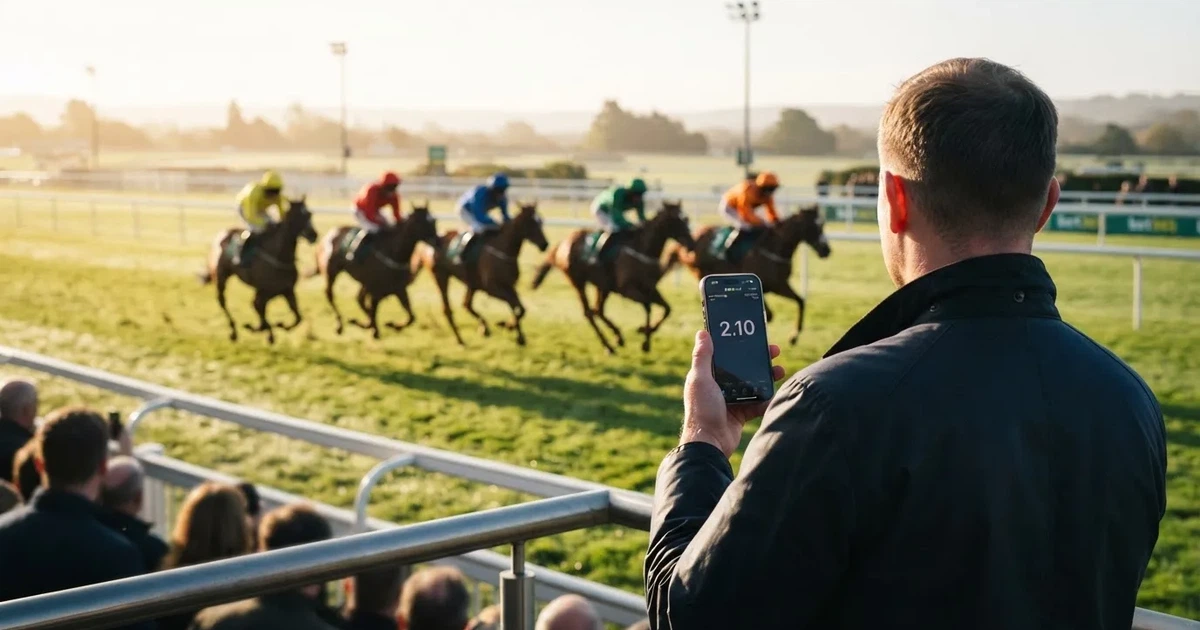
This page is current as of 26 October 2026, with licences and operator terms checked against the Gambling Commission’s public register and each brand’s own published conditions.
Bet Types and Odds: What a Horse Racing Price Actually Means
A horse racing price is a contract. The bookmaker offers to pay a stated multiple of the stake if the selection wins, and the punter accepts by staking on it. Everything else on the page flows from that one exchange.
Win, place, each-way
A single win bet returns the stake plus profit at the stated price if the horse finishes first. A £10 bet at 5/1 returns £60 — £50 profit and the £10 stake back. In decimal odds, the same bet at 6.00 returns £60 in total (profit £50 on a £10 stake).
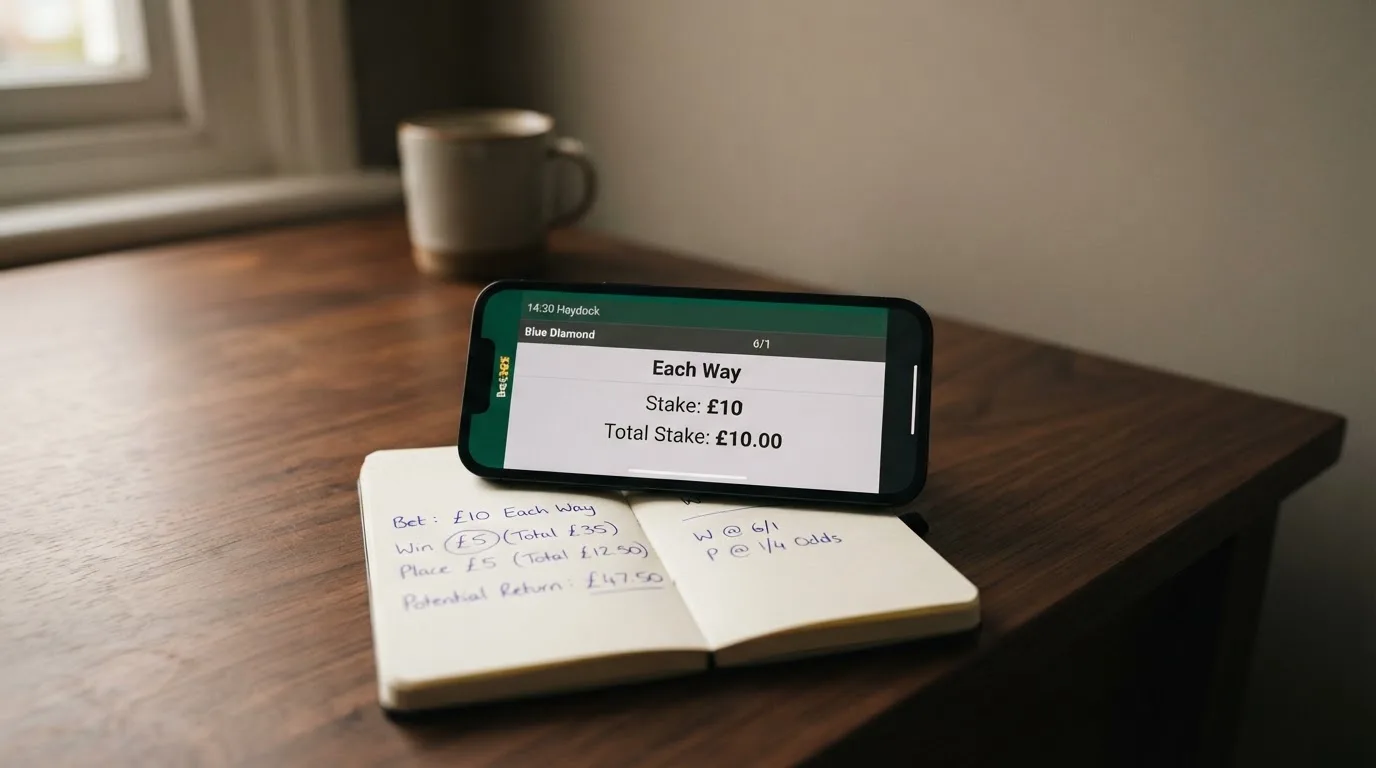
A place bet returns only if the horse finishes in one of the paid places. Each-way paid bets are framed as two bets of equal stake: one on the win market and one on the place market. That structure matters more than it sounds, because the stake doubles. A £5 each-way bet at 5/1 costs £10 in real money, and the return depends on whether the horse wins or merely places. In a six-runner race with 1/4 odds for two places, a horse that finishes second at 5/1 returns the place half — the win half is lost — at 5/4 of the stake, so £5 wins £6.25 plus the £5 stake, £11.25 in total. The same horse winning returns both halves at the full price.
Place terms are not universal. They vary by race type and field size. In Great Britain the common pattern looks like this: handicaps with sixteen or more runners pay a quarter of the win odds for the first four places; twelve to fifteen runners pay a quarter for the first three; other races with eight or more runners pay a fifth for the first three; five to seven runners pay a quarter for two places; fewer than five runners pays the win market only and there is no place element. A punter who bets each-way on a four-runner novice has effectively paid for two win bets, because the place leg is dead money.
A worked example makes the mechanics concrete. A £10 each-way bet at 10/1 in a ten-runner handicap, with place terms of a quarter odds for three places, costs £20. The win half pays £110 (£100 profit plus £10 stake) if the horse finishes first. The place half pays £35 (£25 profit at 10/4 plus £5 stake) if the horse finishes in the first three. If the horse wins outright, both halves pay and the slip returns £145. If the horse finishes second or third, only the place half pays and the slip returns £35 plus the £10 place stake, £45 in total. The punter has paid £20 for the chance at £145 on a win, or £45 on a place.
Accumulators and combined bets
A multiple bet links two or more selections; all must win for the bet to pay. The odds of each leg multiply into one combined price. Two selections at 3.00 and 4.00 combine to 12.00; four at 2.00, 3.00, 4.00 and 5.00 combine to 120.00. The combined price looks generous, but every leg carries its own margin, and a four-fold carries the margin of four markets, not one. A punter who reads only the headline number is reading the most flattering figure on the slip.
Full-cover bets — Trixie, Patent, Yankee, Lucky 15, Heinz, Goliath — package every combination of a set of selections into a single purchase. A Lucky 15 covers four selections in fifteen separate bets: four singles, six doubles, four trebles and one four-fold. A £1 Lucky 15 costs £15 in stake, not £1. A winning single leg returns its own stake and profit; a losing single leg does not refund the doubles and trebles that leg was part of, but they still need the other selections to win. These structures look like a way to soften a losing run, and they are a way to multiply the stake several-fold against a small field of selections.
Spread betting on horse racing
Spread betting is not the same product as fixed-odds betting, even when the screen shows a horse race. The price is a range — a “spread” — and the punter decides whether the result will be higher or lower than the quoted middle. The settlement is the difference between the result and the chosen strike, multiplied by the stake. Sporting Index lets customers switch between fixed odds and spread betting on the same event, and the regulatory position reflects the product: fixed-odds betting sits under the Gambling Commission, while financial spread betting sits under the Financial Conduct Authority. The two licences run in parallel at the same operator. The risk runs in parallel too — losses on a spread position can exceed the deposit, and the FCA’s protection framework treats financial spread betting differently from gambling winnings for tax purposes. A punter who wants fixed odds should not be placing spread bets by accident.
Cash out, Rule 4 and non-runners
Cash out settles a bet before the event has finished, at a price the bookmaker recalculates in running. The price offered is below the true market value of the bet, because the bookmaker needs its own margin on the early settlement as well as on the original bet. The cash-out number is therefore not a free gift — it is a price, and the price carries a margin of its own.
Rule 4 is a bookmaker’s rule, not a law. When a horse is withdrawn from a race after the fixed-odds market has been formed, the bookmaker deducts a stated fraction from the winnings of every other runner. A £10 win bet at 10/1 with one non-runner pays under Rule 4 at a reduced price — typically 10/1 minus a 15p-in-the-pound deduction at one non-runner in a small field — and the punter receives the reduced return. Rule 4 is a feature of fixed-odds horse racing and is set out in each operator’s house rules.
Ante-post betting is a wager placed before the final field is declared, usually days or weeks ahead of the race. The price is bigger than the day-of-race price, because the bookmaker is taking more risk on a horse that may not run. If the horse is declared a non-runner after the ante-post bet is placed, the stake is returned — that is the one protection ante-post carries, and it is the reason ante-post odds are noticeably wider than the morning price on a horse that is certain to line up.
Best Odds Guaranteed
Best Odds Guaranteed — BOG — is the concession that pays the bigger of the price taken and the starting price, on UK and Irish horse racing, from a stated time on the day of the race. William Hill pays BOG from 8 AM on the day of the race on UK and Irish racing, on singles and multiples, and excludes ante-post, tote and pari-mutuel bets. The effect is to give the punter the SP if SP is higher than the price they took, which closes the gap between an early price and the live market without requiring a second bet.
BOG looks like a free option, and the option has a real value, but the value sits inside a product the bookmaker has already priced. A bookmaker offering BOG builds the cost of paying out at SP into the morning price, so the price offered at 9 AM is slightly shorter than it would otherwise be. The punter still gains on races where the price drifts between 9 AM and the off, and loses nothing on races where it shortens. BOG is worth taking, and it is not worth chasing across two bookmakers — the difference is rarely large enough to justify splitting a stake.
The Fixture Side: What Races the UK Calendar Runs
Horse racing in Great Britain splits cleanly into two codes: racing on the flat, and racing over obstacles. Jump racing — steeplechases and hurdle races — is called National Hunt racing in Britain and Ireland. The two codes do not run on the same calendar: the Flat season runs roughly from March to November, and the National Hunt season runs through the winter, with the Cheltenham Festival in March and the Grand National meeting at Aintree in April sitting at the National Hunt end of the year. Flat racing returns at Newmarket in the spring and builds to its showcase meetings through the summer and early autumn.
Distances differ between the two codes and within each code. Flat races range from around 440 yards at the very short end to more than four miles at the longest, with five to twelve furlongs the most common range — that is one to two and a half kilometres, the band in which most Classic and Group-race distances sit. The Derby and the Oaks are run over a mile and a half; the St Leger is the longest Classic at just under a mile and three-quarters. National Hunt races are run over longer distances, typically from two to four and a half miles, with the Grand National at just over four and a half miles and thirty fences.
Race conditions affect the betting as well as the form. In handicap races each horse carries a weight set by the handicapper, with the better horses carrying more weight to give every runner a theoretical chance. In conditions races horses carry the same weight, with allowances for younger horses, for fillies racing against colts, and for less experienced runners. Handicaps tend to produce closer markets and longer-priced winners; conditions races tend to be dominated by a small number of well-regarded horses and the favourite wins more often. The shape of the race — the distance, the going, the field size, the type — sets the shape of the betting market on it.
The British Classics are the centre of the Flat calendar. The 2000 Guineas and the 1000 Guineas open the Classics at Newmarket in early May; the Derby and the Oaks follow at Epsom in early June; the St Leger closes the Classics at Doncaster in September. The first three colts’ Classics — 2000 Guineas, Derby, St Leger — form the British Triple Crown. The fillies’ equivalent — 1000 Guineas, Oaks, St Leger — is sometimes called the Fillies’ Triple Crown. No horse has won the colts’ Triple Crown since Nijinsky in 1970, and the betting markets on each Classic reflect that rarity: the Guineas favourite is rarely the Derby favourite, and the Derby favourite rarely starts the St Leger.
Ten Licensed UK Bookmakers Compared
The ten brands below all hold a Gambling Commission remote operating licence, the licence class being remote general betting standard (real events) for every one of them. Several of them also hold adjacent licences — pool betting, casino, bingo — but the licence that covers a horse race is the limited surface general betting standard (real events) licence, and that is the one named here. The brands are listed in the order they appear on the Commission’s public register against the account number given; the order is not a ranking of quality.
| Brand | Gambling Commission licence | Position on the page’s subject |
|---|---|---|
| Tote | 054779-R-331321-008 (TDCO Limited) | Pool-betting native with a heritage in UK and Irish racing |
| BetGoodwin | 002927-R-327985-008 (Goodwin Racing Limited) | Racing-focused brand with a sports welcome structure |
| Geoff Banks | 054095-R-330366-010 (GB Sports Advisors Limited) | Independent racing bookmaker with ante-post depth |
| VBet | 044662-R-324273-022 (SCGO Limited) | Multi-product sportsbook with a one-stake racing welcome |
| Sporting Index | 027343-R-308898-011 (Sporting Index Limited) | Spread and fixed-odds dual product on the same race |
| Kalooki Sportsbook | 057730-R-333396-005 (Kalooki Sportsbook Limited) | Independent racing bookmaker, GAMSTOP member |
| LiveScore Bet | 056859-R-332720-005 (LiveScore Betting and Gaming (Gibraltar) Limited) | Score-feed brand with a deep Bet Builder product |
| Dabble | 065677-R-340363-005 (Dabble Sports UK Ltd) | Social-led app with a simple racing welcome |
| 10bet | 043173-R-322899-023 (Blue Star Planet Limited) | Mainstream sportsbook with horse racing and streaming |
| Betfred | 039544-R-319290-010 (Petfre (Gibraltar) Limited) | High-street legacy brand with deep racing markets |
A licence confirms the operator is regulated and offers the named product category under Commission rules. It is not a verdict on the price, the payout speed, or the depth of the racing markets. Those vary by brand and the rest of this section says how.
1. Tote — the pool-betting native
Tote runs the pool-betting licence class alongside its general betting licence, which makes it the only operator on this list whose primary product is the pool rather than the fixed-odds book. The pool is a different market: returns are not set by a bookmaker but by dividing the pool among winning tickets after a takeout, the dividend is announced at the off, and large fields can throw up large place dividends. For a punter used to a fixed price, the pool looks unfamiliar — there is no price to take before the race, only a stake to commit.
Tote is the natural home for a punter who already bets into pools at the track. The fixed-odds offering on the same site is the conventional product. A punter looking for BOG on a UK handicap will find it at the fixed-odds book rather than at the pool, and the Tote site is set up around both products running side by side.
2. BetGoodwin — the racing-focused brand
BetGoodwin is the online arm of an independent bookmaking family with a long history in UK racing. The racing welcome structure is built around a £10 sports bet, a £5 acca and a £5 Sub-Cover bet for staking £10 — a package designed to nudge the new customer across multiple product types rather than to load the welcome on to a single line.
The brand is built for the punter who wants to bet on British and Irish racing and is happy to take the smaller bookmaker route. The depth of the racing markets is wider than the headline suggests, and the ante-post coverage includes the major festivals and the spring Classics.
3. Geoff Banks — the independent racing bookmaker
Geoff Banks runs a small but dedicated racing product, with both live in-play prices on the day’s meetings and ante-post prices on the bigger future events. The brand is set up for the punter who treats racing as their main sport and wants a smaller bookmaker with a personal account rather than a mass-market sportsbook.
The limits on a smaller bookmaker are sometimes tighter at the top end, and the in-play product is sometimes narrower than the bigger houses. The trade is price — independent racing books can offer bigger prices on selected horses, because they do not carry the same liability as a major firm.
4. VBet — the multi-product sportsbook
VBet is a multi-product sportsbook licensed in Great Britain under SCGO Limited, with horse racing sitting alongside football, tennis and a casino vertical. The racing welcome is built around a £10 free bet when a new, verified customer stakes £10 or more on a first bet that loses — a refund structure that converts the losing stake into bonus betting rather than cash.
A punter who wants one account for racing, football and casino will find VBet a familiar shape. A punter looking for the deepest racing product on the page will find more depth at brands whose primary sport is racing. The racing welcome reads cleanly because the structure is simple, but the lost-stake refund carries the usual free-bet caveat: a winning first bet leaves the new customer with no bonus, and the £10 free bet carries the terms that attach to the brand’s free bets generally.
5. Sporting Index — the spread-and-fixed hybrid
Sporting Index is regulated by both the FCA for financial spread betting and the Gambling Commission for fixed-odds betting, and the brand offers both products on the same race. Sporting Index lets customers switch between fixed odds and spread betting on horse racing, with in-play betting and auto cash-out sitting on the same platform.
The dual product is the point of Sporting Index. A punter who wants to back a horse at fixed odds on one tab and take a spread view on the race result on the other is in the right place. The risk profile of the spread product is higher than the fixed-odds product, and the FCA’s protection framework for spread betting is different from the Commission’s for gambling. A punter should choose the product deliberately.
6. Kalooki Sportsbook — the independent racing brand
Kalooki Sportsbook is operated by Kalooki Sports Book Ltd, licensed by the Gambling Commission under account 57730, and is a GAMSTOP member. The brand runs an independent racing product with the verification and account rules set out in the Commission’s licence conditions.
The brand’s appeal is the same shape as Geoff Banks’: a smaller, racing-focused book with a real human behind it. The terms read cleanly and the welcome structure is built around the racing product rather than a multi-product sign-up bonus.
7. LiveScore Bet — the score-feed sportsbook
LiveScore Bet is the betting arm of the LiveScore score-feed brand, licensed in Great Britain under LiveScore Betting and Gaming (Gibraltar) Limited. The product runs a Bet Builder that allows up to ten selections on a single football match, covering match result, both teams to score, corners, total goals, player scoring and cards.
The horse racing product sits alongside the football depth, with the standard racing markets on UK and Irish meetings. The appeal to a racing punter is the familiar LiveScore feed on the same screen as the betting slip. The Bet Builder is a football feature, and a punter who bets racing rather than football will use a smaller share of the platform.
8. Dabble — the social-led app
Dabble runs a social-led mobile product with a chat feature sitting alongside the betting slip, licensed in Great Britain under Dabble Sports UK Ltd. The racing welcome is a £10 free bet on a £10 first deposit, with a 7-day expiry and the stake not returned on a winning free bet.
The social feed is the differentiator: a punter who likes to talk through their betting in real time has a built-in audience. A punter who bets in private will find the feed a distraction.
9. 10bet — the mainstream sportsbook
10bet’s sportsbook covers football, tennis and horse racing with cash out, a Bet Builder and live streaming. The brand is licensed under Blue Star Planet Limited and runs the conventional sportsbook product shape, with horse racing as one sport among many.
The mainstream shape is the appeal: a punter who wants one account across multiple sports will find 10bet a familiar offering. The depth of racing is narrower than the racing-focused brands above.
10. Betfred — the high-street legacy
Betfred is the high-street legacy brand, licensed under Petfre (Gibraltar) Limited. The app covers twenty-one sports and over two thousand casino-style games, with the racing product running alongside everything else. The high-street background shows in the depth of the UK and Irish racing product, and the brand has historically offered BOG and extra places on the major festivals.
The breadth of product is the appeal and the drawback: a punter who wants a single account across everything finds a familiar shape, and a punter who wants the racing focus finds the racing product sitting inside a much larger sportsbook.
What a UK Horse Racing Bookmaker Actually Offers
The product set at a UK horse racing bookmaker divides into three layers: the racing market itself, the trading features around it, and the welcome structure on top.
Markets on a single race
The standard menu on a UK and Irish horse race includes win and each-way markets, place markets as a standalone product, forecast and tricast (the first two or three in order), and a without-the-favourite market that lets the punter back a horse in the field excluding the favourite. Each market has its own margin, and the margin on the place market is wider than the margin on the win market because the place market pays more runners. Forecast and tricast markets are pari-mutuel in shape, with the dividend set after the race rather than at the off.
Bigger meetings pull in extra markets: distance-to-judge, head-to-head matchups between named horses, and boosted-odds markets on the favourites. The boosted-odds market is a marketing product: the headline price is bigger than the underlying book would carry, and the boost carries its own margin on top of the underlying market. A punter who takes the boost pays for the marketing with a worse price than the underlying market would give.
Trading features: cash out, BOG and extra places
Cash out, BOG and extra places are the three features a racing punter expects at a UK bookmaker. Cash out settles the bet early at a price the bookmaker recalculates; the price offered is below the true market value because the bookmaker needs its own margin on the settlement. BOG pays the bigger of the price taken and the starting price on UK and Irish racing from a stated time on race day. Extra places add paid places on selected races — typically the bigger handicaps and the festival handicaps — and the place terms are restated at the boosted number of places.
Each of the three features looks like a freebie and is not. Cash out carries a margin of its own. BOG is paid for in the morning price the bookmaker offers. Extra places are paid for in the win price the bookmaker offers on the favourite, which is shorter at a book paying extra places than at a book that does not. A punter who reads the small print on the place terms on a handicaps extra-place offer will see the place odds reduced to reflect the extra places.
Welcome structures
Welcome offers on UK racing divide into four shapes: a free bet on a losing first bet, a free bet bundle on a first deposit, acca-insurance offers that refund the stake as a free bet if one leg lets a multiple down, and odds-boost tokens that raise the price on a named bet. Each shape carries its own terms.
A losing-first-bet refund is the commonest shape. The new customer bets, the bet loses, and the bookmaker refunds the stake as a free bet. The free bet carries the usual terms: a 7-day expiry is typical, the stake is not returned on a winning free bet, and the free bet is paid as bonus funds rather than cash. The punter who wins the first bet gets no welcome at all, which is the structural cost of a losing-bet refund.
A first-deposit bundle is the next commonest shape. The new customer deposits and stakes, and the bookmaker credits a bundle of free bets split across single, acca and a brand-specific product. BetGoodwin’s structure splits the welcome into a £5 sports bet, a £5 acca and a £5 Sub-Cover bet — three separate tokens on three separate products. The token bundle carries the multi-product shape that the 19 January 2026 promotion rules discourage, and a punter who reads the welcome terms will see that each token has its own minimum odds and its own expiry.
The wagering cap is the rule that has reshaped UK bonuses since 19 January 2026: wagering requirements are capped at 10x the bonus, so a £10 bonus needs £100 of qualifying bets, and a £50 bonus needs £500. The cap does not apply to free bets with no wagering condition, and a free bet with no wagering condition is a simpler product than a cash bonus with a turnover requirement. A bookmaker offering a 50x wagering requirement on a £10 bonus is now outside the rules.
Mixed-product promotions are out: an offer that requires gambling on two or more product types — betting, casino, bingo and lottery — is banned under the 19 January 2026 rules. A welcome structure that credits free spins alongside a sports free bet is therefore not a UK welcome structure, and a UK welcome structure is a sports-only structure. A punter reading a UK welcome will see sports-only tokens.
Legality and Regulation in Great Britain
The legal frame around a UK horse racing bet is the Gambling Act 2005, which covers Great Britain — England, Scotland and Wales. Northern Ireland sits outside the Act and is governed by older legislation, and a GB licence does not reach Northern Irish customers. The Commission is the regulator; a bookmaker whose remote facilities are used in Great Britain needs a Commission licence wherever the operator itself is based, since the Gambling (Licensing and Advertising) Act 2014. A Curaçao, Maltese or Gibraltar licence is not a substitute, even though several of the operators above are themselves based in Gibraltar. The point of the test is where the customer sits, not where the company is incorporated.
Licence categories that cover a horse race
A bookmaker taking horse racing bets from a GB customer holds a remote general betting standard (real events) licence. The category is the one named on every row of the table above. Adjacent categories cover pool betting, betting exchanges, virtual events and financial spread betting, and a brand holding a remote general betting standard (real events) licence may also hold one or more of those. Tote’s pool licence is the obvious example; Sporting Index’s FCA registration covers the financial spread betting element of its product.
The Commission’s public register lists each licence and its account number. A punter can check a brand by business name, trading name, domain or account number; the register is the whole test of whether a brand holds a GB licence, and there is no shortcut around it. A licensed operator uses both .co.uk and .com domains, so the domain does not prove the licence.
Age, identity and the first deposit
The minimum age for betting in Great Britain is 18, and the verification happens before the first deposit. Name, address and date of birth are checked against public records and against the operator’s own checks, and a punter who fails the check cannot deposit or gamble. The check applies even where the first bet is a free bet or a no-deposit offer — the verification gate runs before the bonus credit, not after it. The result is that a licensed UK racing bookmaker does not offer anonymous betting.
A financial vulnerability check sits on top of the verification, in force since 30 August 2024 and tightened since 28 February 2025: when a customer’s deposits minus withdrawals exceed £150 in a rolling thirty days, the operator runs a public-record check, looking at indicators such as bankruptcy or county court judgments. It is not an income check and not a credit reference check. The financial risk assessment — the deeper affordability check the press calls an affordability check — has been announced in a staged plan and has no start date.
Player protection: GAMSTOP, limits and help
GAMSTOP is the national multi-operator online self-exclusion scheme and a mandatory licence condition for every online bookmaker in Great Britain since 31 March 2020. A punter who registers with GAMSTOP is excluded from every licensed online operator for the chosen duration: six months, one year, five years, or five years with auto-renewal. After the minimum period the exclusion stays in place for a further seven years unless the customer asks GAMSTOP to remove it. GAMSTOP covers online sites and apps; betting shops use a separate service, and a punter who wants shop-level exclusion needs to ask at the shop.
Deposit limits are required under the Commission’s Remote Technical Standards. The first changes took effect on 31 October 2025, a second phase was postponed to 30 September 2026, and whether the second phase is in force today is not established. The deposit limit is the customer’s choice, and the Commission does not set a default ceiling across the market. A punter who wants a £50-a-week deposit cap can set one at any licensed operator; a punter who wants no cap can leave the operator’s default in place.
Help exists outside the operators. GamCare runs the National Gambling Helpline. GambleAware funds treatment and education. The NHS runs gambling clinics in several regions. Gamblers Anonymous runs peer-support meetings.
Advertising rules
Advertising is regulated by the Advertising Standards Authority through the CAP Code (non-broadcast) and BCAP Code (broadcast), and the LCCP adds marketing conditions on top. The CAP Code section 16 requires marketing to be socially responsible, prohibits strong appeal to under-18s, and sets the under-25 rule: no one who is or seems to be under 25 may be featured gambling or play a significant role in a betting advertisement. The under-25 rule concerns who may appear in the advertisement, not who may place a bet.
“Whistle-to-whistle” — no betting advertisements on TV from five minutes before a live sporting event to five minutes after it, before the 9pm watershed — has been in force since 1 August 2019. Horse and greyhound racing are excluded from the whistle-to-whistle restriction because the broadcasts already carry the betting context of the sport. The Premier League clubs’ withdrawal of gambling sponsorship from the front of matchday shirts from 2026/27 is voluntary, not law; sleeves and hoardings remain.
Tax on winnings
The player pays no tax on betting winnings in Great Britain. General Betting Duty is the operator’s tax on its gross profits from betting, currently 15%, and a new remote betting rate of 25% applies from 1 April 2027 within the duty, while remote bets on UK horse racing, bets on self-self-service betting terminals, pool betting and in-person betting stay at 15%. The duty is the operator’s cost and is not levied on the punter’s stake. Until 1 April 2027 the remote rate stays at 15%, and whether operators pass the duty change through their odds is not established.
Financial spread betting carries its own rates: 3% on financial spread betting and 10% on other spread bets. The spread betting side of Sporting Index sits under those rates, and the fixed-odds side sits under General Betting Duty.
Offshore: the cost of betting without a GB licence
A GB-licensed operator is the only operator that takes a GB customer’s bet under the Commission’s rules. The point-of-consumption test, in force since the 2014 Act, requires the licence where the customer sits, not where the operator is based. An operator without a GB licence that takes a GB customer’s bet commits an offence under section 33 of the Gambling Act 2005; the offence is aimed at the operator, not the punter, but the consequence for the punter is the loss of the protections the licence confers.
The cost of the unlicensed route is the loss of GAMSTOP coverage, the loss of the Commission’s complaints route, the loss of an approved dispute-resolution body, and the loss of British consumer redress if funds are held. The 10x bonus cap does not apply, the £150 vulnerability check does not run, the source-of-funds questions under the money-laundering rules do not apply. The licensed operator runs those checks; the unlicensed one does not. The unlicensed route is therefore not a route around the checks, it is a route around the consumer protection.
The enforcement response is disruption rather than blocking. The Commission issues cease-and-desist notices, refers unlicensed brands to search engines, and works with registrars, hosts and payment providers to take the infrastructure away. The Commission has been given, or is about to receive, court-order DNS blocking powers, and the framing is therefore: licensed means checks, limits, GAMSTOP, the bonus cap, and verification before the first bet; unlicensed means none of those, plus the possibility of losing the funds in the account.
Responsible Gambling in Practice
A punter who treats the betting account as a budget — a fixed amount per week, set in advance and not topped up on a losing run — gets further than a punter who treats the account as a float. The licensed UK bookmaker offers the tools to set that frame: a deposit limit, a time-out, a reality check, and GAMSTOP for the longer exclusion. The toolset is the same across the ten brands above, and the punter who sets a deposit limit at the first deposit has done more for their own protection than any welcome offer has done for their betting.
A punter who chases losses — stakes bigger amounts to recover a losing run — pays the bookmaker’s margin on a longer run of bets and pays the bookmaker’s psychology tax on top of it. The marketing terms around “Best Odds Guaranteed” and “Extra Places” both look like reasons to bet, and both are also reasons to bet more than the planned stake. The punter who keeps the planned stake regardless of the day’s offer gets the offer and keeps the discipline.
Crypto and Anonymity at UK Racing Bookmakers
A licensed UK racing bookmaker does not accept cryptocurrency deposits as a standard product, and the Commission’s source-of-funds and identity-verification rules run before the first deposit, so anonymous play is not on offer. The verification gate applies before the first bet — whether the bet is paid in pounds or paid in any other unit — and a punter who has not passed name, address and date-of-birth verification cannot deposit or stake.
The crypto-native racing product sits offshore, outside the Commission’s licence frame. The product shape is the same — win, place, each-way, ante-post — and the deposit shape is the difference. The crypto route takes the GB punter out of the GB protections, and the protections are the same protections the previous section names: GAMSTOP, the £150 vulnerability check, the bonus cap, the Commission’s complaints route, the approved dispute resolution. A punter who values the protections does not take the crypto route; a punter who values the crypto route accepts that the protections are not on offer.
Bonuses and Free Bets on UK Racing
The standard offer on a UK racing bookmaker is a free bet, paid on a losing first bet or as a bundle on a first deposit. The free bet carries the standard free-bet caveat: the stake is not returned on a winning free bet, the free bet expires within seven days of credit, and the free bet cannot be withdrawn as cash.
A cash bonus with a wagering requirement is rarer on UK racing than on a casino product, because the 19 January 2026 wagering cap makes the structure less attractive for the operator. A £10 cash bonus at 10x wagering needs £100 of qualifying bets, and a £50 cash bonus needs £500. The shape is workable for the punter who was going to bet anyway; it is expensive for the punter who bets the bonus and stops. The expected cost of clearing the bonus depends on the margin of the market the punter uses to clear it — the lower the margin, the less the bonus costs in expectation, and the higher the margin, the more the bonus costs. The arithmetic is the next section’s work.
The “free bet” shape is the cleanest product on the UK market, because no wagering requirement runs against it. The cost is that a winning free bet pays only the profit, not the stake. A £10 free bet at 5.00 returns £40 in profit — the £10 stake is gone. A £10 cash stake at 5.00 returns £50 in profit plus the £10 stake back, £60 in total. The free bet looks like £50, and it pays like £40; the £10 difference is the cost of the bonus.
Mobile and App
A UK racing punter in 2026 bets on a phone more often than on a desktop, and the racing app is the primary product surface. The ten brands above all run iOS and Android apps; bet365 is described as the most downloaded sports betting app in the UK. The app gives the punter the day’s racecards, the live odds, the bet slip and cash-out control from a single screen, and the racing product is set up around the touchscreen rather than the desktop.
The features that matter on a racing app are the bet slip’s speed, the in-play product, cash out, the racecard’s depth and the live stream of the meeting. Bet Builder, acca insurance and boosted odds are useful on football and tennis; on horse racing the racing-specific features — BOG, extra places, Rule 4 display, non-runner alert — matter more than the football products.
Live Betting and Cash Out on UK Racing
In-play betting on horse racing is a real product at UK bookmakers, and the controls are the operator’s licence conditions and customer-protection duties rather than a statutory list of in-play markets. The product shape is the same as pre-race: win, place, each-way, with a cash-out price available at every stage of the race. The in-running price moves with the race, and the cash-out price moves with the price.
The in-running margin is wider than the pre-race margin, because the bookmaker has less time to lay off the liability on a fast-moving market. The cash-out price is set at the book’s in-running margin, not at the live market price, and the punter who cashes out pays the cash-out margin. A punter who lets the bet run to the finish avoids the cash-out margin and accepts the result.
Predictions and Selection
No system predicts a horse race. The form, the going, the trip, the jockey and trainer bookings, the market moves and the pace map all matter, and no combination of them produces a winning bet on demand. The bookmaker’s edge sits in the margin, and the punter’s edge, where it exists, sits in the price.
A punter who reads the form and follows the market has the same information the bookmaker has, plus the bookmaker’s margin. A punter who reads the form, follows the market, and looks for the price that is bigger than the horse’s chance is doing the same job the bookmaker is doing on the other side of the trade. A punter who bets because a tipster said so is paying the tipster for the tipster’s opinion and the bookmaker’s margin on top.
The starting price is the market’s verdict at the off. A horse that drifts from 5/1 in the morning to 10/1 at the off has either lost form, lost a piece of the market’s confidence, or both; the SP is the price the rest of the market has settled on. A horse that shortens from 5/1 to 2/1 has either won the market’s confidence or been the subject of informed money. The SP is not a predictor, and the punter who backs every SP favourite loses at the margin.
How a Bookmaker’s Margin Shows Up in the Odds
The margin is the slice of every pound staked that the bookmaker keeps on average. The margin is built into every price on the book, and the punter who reads the margin reads the bookmaker’s edge.
The arithmetic of a two-way market
A two-way market with one winner pays the stake back at the price on the winning side. In a fair market the prices on both sides would reflect each outcome’s true probability, and the implied probabilities across both sides would sum to 1.00 — 100%. The bookmaker’s margin is the difference between 1.00 and the actual sum of implied probabilities.
A worked example makes the arithmetic concrete. Consider a hypothetical two-way market priced at 1.90 / 1.90 (fractional 9/10 each side). The implied probability of each side is 1 ÷ 1.90, which is approximately 0.5263, or 52.63%. Two sides at 52.63% sum to 105.26%. The excess over 100% — the 5.26 percentage points — is the bookmaker’s margin.
The payout share — the proportion of every pound staked that the bookmaker returns to winning punters on average, across all outcomes — is the inverse of that calculation. The payout share is 1 ÷ 1.0526, which is approximately 0.9500, or 95.00%. The bookmaker keeps 5.26% on average and returns 95.00% on average. The 5% headline number is a rounded version of the 5.26% margin, and the precise number depends on the price the bookmaker offers.
What the margin means for a stake
A punter who stakes £100 on a market with a 5% margin expects to receive £95 back over the long run, before any bonus or promotion is applied. The £5 difference is the bookmaker’s take. The punter who bets on a market with a 10% margin expects to receive £90 back over the long run. The punter who bets on a market with a 2% margin expects to receive £98 back.
The margin on a horse race varies by market and by race. The win market on a competitive handicap typically carries a margin of 5% to 8% at the bigger books; the place market typically carries a margin of 8% to 12% because more runners pay. The forecast and tricast markets carry their own margin, often wider than the win market. The each-way bet, which is a win bet and a place bet combined, carries the combined margin.
Where the margin is hidden
The margin is hidden in the symmetry of the book. A fair book on a two-way market with 50/50 chances would offer 2.00 on each side; the bookmaker’s book at 1.90 / 1.90 is the fair book with the 5.26% margin taken off each side. The punter who reads only one side of the book misses the other side, and the punter who reads only the favourite misses the outsider’s price.
The margin is also hidden in the place terms. A bookmaker offering a quarter of the win odds for three places on a ten-runner handicap is offering a place market at one-quarter of the win price, and the place market’s margin is built into the one-quarter fraction. The punter who reads the place terms as “free” is missing the place market’s own margin.
The margin is also hidden in the boosted-odds market. A boosted favourite at 5/1 when the underlying price is 4/1 carries a boost of one point, and the boost is paid for by a shorter price on the place market, the other runners, or both. A punter who takes the boost alone misses the price the boost is paid for in.
The honest framing is that the margin is everywhere, the price is the only number that matters, and the operator with the smallest margin on the same race at the same time is the operator paying the most in expectation. The punter who wants the most for their stake shops the price on the specific horse they want to back, at the specific race, at the specific time. The punter who takes the first price on the screen leaves the difference on the table.
A Closing Word
The page is built around what a horse racing price costs and what the betting account looks like under UK rules. The ten brands above are all licensed, all offer UK and Irish racing, and all carry the same verification, GAMSTOP and bonus-cap frame. The differences sit in the product shape — pool versus fixed odds, racing-only versus multi-product, social feed versus score feed, spread plus fixed odds on the same race — and the punter who knows which product they want picks the brand that runs that product.
A punter who reads the price, checks the place terms, takes the BOG when it pays, sets a deposit limit at the first deposit, and walks away from the day’s offer when the planned stake is spent has done more for their own pocket than any system of selections ever has.
Frequently Asked Questions
How do I bet on horse racing?
Pick a race from the day’s racecard at a licensed bookmaker, choose the horse, decide on the stake, and confirm the bet on the slip. The bet pays if the horse wins at the stated price, and an each-way bet adds a place leg at the place terms stated by the bookmaker for the race.
How do I work out the return on a horse racing bet?
For a win bet, the return is the stake multiplied by the decimal odds. A £10 bet at 6.00 returns £60, made up of £10 stake and £50 profit. For an each-way bet, the win leg pays at the full price and the place leg pays at the place fraction; both stakes are returned with a win.
How do betting odds work in horse racing?
Decimal odds show the total return per unit stake, including the stake. Fractional odds show the profit per unit stake, with the stake returned on top. Odds of 5/1 (6.00 decimal) return £5 profit plus £1 stake, £6 in total, on a £1 stake. The shorter the odds, the bigger the implied chance of winning, and the smaller the return per unit stake.
How can I check that a bookmaker holds a Gambling Commission licence?
Search the Commission’s public register by business name, trading name, domain or account number. The register lists every operating licence and its account number, and a brand whose name appears with a remote general betting standard (real events) licence is licensed for horse racing.
What is the bookmaker’s margin and how does it show in the odds?
The margin is the slice of every pound staked that the bookmaker keeps on average. In the odds it shows as the sum of the implied probabilities of every outcome being more than 100% — a two-way market at 1.90 / 1.90 implies 105.26% across both sides, so the bookmaker’s take is 5.26%, and the punter’s expected return is 95.00% across the long run.
Horse racing & greyhounds – Accumulator
Content created by the «Accumulator» team
