
Online rugby union betting in Great Britain: where it sits and what it costs
 Available in US
Data current as of 26 October 2026, verified against the Gambling Commission’s public register and each operator’s own published terms.

Rugby union has sat at the edge of British sports betting for years, treated as a serious but secondary sport behind football and horse racing. That position is shifting. The Rugby World Cup cycle brings a fresh wave of bettors into the market every four years, the Six Nations and the southern-hemisphere internationals keep interest going between World Cups, and the English Premiership, the United Rugby Championship and Super Rugby now run on calendars that stretch through most of the year. A bettor who wants to put money on rugby in Great Britain in 2026 has more places to do it than at any previous point, but also more offers, more markets and more terms to read than at any previous point.
This page is about what that looks like in practice. It walks through where rugby union betting stands under a British licence, what responsible-gambling infrastructure a GB-licensed bettor sits inside, what bookmaker offers and free bets actually cost once the wagering is factored in, how live betting and cash out behave on a sport whose clock does not stop, where tipsters and predictor fits in without becoming a tipster, the bet types and odds formats a rugby bettor meets, the tournaments and competitions that make up the rugby betting calendar, and a ranked comparison of ten bookmakers whose names sit on the Gambling Commission’s public register against a remote general betting licence for real events. A worked example shows what a margin of a few percent does to a price. An FAQ closes the page.
Regulation: where rugby union betting is legal in Great Britain
Rugby union betting in Great Britain is not regulated as a special case. It falls under the same framework as every other sport on a licensed sportsbook: the Gambling Act 2005, the Gambling Commission as regulator, and a remote general betting standard (real events) licence on the public register. There is no statutory list of permitted sports, no separate approval for rugby markets, and no rule that says a rugby union fixture must be priced in any particular way.

What matters is the licence itself. Since the Gambling (Licensing and Advertising) Act 2014, an operator whose remote facilities are used in Great Britain needs a Gambling Commission licence wherever that operator is based. Sections 33 and 36 of the 2005 Act are the relevant provisions; an offshore licence from Curaçao, Malta or Gibraltar is not a substitute for a Commission licence when British customers are involved. The Commission’s public register, searchable by business name, trading name, domain or account number, is the test of who holds one. A bettor who wants to check a brand before depositing opens that register and confirms the account number, the licence category and the licence holder before a penny goes down.
The licence categories a rugby bettor is most likely to meet are remote general betting standard (real events), which covers sports including rugby union, and remote betting intermediary, which covers betting exchanges. Spread betting that touches financial instruments sits under the Financial Conduct Authority rather than the Commission, and Spreadex is the clearest example of an operator that holds both licences for two distinct product lines. A bookmaker offering spread bets on a rugby match under a general betting licence, and a spread-betting firm offering the same market under an FCA licence, are not in the same regulatory bucket even when the price looks identical on screen.
Identity verification sits before the first deposit. A GB-licensed operator has to verify name, address and date of birth before the customer can deposit or gamble, and that requirement has been in place since 7 May 2019 and applies even when the bet is a free bet or a bonus. Anonymous play is not available at a licensed site. The credit-card ban for gambling, in place since 14 April 2020, applies to credit cards and to e-wallet top-ups funded by credit cards, and removes one route that used to allow a bettor to defer payment on a losing stake.
A single Commission licence does not mean an operator offers deep rugby markets. Several brands reviewed on this page cover the Premiership, the Six Nations and the Rugby World Cup; others cover the Six Nations and a handful of autumn internationals and leave the club game thin. A licence is the entry ticket, not the depth chart. The comparison later on the page looks at what each bookmaker actually shows in its rugby coupon, not the licence alone.
Responsible gambling: the architecture around a GB-licensed bet
The protection that comes with a GB licence is not a marketing line. It is a set of licence conditions, a self-exclusion scheme the operator has to take part in, and rules on deposit limits and financial checks that bind the operator whether the bettor asks for them or not.
GAMSTOP and self-exclusion
GAMSTOP is the national multi-operator online self-exclusion scheme, and taking part in it has been a mandatory licence condition for online operators since 31 March 2020. A customer who registers with GAMSTOP is blocked from every GB-licensed online operator for the period they choose: six months, one year, five years, or five years with auto-renewal. After the minimum period has run, it stays in place for a further seven years unless the customer asks GAMSTOP to remove it. Betting shops use a separate service, not GAMSTOP, so excluding online does not exclude over the counter. Self-exclusion is the most effective single protection available to a bettor who has decided to stop, and it is the lever a British bettor has that an offshore customer does not.
Financial vulnerability and risk checks
A financial vulnerability check applies to licensed remote betting when a customer’s deposits minus withdrawals exceed £150 in a rolling 30 days, and that threshold has been in force since 28 February 2025. The check looks at public records (bankruptcy, county court judgments and similar), not income and not credit reference files, so it does not ask for payslips at £151 of net spend. Beyond that, a financial risk assessment — the affordability check that has been the subject of extensive press coverage — has been announced in a staged plan, with no start date confirmed. The position in 2026 is that vulnerability checks at the £150 threshold are running; risk assessments are announced, staged, and have not started. A bettor who hears the two talked about as the same thing is being told half the story.
Deposit limits and stake limits
Operators must offer a gross deposit limit on a fixed time frame. A first phase has been in force since 31 October 2025 and a second phase was postponed to 30 September 2026, so the deposit-limit regime in 2026 is partly live and partly pending. There is no state-set ceiling on deposits or losses for sports betting; the limit is the customer’s choice, and the choice to set a small one is the cheapest form of protection available. Maximum stakes on a market are set by the operator, and a bettor who tries to push a wager through at a stake the bookmaker will not price is refused at the slip, not at the register.
Where to get help
GamCare runs the National Gambling Helpline. GambleAware funds treatment and provides information. NHS gambling clinics operate in several regions. Gamblers Anonymous runs peer-support meetings. A bettor who finds that betting has stopped being a choice should reach for one of those names rather than another betting app.
What an offshore bookmaker does not give a British bettor
A bookmaker licensed outside Great Britain and serving British customers without a Commission licence is operating illegally under section 33 of the Gambling Act 2005. The offence is aimed at the operator; no offence aimed at the customer was found. The practical consequence is the loss of everything the licence carries: no GAMSTOP coverage, no Commission complaints route, no approved dispute-resolution service, no recourse through British consumer law if the operator withholds funds, no protection under the 10x bonus wagering cap, no vulnerability check at the £150 threshold. A bettor who uses an unlicensed site is not “playing more freely”; they are playing with no British backstop. The page names licensed operators only.
Bonuses and free bets: what an offer actually costs a rugby bettor
Rugby union is not a sport bookmakers compete on with welcome bonuses the way football is. Most of the welcome offers a rugby bettor sees are sport-agnostic, and the same welcome structure is applied to a £10 rugby bet, a £10 football bet and a £10 horse racing bet. What changes between bookmakers is the size, the qualifying conditions, the minimum odds, the expiry, and whether the free bet stake is returned with a win. That is where the real cost hides.
How a free bet is read
A free bet is a token the operator credits to the account after a qualifying bet is placed and settled. The stake of the free bet is not paid back when the free bet wins; only the winnings land on the account, calculated as stake times (odds minus one). A £10 free bet at odds of 3.00 that wins pays £20 back, not £30. That single line — stake not returned — is the difference between a £10 free bet that pays £20 and a £10 cash bet that pays £30, and it is why a free bet is worth roughly its face value times (odds minus one) divided by odds, averaged over many uses.
A “risk-free” offer is, on inspection at licensed British bookmakers, almost always a free bet refunded on a losing qualifier rather than a cash refund. The refund carries the stake-not-returned rule, so a £10 risk-free bet at odds of 2.50 that loses and returns as a £10 free bet is worth less than a £10 cash refund would have been. The marketing word and the arithmetic disagree, and the arithmetic is what counts.
A price boost is an enhanced price on a chosen selection, settled at the new odds rather than the original. Boosts carry a maximum stake, sometimes as low as £10 and sometimes as high as £100, and a boost at higher odds than the market justifies is a one-shot marketing line rather than an edge.
An accumulator insurance refunds the stake as a free bet if one leg of an accumulator loses. The refund usually covers accumulators of a minimum number of legs at minimum odds per leg, and the free bet refund carries the stake-not-returned rule. A five-fold acca with insurance that loses on the fifth leg is not the same as a five-fold acca that lands.
What the wagering requirement costs
The headline number on a sports welcome offer is the bonus amount. The number that decides whether it is worth taking is the wagering multiplier, the minimum odds and the expiry. From 19 January 2026 a Commission promotion rule limits wagering requirements on bonuses to 10x the bonus amount, so a £10 bonus at 50x wagering — £500 of qualifying bets — is no longer permitted at a GB-licensed operator; under the cap no more than £100 of wagering is required for a £10 bonus. Mixed-product promotions, where a sports bet unlocks casino free spins or a casino deposit unlocks a sports free bet, are banned under the same rule. The cap does not apply to a free bet with no wagering condition, and whether any cap applies to the money value of a bonus has not been established; both points sit outside the rule.
A bookmaker that advertises a £30 free bet for a £10 qualifier is offering three times the face value back, but only after the £10 has been placed at the minimum price (often 1.50 or 2.00), settled, and the free bet is used within seven days. A bettor who places the £10 qualifier on a rugby match, sees it win at 1.40, and loses the free bet on a six-fold acca three days later has paid full price for the marketing line. The welcome structure is generous on the headline and disciplined on the conditions.
Where the rugby-specific offer lives
A handful of operators run rugby-specific price boosts during the Six Nations and around the Rugby World Cup: enhanced odds on the outright winner market, acca insurance on selected international fixtures, and free-to-enter predictor competitions on the weekend’s matches. The Rugby World Cup in 2027 is the next large-scale promotion window, and bookmakers typically reserve their deepest rugby-specific offers for that tournament. In a quiet week between autumn internationals and the Six Nations, the rugby coupon at most bookmakers sits at the bottom of the homepage, and the offers on it are the standard sport-agnostic price boosts rather than rugby-only lines.
Live betting and cash out: what changes during a rugby match
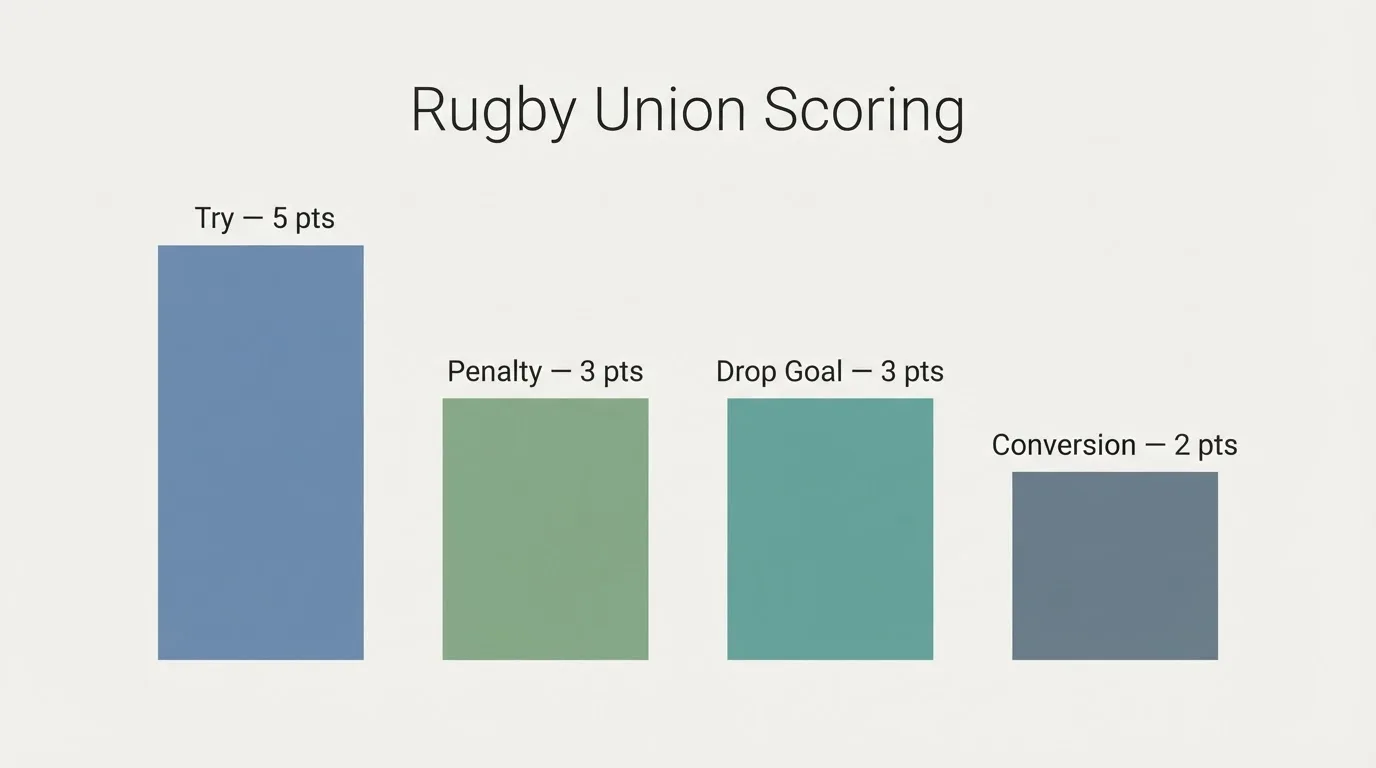
Rugby union is one of the harder sports to bet on in play. The clock runs continuously through two 40-minute halves, the clock does not stop for general play, and the scoreboard does not move on every phase. A try is worth five points and a conversion two; a penalty is three and a drop goal three; the scoreboard can sit still for ten minutes and then jump by seven. A live bettor on a rugby match needs to know what the clock is doing as much as what the scoreboard is doing, because a five-point swing at 60 minutes means something different from a five-point swing at 78 minutes.
How the clock behaves
A rugby union match is two 40-minute halves; stoppages are not counted, so games usually run longer than 80 minutes, often into the mid-eighties, occasionally into the nineties when there are injuries in the final quarter. A live market that prices by minute therefore runs over more minutes than the clock suggests, and a bettor using a stopwatch to time a wager needs to factor in the overrun. Several bookmakers show the official match clock and a countdown to half-time and full-time, and the better live interfaces mark which minute the price is being shown at.
How live odds behave
The price on a rugby live market moves on scoreboard events, on red and yellow cards, and on sin-binnings that take a player off the field for ten minutes. A yellow card in open play shifts the win market by more than the same card in the final ten minutes would, because the time for the disadvantaged team to recover is shorter. A try in the final move of a half compresses the half-time and full-time markets into the same minute, and on a fast in-play interface that compression is visible in real time. The bookmaker’s margin on a rugby live market tends to be wider than on the pre-match equivalent, because the bookmaker’s pricing model is working with less information and is protecting against fast bettors who have the same model. The cost of that wider margin is the headline expense of in-play betting on rugby.
What cash out does on a rugby match
Cash out lets a bettor lock in a position before the event settles, at a price the bookmaker offers at that moment. On a rugby match with a five-point lead inside the final ten minutes, a back bet on the leading side will usually cash out at a profit; the same lead with twenty minutes left may cash out at a loss because the trailing side has more time to score. Cash out on a multi-leg accumulator compresses every leg into the live price the bookmaker offers, and that price carries the bookmaker’s margin on top of the underlying legs. The offer is real and the price is real; the bookmaker keeps its margin in both.
Bet365 carries Bet Builder+ on rugby markets, available pre-match and in-play, and combines markets from one match into a single bet. A bettor who wants a New Zealand win plus over 40.5 points plus a try in the first half can build that as one wager with one price, and the in-play version lets the same bet be assembled during the match. Betfair’s 90 Minute Payout market settles on the full-time result regardless of how the match has progressed, which matters on a sport where a late scoreboard swing can overturn a settled position on a different market. NetBet’s Bet Builder shows instant dynamic odds as selections are added, which gives a clearer view of how each leg contributes to the overall price.
Where live betting on rugby is thinnest
The Six Nations and the Rugby World Cup get full in-play coverage across most GB-licensed bookmakers. The Premiership gets good but not universal coverage; some bookmakers show in-play prices on Premiership matches and others do not. Below the Premiership — the English Championship, the United Rugby Championship, the southern-hemisphere franchises — in-play coverage is patchy, and a bettor wanting live odds on a specific lower-division match may find that only two or three bookmakers in the comparison offer the market at all. That thinness is structural: lower-division matches have less liquidity, less data for the pricing model, and less in-play depth as a result.
Predictions and strategy: where analysis fits without becoming a tipster
A prediction is a forecast. A strategy is a method. The difference is that a strategy can be tested against many matches and is judged on whether it makes money over the long run, while a prediction is a one-off forecast on one match and is judged on whether it is right once. A betting tipster sells predictions; a betting strategist sells a method. This page does the second.
What tipsters publish
Tipsters publish forecasts on upcoming matches, often for a subscription fee, often with a claimed strike rate and a claimed profit over a stated period. A claimed strike rate without a stake plan is a marketing number: a tipster who picks 80% winners at odds of 1.10 makes less than a tipster who picks 40% winners at odds of 4.00, and the stake plan is what turns strike rate into profit. A claimed profit over a stated period without an independent audit is a self-reported number, and self-reported numbers have a long history of overstating the truth. A bettor who buys a tipster subscription is paying for forecasts, and the only test that matters is whether the bettor’s account is up after staking the forecasts on the bookmaker’s price rather than the tipster’s claimed price. The two are not the same. Bookmakers price in a margin; tipsters often quote a price before that margin, and the gap is the difference between a tipster who looks good on a spreadsheet and a tipster who looks good in a betting account.
What a strategy looks like
A strategy on rugby union betting might focus on the handicap market, where a starting position is applied to each side and the bookmaker’s margin can be narrower than on the outright. A strategy might focus on totals, where over and under a points line is priced on the bookmaker’s model of expected scoring, and the bettor’s model of expected scoring has to outperform the bookmaker’s by enough to clear the margin. A strategy might focus on the team-to-score-first market, which is priced on the bookmaker’s model of which side is likelier to score first from the kick-off. None of these strategies guarantees a profit; what they do is frame the question the bettor is asking, so the bettor knows when the strategy is working and when it is not.
The bankroll discipline
Bankroll discipline is the boring half of strategy and the half that determines whether the strategy survives long enough to be tested. A bankroll is the amount a bettor has set aside for betting and is willing to lose; a stake is a fraction of that bankroll, often between 1% and 5%, that the bettor places on any single bet. The fraction keeps a losing streak from ending the betting before the strategy has been given enough matches to be tested. A bettor who stakes 10% of the bankroll on a single bet will lose the bankroll after ten consecutive losses; a bettor who stakes 1% will lose about 10% of the bankroll after ten consecutive losses and will still be betting after fifty. Rugby union seasons are long, and a bad run at the wrong stake size is the most common reason a bettor who is following a working strategy stops following it.
What the page is not
The page does not name a winner of the next Rugby World Cup, does not name a side who will win the Six Nations, does not publish a “sure bet”, and does not run a model that the reader can copy. Nobody can know an outcome in advance; the published probabilities are the bookmaker’s, the historical frequencies are the data the bookmaker uses to set them, and the gap between the two is the bookmaker’s margin. A reader who acts on a named prediction on this page loses real money on the page’s word, and the page does not write that word.
Bet types and odds: how a rugby bet is priced
A rugby match on a GB-licensed sportsbook opens the same way a football match does: with an outright win market, often with the draw, and with a set of derived markets underneath.
The win market and the draw
The win market on a rugby match is sometimes a two-way market — home win or away win, with the draw returned as a stake on most bookmakers — and sometimes a three-way market with home, draw and away. The two-way format is the more common at British bookmakers for the Six Nations and the Premiership; the three-way format is more common on international fixtures. A two-way market on a rugby match has a margin that is comparable to the margin on a tennis match; a three-way market has a wider margin because the draw outcome has to be priced in. The bookmaker’s job is to set the prices so that the margin covers the cost of running the book and returns a profit; the bettor’s job is to find prices that are higher than the true probability warrants.
The handicap market
The handicap market applies a starting position to each side, usually expressed in points: a -7.5 handicap on the favourites means they start the match effectively 7.5 points down, and a +7.5 handicap on the underdogs means they start 7.5 points up. A bet on the favourites wins if they win by eight points or more on the handicap; a bet on the underdogs wins if they lose by seven points or less, or win outright. The handicap compresses the outright market by spreading them away from each other, and the margin on a handicap market is often narrower than on the outright because each side has a clear settled position. A bettor who backs the favourite on a -3.5 handicap and the favourite wins by four is settled as a winner on the handicap but a loser on the outright; the difference is the same contest seen from two angles.
Totals: over and under
Totals on rugby are over and under a stated points line, typically 40.5, 41.5, 42.5 or 43.5 for internationals and lower for some domestic matches. The line is set on the bookmaker’s model of expected total points, and the bettor’s view of expected total points has to clear the margin to make a long-run profit. A match between two attacking sides in dry weather at a fast pitch tends to push the line up; a match in wet conditions between two forward-oriented sides tends to push the line down. The weather and the venue are part of the model on both sides.
Outrights and futures
The outright winner market on a tournament names the side that wins the tournament outright, and is settled at the end of the tournament. The Rugby World Cup, the Six Nations, the Premiership, the United Rugby Championship and the southern-hemisphere franchises all have outright markets, and the prices shift through the season as the standings change. A bet on the outright at the start of the season is staked against the field, not against a single match, and the stake is locked until the tournament settles or the bettor cashes out. Outrights carry a wider margin than match markets because the bookmaker’s model has more uncertainty to cover and is more exposed to information that moves the price between the bet being placed and the tournament starting.
Same-game multiples and accumulators
A same-game multiple, called a bet builder at most British bookmakers, combines markets from one match into a single bet: New Zealand to win and over 40.5 points and a try in the first half, all settled on the same fixture. The odds of the legs multiply into one price, but the multiplied price is the bookmaker’s multiplied price and carries a margin on each leg. A bettor who builds the same bet across three bookmakers may find three different prices for the same combination, because each bookmaker’s pricing model is different and each bookmaker’s margin is different.
An accumulator, called an acca, combines markets across matches into one bet, settled when all legs have settled. A four-fold acca at odds of 2.00, 2.00, 2.00 and 2.00 has combined odds of 16.00, and a £10 stake returns £160 if all four legs win. The margin on an accumulator is wider than on a single match because the margins on each leg multiply into the overall margin, and the bookmaker’s protection against a bettor who has information on one leg is to widen the overall margin.
Odds in fractional and decimal
British bookmakers price in fractional odds by default: 5/1 means a £1 stake returns £6 (£5 profit plus the £1 stake), 11/4 means a £4 stake returns £15 (£11 profit plus the £4 stake), evens (1/1) means a £1 stake returns £2. Decimal odds express the same thing as a single number: 6.00 for 5/1, 3.75 for 11/4, 2.00 for evens. The conversion is straightforward: decimal odds = (numerator ÷ denominator) + 1. A 5/1 in decimals is (5 ÷ 1) + 1 = 6.00; a 11/4 is (11 ÷ 4) + 1 = 3.75. Odds-on means shorter than evens: 4/6 is odds-on at fractional form and 1.67 in decimals. Odds-on prices on rugby are common on heavy favourites, and the margin on a 1.20 favourite is structurally wider than on a 3.00 outsider because the bookmaker has to cover more stake on the favourite.
How the margin appears in the prices
A worked example makes the margin visible. A two-way rugby match priced at 1.90 and 1.90 in decimal odds is a symmetric book: the bookmaker has set the same price on each side. The implied probability of 1.90 is 1 ÷ 1.90 = 0.5263, or 52.63%. Two outcomes at 52.63% each sum to 105.26%, and the 5.26% above 100% is the bookmaker’s margin, sometimes called the overround. The bettor’s payout share is 1 ÷ 1.0526 = 95.0%, which is the same margin expressed from the other side. On a 100% market with no margin, both sides would be priced at 2.00 and both sides would imply 50%. A bettor who backs a 1.90 side is paying 5.26% of stake as the cost of the bookmaker’s service, before any edge from the bettor’s own information.
The cost compounds. A two-way match at 1.90 and 1.90 carries a margin of 5.26%; a same match priced at 1.85 and 1.85 carries a margin of (2 × (1 ÷ 1.85)) – 1 = 8.11%; the same match at 1.95 and 1.95 carries a margin of (2 × (1 ÷ 1.95)) – 1 = 2.56%. A bookmaker offering 1.95 and 1.95 is charging the bettor half what a bookmaker offering 1.85 and 1.85 charges. The price difference looks small in numbers and is large in long-run cost. The band in this example — between roughly 2.5% and 8% on a symmetric two-way market — is typical of where rugby match odds sit at GB-licensed bookmakers, with the wider end on three-way markets and the narrower end on outrights of major tournaments where liquidity is high.
The same calculation on a four-fold accumulator with each leg at 2.00 (a 50% chance on each leg if the bookmaker’s price were fair) compounds the margin on each leg into the overall price, and a four-fold at 16.00 is the same shape as a single leg with a wider margin. That is why accumulators look generous on the screen and expensive on the long run: the cost of the margin scales with the number of legs.
Sports and tournaments: the rugby betting calendar
The rugby union calendar in 2026 runs through most of the year, with a quieter window in late summer and a denser cluster of fixtures in the autumn, the Six Nations window and the southern-hemisphere internationals.
The Six Nations
The Six Nations runs from late January or early February to mid-March each year, with five rounds of international fixtures between England, France, Ireland, Italy, Scotland and Wales. It is the most heavily bet international rugby tournament of the calendar at British bookmakers, with full coverage across all ten operators compared on this page, deep in-play markets, and outright winner markets that open months before the first fixture. The 2026 tournament sits at the centre of the rugby betting calendar in the year this page covers, and the 2027 tournament will open before the end of the year this page is published.
Autumn internationals
The autumn internationals run from late October through the end of November, with the northern-hemisphere sides hosting southern-hemisphere visitors in test matches. England at Twickenham, Ireland at the Aviva Stadium, France at the Stade de France, Wales at the Principality Stadium and Scotland at Murrayfield all play four or five fixtures each autumn, and the markets around them are deep at the major bookmakers. The 2027 Rugby World Cup is hosted by Australia from 1 October to 13 November 2027, and the autumn internationals in the year before a World Cup tend to carry more weight as form indicators for the following summer’s tournament.
The Rugby World Cup
The Rugby World Cup was first held in 1987 in Australia and New Zealand, and New Zealand won the inaugural title. The tournament runs every four years and is the biggest single event on the rugby betting calendar; the 2023 final was won by South Africa against New Zealand. The 2027 tournament is hosted by Australia from 1 October to 13 November 2027, with 24 teams in six pools of four and 52 matches in total, and the outright market opens more than a year in advance. A bet on the 2027 outright winner is a long-dated position that runs through the 2026 internationals and the 2026/27 club season before settling.
The Premiership
The English Premiership is the top tier of English club rugby, with ten sides playing across the regular season and the playoffs. The Premiership is the most heavily bet domestic rugby competition at British bookmakers, with outright winner markets, top-four finish markets, and match odds across the regular season and the playoffs. Coverage at the comparison bookmakers is good but not universal; some bookmakers show every Premiership fixture with in-play odds and others show only the televised fixtures. The 2025/26 season runs from the autumn of 2025 through the summer of 2026, and the 2026/27 season opens in the autumn of 2026.
The United Rugby Championship and Super Rugby
The United Rugby Championship is the top-tier cross-border competition for club sides from Ireland, Italy, Scotland, South Africa and Wales, and runs alongside the Premiership in the club calendar. Super Rugby is the southern-hemisphere equivalent, with sides from Australia, Japan, New Zealand and the Pacific Islands. Both competitions have outright winner markets at the major bookmakers, and match odds on the televised fixtures; the depth of in-play coverage is thinner than on the Premiership. A bettor who follows the URC or Super Rugby closely may find the live markets are priced at fewer bookmakers than the same bettor sees on the Premiership.
The Championship and below
The English Championship, the second tier of English rugby, gets match odds at most of the comparison bookmakers but rarely gets in-play coverage outside the televised fixtures. Below the Championship, the coverage thins further and a bettor looking for odds on a specific lower-division match may find only one or two bookmakers in the comparison offer the market. The French Top 14, by contrast, is heavily bet at French-facing bookmakers and gets patchier coverage at the British-facing comparison set. The shape of the coverage follows the broadcast schedule and the bookmaker’s view of the betting public, not the importance of the competition on the field.
Top 10 bookmakers for online rugby union betting in Great Britain
The ten bookmakers compared below all hold a remote general betting standard (real events) licence on the Gambling Commission’s public register. Each is a brand whose domain appears against a Commission account, and each is presented here as a candidate for a rugby union bettor rather than as a recommendation. The order runs from the deepest rugby coverage at the top of the comparison to the thinnest at the bottom, with the licence, the welcome structure, the rugby-specific features and the verdict at the foot of each block. Where research does not carry a specific figure for a brand on a specific point, the page does not print a figure for that point.
Fitzdares
Fitzdares is a long-standing British betting name, and the app carries cash out, accumulators, Lucky 15s, specials and ante-post markets across horse racing, football, tennis, rugby, cricket, golf and American football, with in-play live odds. The rugby coverage at Fitzdares sits on the televised internationals and the Premiership with full match odds and outrights. The licence is held by Fitzdares Limited under Gambling Commission remote licence 000400-R-103839-030 against Commission account 400. The verdict: an ideal destination for an experienced bettor who values a British heritage brand and wants an account that covers rugby as part of a wider sports portfolio.
Bet Ahoy
Bet Ahoy is a newer British-facing brand, and its welcome structure on the app is a £5 sports bet and a £5 acca for a £10 qualifying bet. The licence is held by Bet Ahoy Ltd under Gambling Commission remote licence 100094-R-341742-003 against Commission account 100094. The rugby coverage at Bet Ahoy is built around the major internationals and the Premiership, with match odds and outright markets on the Six Nations, the autumn internationals and the Rugby World Cup. The verdict: a modern alternative for anyone looking to try a fresh interface, especially if they are interested in testing a new British-facing operator.
Betway
Betway is one of the larger international sportsbook brands and has a UK-licensed site under Betway Limited, with the licence held under Gambling Commission remote licence 039372-R-319367-029 against Commission account 39372. The sports welcome structure is a Free Bet Club that gives up to £10 in free bets every week after opt-in, with £25 or more of sports spend earning 2 × £5 free bets each week. The rugby coverage at Betway includes the Six Nations, major internationals, the Premiership and the World Cup, with in-play markets on televised matches. The verdict: weekly free bets for a bettor who values regular rewards over a single sign-up offer, backed by a comprehensive rugby calendar.
Fafabet
Fafabet is a British-facing sportsbook with a Best Odds Guaranteed offer on UK and Irish horse racing win and each-way bets from 9am on race days, paying the bigger of the original price or the SP when the SP is higher. The licence is held by Taichi Tech Limited under Gambling Commission remote licence 057385-R-333191-006 against Commission account 57385. The rugby coverage at Fafabet features international matches and club competitions like the Premiership and World Cup, with match odds on televised fixtures. The verdict: this operator is a strong option for a bettor who appreciates BOG on racing alongside a solid selection of rugby union markets in the same account.
Betfair Sportsbook
Betfair Sportsbook is the fixed-odds sportsbook of the Betfair group, distinct from the Betfair exchange, and runs in-play betting, Bet Builder, free live streaming of UK and Irish horse racing and football within the app, and a 90 Minute Payout market. The licence is held by PPB Counterparty Services Limited under Gambling Commission remote licence 039439-R-319330-013 against Commission account 39439, and Betfair Sportsbook runs alongside the Betfair exchange under the same parent. The rugby coverage at Betfair Sportsbook is full on the major internationals and the Premiership, with in-play markets on the televised fixtures. The verdict: a combined fixed-odds and exchange account that offers versatility, with the 90 Minute Payout market a distinct safety net for bettors who worry about late scoreboard shifts.
NetBet
NetBet Sport is a British-facing sportsbook with Daily Boosts, Profit Boosts and free bet offers, a Bet Builder with instant dynamic odds, and sports stats for major leagues. The licence is held by Netbet Enterprises Limited under Gambling Commission remote licence 039170-R-319343-032 against Commission account 039170. The rugby coverage at NetBet features major internationals and top club tournaments, with a Bet Builder that lets a bettor assemble a same-game multi on a single match. The verdict: an efficient platform for building same-game rugby multis, with dynamic odds updates that show how each leg moves the price.
Kwiff
Kwiff is a British-facing sportsbook and casino operating as a trademark of Spryme Ltd, with a 17+ age rating on the App Store. The licence is held by Eaton Gate Gaming Limited under Gambling Commission remote licence 044448-R-323408-017 against Commission account 44448. The rugby coverage at Kwiff is built around the major internationals and the Premiership, with match odds and outright markets on the Six Nations, the autumn internationals and the World Cup. The verdict: a straightforward mobile experience for a bettor who wants both sports and casino play in one UK-licensed interface.
Star Sports
Star Sports is a long-standing British betting name with a phone-led customer service: customers can speak to a trader directly on 08000 521 321 to open an account, place bets or ask customer queries, with email support at [email protected]. The licence is held by Star Racing Limited under Gambling Commission remote licence 009177-R-104555-019 against Commission account 9177. The rugby coverage at Star Sports is built around the major internationals, the Premiership and the ante-post markets on the World Cup, with the phone-led service a differentiator for a bettor who prefers to place larger bets through a trader. The verdict: a bookmaker for a bettor who bets by phone with a trader and wants a British heritage brand with ante-post markets on the major rugby tournaments.
Dabble
Dabble is a British-facing sportsbook with a welcome structure that gives £10 in free bets on a first deposit for new customers, with a minimum price on the qualifying bet, a 7-day free bet expiry and the stake not returned. The licence is held by Dabble Sports UK Ltd under Gambling Commission remote licence 065677-R-340363-005 against Commission account 65677. The rugby coverage at Dabble is built around the Six Nations, the autumn internationals, the Premiership and the World Cup, with match odds and outright markets on the major fixtures. The verdict: a simple approach for those who want a straightforward sign-up bonus without complex wagering conditions, provided the seven-day expiry is noted.
Bet365
Bet365 is the official global betting partner of the UEFA Champions League and the most downloaded sports betting app in the UK by the App Store ranking at the time research was carried out. The licence is held under a UK Gambling Commission remote licence, and bet365 offers Bet Builder+ combining markets from one event into a single bet pre-match and in-play, Super Boosts, Winnings Boosts on Bet Builders and selected singles, and daily Bet Boosts. The rugby coverage at bet365 is the deepest in the comparison: full match odds and outrights on the Six Nations, the autumn internationals, the Premiership, the URC, Super Rugby and the World Cup, with in-play markets on the televised fixtures and Bet Builder+ on the major matches. The verdict: the strongest single account for a rugby bettor who wants depth across the calendar, with the Bet Builder+ feature setting the standard for same-game multis on rugby and the Super Boosts offering the kind of one-shot price enhancements the rest of the comparison does not match at the same scale.
Where the comparison leaves the rugby bettor
The comparison runs from Bet365 at the top of the depth chart to Midnite at the bottom, with the gap measured by what each bookmaker shows in its rugby coupon. A bettor who follows the Premiership closely and wants in-play on every televised match has fewer candidates than a bettor who follows the Six Nations and wants outright markets on the tournament weeks before the first fixture. A bettor who follows the URC or Super Rugby has fewer candidates again. The licence is the entry ticket, not the depth chart, and the comparison is a read of the depth rather than the licence.
| Bookmaker | Gambling Commission remote licence | Licence holder | What the operator’s own terms state on rugby union betting |
|---|---|---|---|
| Fitzdares | 000400-R-103839-030 (account 400) | Fitzdares Limited | Cash out, accumulators, Lucky 15s, specials, ante-post and in-play live odds across horse racing, football, tennis, rugby, cricket, golf and American football |
| Bet Ahoy | 100094-R-341742-003 (account 100094) | Bet Ahoy Ltd | Welcome structure of a £5 sports bet and a £5 acca for a £10 qualifying bet |
| Betway | 039372-R-319367-029 (account 39372) | Betway Limited | Free Bet Club with up to £10 in free bets every week after opt-in |
| Fafabet | 057385-R-333191-006 (account 57385) | Taichi Tech Limited | Best Odds Guaranteed on UK and Irish horse racing win and each-way bets from 9am on race days |
| Betfair | 039439-R-319330-013 (account 39439) | PPB Counterparty Services Limited | In-play betting, Bet Builder, free live streaming on UK and Irish horse racing and football, and a 90 Minute Payout market |
| NetBet | 039170-R-319343-032 (account 39170) | Netbet Enterprises Limited | Daily Boosts, Profit Boosts and free bet offers, Bet Builder with instant dynamic odds, and sports stats for major leagues |
| Kwiff | 044448-R-323408-017 (account 44448) | Eaton Gate Gaming Limited | UK Gambling Commission licence; trademark operated by Spryme Ltd; 17+ App Store age rating |
| Star Sports | 009177-R-104555-019 (account 9177) | Star Racing Limited | Trader-led phone service on 08000 521 321 to open an account, place bets or ask customer queries, with email support at [email protected] |
| Dabble | 065677-R-340363-005 (account 65677) | Dabble Sports UK Ltd | £10 in free bets on a first deposit for new customers, with a minimum price, a 7-day expiry and the stake not returned |
| Bet365 | held under a UK Gambling Commission remote licence (account not separately confirmed) | Bet365 Group Limited | Bet Builder+ combining markets from one event pre-match and in-play, Super Boosts, Winnings Boosts on Bet Builders and selected singles, and daily Bet Boosts |
Overview: what a rugby bettor sits inside at a single licensed account
A rugby bettor who opens one of the comparison accounts sits inside a set of British protections: a Commission licence, GAMSTOP self-exclusion, a £150 financial vulnerability check, the 10x bonus wagering cap, the credit-card ban, and the dispute-resolution and complaints routes the Commission oversees. The same bettor sits outside the protections the licence does not cover: the bookmaker’s pricing model, the bookmaker’s margin on every market, and the bookmaker’s right to refuse a bet at a stake it will not price. The protection and the constraint come from the same place, and a rugby bettor who reads the comparison above as a list of brands to claim welcome offers from is reading the wrong page; the comparison is a list of brands to deposit with, place bets with, and read the terms of, not to extract value from through the welcome alone.
What a bettor gets from a single licensed account that no offshore booking offers is the British backstop. What a bettor pays for the British backstop is the bookmaker’s margin on every market, set inside every price. The page is built around that trade: the licence is the protection, the margin is the cost, and the comparison is the depth chart that lets a bettor pick which licensed bookmaker offers the deepest rugby coupon at the price the bettor is willing to pay. A bettor who reads it that way has read it right.
Frequently asked questions about online rugby union betting in Great Britain
How does rugby union betting work in Great Britain?
Rugby union betting in Great Britain is licensed under the Gambling Act 2005 and regulated by the Gambling Commission, with a remote general betting standard (real events) licence required of any operator serving British customers online. A bettor places a stake on a market, the bookmaker prices the market with a margin built into the odds, and the bet settles on the result of the match or tournament. Winnings are paid back to the bettor’s account, and the bettor pays no tax on the winnings.
How does a bettor place a bet on rugby union?
A bettor opens an account at a GB-licensed bookmaker, verifies identity before the first deposit, chooses a rugby match or tournament, selects a market (win, handicap, totals, outright), enters a stake and confirms the bet. The bet settles when the match or tournament result is known, and the winnings are added to the account balance at the price taken at the time the bet was placed.
How does a bettor check that a bookmaker holds a Gambling Commission licence?
A bettor opens the Gambling Commission’s public register, searches by business name, trading name, domain or account number, and confirms the licence category and the licence holder. The register is the whole test of who holds a licence, and a brand whose name does not appear on the register is not licensed for British customers.
How is the return on a bet worked out from the stake and the odds?
The return is stake times the decimal odds: a £10 stake at 3.00 returns £30, the net profit is stake times (odds minus one), so the £10 at 3.00 returns a net profit of £20. On a combination bet the odds of the legs multiply into one price, so a four-fold at 2.00, 2.00, 2.00 and 2.00 has combined odds of 16.00, and a £10 stake returns £160.
What is the bookmaker’s margin and how can it be seen in the odds?
The margin is the slice of every unit staked that the bookmaker keeps on a market, and it shows in the prices as the gap between the implied probabilities of all outcomes and 100%. A two-way market priced at 1.90 and 1.90 has implied probabilities of 52.63% on each side, summing to 105.26%, and the 5.26% above 100% is the margin. A bettor who backs a 1.90 side is paying 5.26% of stake as the cost of the bookmaker’s service.
How do fractional odds such as 5/1 convert to decimal odds such as 6.00?
The conversion is decimal odds = (numerator ÷ denominator) + 1. A 5/1 in fractional form is (5 ÷ 1) + 1 = 6.00 in decimal, a 11/4 is (11 ÷ 4) + 1 = 3.75, and evens (1/1) is (1 ÷ 1) + 1 = 2.00. The decimal form is the total return per unit stake; the fractional form is the profit per unit stake.
Rugby, cricket & Gaelic – Accumulator
Content created by the «Accumulator» team
