
Curling Betting Tips 2026 — How to Read Curling Odds and Pick a Bookmaker
 Available in US
Curling sits in an odd corner of the British sportsbook. It is a fixture on the Winter Olympics and on the World Curling Tour, bookmakers do put up prices on the top events, and there is a real game to study before the first stone is thrown. There is also a reason the search results for “curling betting tips” return more guide pages than actual tips: there is no tip that beats a market’s margin in the long run, and no one can tell who will land the hammer in the tenth end. What a British bettor can do is read the prices, pick a bookmaker that holds a Gambling Commission licence, and decide what each offer is actually worth before a stone leaves the hand.

That last part is what this page is about. It works through how curling works on the sheet, how its markets are priced, what the bookmaker’s margin takes off the top of every bet, and where the welcome offers sit once their conditions are spelled out. The page ends with the ten brands the Gambling Commission register lists as holding a remote betting licence for Great Britain, judged by what each one actually offers a curling bettor rather than by what the marketing claims.
Current as of 26 October 2026, checked against the Gambling Commission’s public register.
How Curling Bets Are Priced: The Short Form
Every price a bookmaker offers on a curling match carries a margin — the cut the book keeps on every pound bet, before any one punter wins or loses. The easy way to see the margin on a two-way market is to add the implied probabilities from the two prices and subtract one. Take an illustrative two-way market at decimal odds of 1.90 on each side: the implied probability on each side is 1 ÷ 1.90, which is 0.5263, or 52.63 per cent. Two sides at 52.63 per cent add to 105.26 per cent. The extra 5.26 per cent is the bookmaker’s margin.
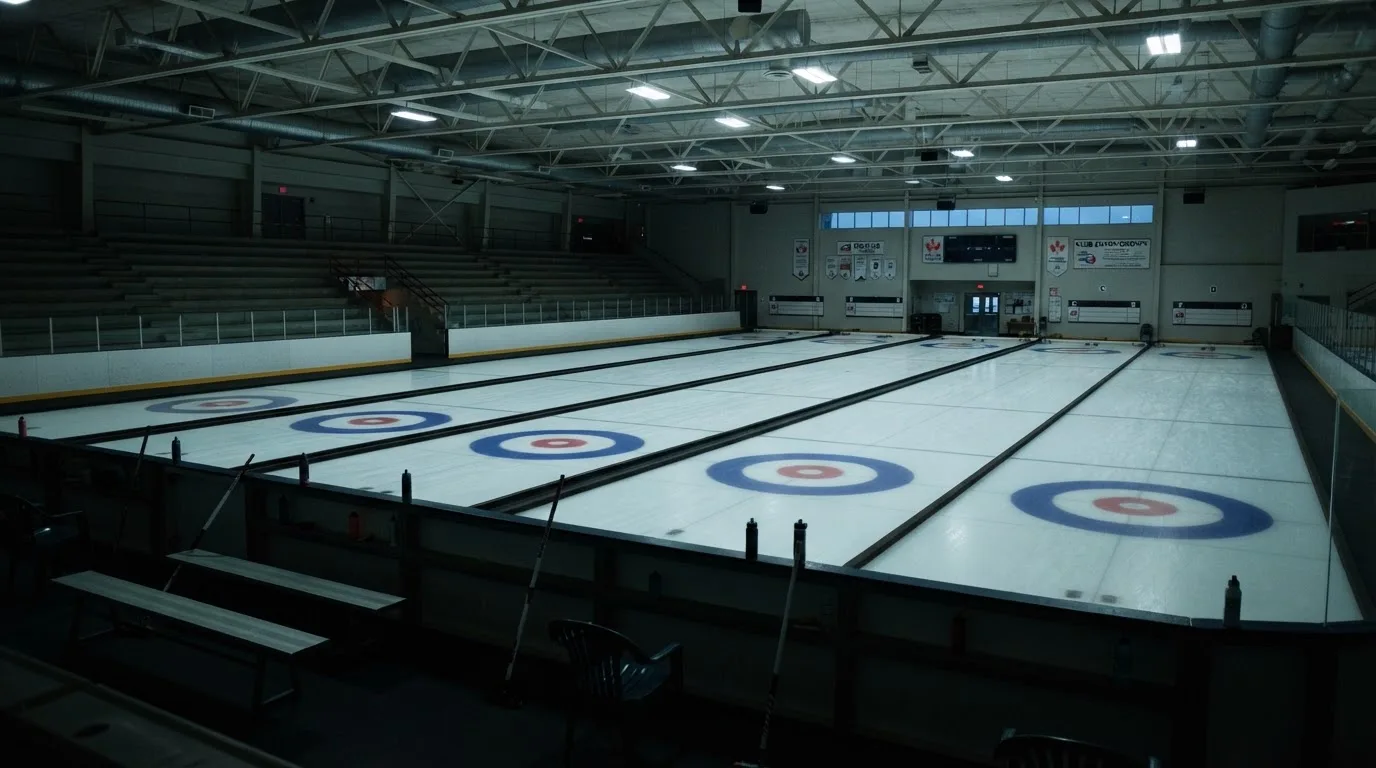
That 5 per cent band is what to expect on a well-priced curling market. Decimals around 1.90/1.90 give a margin in the 5 to 6 per cent range; shorter prices push it lower and longer prices push it higher. The margin is a property of the whole market, not of one price — a price of 1.90 on one side tells a bettor nothing until the other side is read alongside it. This is the figure that quietly eats any edge a tip might offer.
A 5 per cent margin means the book keeps 5p out of every £1 wagered across the market, on average across a long series of bets. A punter needs to beat that 5 per cent to come out ahead, which is a much harder task than picking the right team in any one game.
What Curling Actually Is on the Ice
A curling team has four players, two in doubles, and each player throws two of the team’s eight stones. Stones weigh between 17.24 and 19.96 kilograms under World Curling Federation rules, and a game lasts eight or ten ends, with international competitive games generally going to ten. An end ends once all sixteen stones have been thrown; the team with the stone closest to the button — the painted rings at the house — takes one point for each of its own stones sitting closer to the button than the opponent’s nearest stone, and only stones inside the house count.
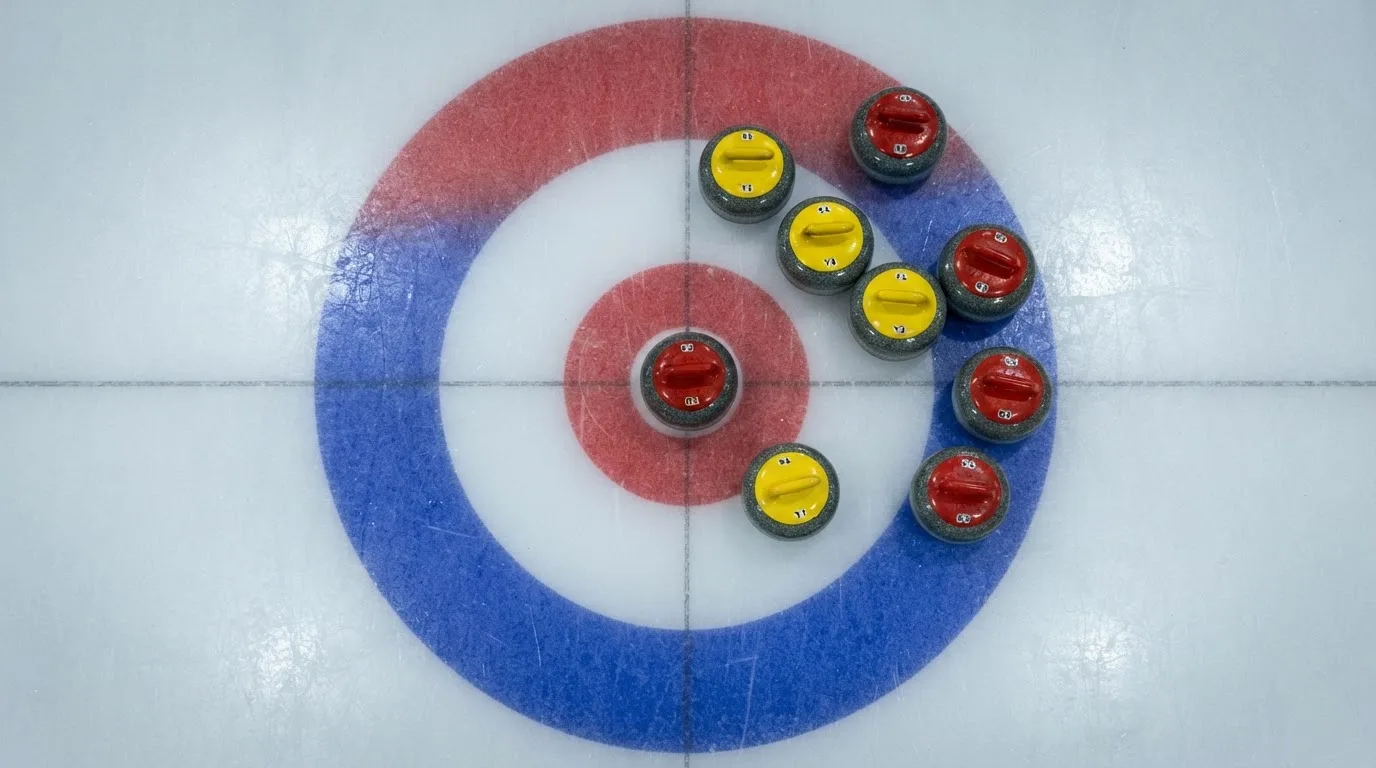
Two rules drive most of the betting decisions. The hammer, the last stone of an end, goes to the team that did not score in the previous end, and if an end is blanked — cleared with no score — the hammer stays where it was. A team with the hammer in a tied game goes to an extra end. The hammer is the single biggest tactical lever on the sheet, and the bookmakers price it. A team that scores three with the hammer loses the hammer for the next end; a team that blanks keeps it. That one rule decides almost every tactical decision in the last four ends of a close game, and it is the rule most casual curling bettors misread.
Curling became an official Olympic medal sport at the 1998 Winter Olympics, with mixed doubles added in 2018. The sport’s competitive calendar runs from autumn through spring, with World Curling Championships and the Olympic cycle at the centre of it; off-season, the men’s and women’s tours in North America and Europe carry most of the betting liquidity.
Curling Betting Markets: What the Bookmakers Actually Price
The thinner a sport’s betting liquidity, the fewer markets a bookmaker offers, and curling sits at the thin end. Most licensed British bookmakers price only the head-to-head winner on the main international events, with totals (over/under on total ends or total points) and a handful of handicap lines on the bigger tournaments. Some put up after-end prices during the game, and a few carry outright winner markets on the World Championships and the Olympics.
Two practical consequences follow from that thinness. First, the prices move less between bookmakers than they do on Premier League football, because fewer bookmakers are pricing the same event at the same time. A bettor comparing prices across the ten licensed brands will see most of them clustered within a tick or two on the head-to-head, with the bigger bookmakers — William Hill, Betfred, bet365 — typically on the sharper side and the smaller ones further out. Second, in-play markets are scarce. The fast-moving, bet-builder-heavy menus that football bettors are used to do not exist on curling; the live markets that do appear tend to be match-winner and next-end only, and they vanish between ends when no betting is possible.
The Margin, the Value Bet, and Why No Tip Is Certain
A value bet, in the textbook sense, is a price larger than the true probability of the outcome — a price that, once the margin is taken out, pays the reader more than the event is worth. Finding one means estimating the true probability of the outcome better than the market has. On a curling match that is a tall order for a casual bettor: the public form, the head-to-head record and the rinks available are all on the bookmaker’s screen too, often with sharper models behind them.
The honesty test for a tip is the one that survives the margin. A price of 2.10 on a team the bettor thinks is a 50 per cent chance to win — a fair price would be 2.00, not 2.10 — looks like value until the 5 per cent margin on the market is accounted for, at which point the “fair” price becomes roughly 1.90 and the 2.10 is much less generous than it looked. A tip that does not survive a 5 per cent haircut is not a value bet at all; it is just a price the marketing has highlighted.
This is why no tip is ever certain. Even a tip that beats the margin over a long series of bets leaves most bettors losing most of the time, because the variance of curling results is wide — a steal of three in the eighth end flips the win probability on its head, and a single missed double-takeout in the tenth can hand the game to the other side. Bankroll discipline — staking a fixed percentage of a fixed bank, never chasing losses, walking away after a bad session — does more for the long-run result than any pick.
How a Return Is Worked Out from a Stake and the Odds
Decimal odds multiply the stake by the price to give the total return. A £10 single at decimal odds of 2.50 returns £25, of which £15 is profit. A £5 each-way bet on a curling head-to-head is two bets of £5 — £10 total stake — and pays out on the win and on the place. An accumulator multiplies the prices of the legs together, so a four-leg curling accumulator at 2.00, 2.50, 1.80 and 3.00 returns the stake multiplied by 25.20.
The maths behind a combination bet matters because the margin compounds across the legs. A four-leg accumulator at a 5 per cent margin per leg carries a margin well above 5 per cent on the combined price — the legs all have to win, and the bookmaker has priced each one with the margin built in. The advertised “odds boosted” accumulators in the marketing copy are usually boosting a price the bookmaker has already loaded.
For a free bet whose stake is not paid back with a win, the value to the reader is the free-bet amount multiplied by (odds minus 1) divided by the odds, then scaled by the payout share of the market the free bet is used on. A £10 free bet at 3.00 on a 95 per cent payout-share market is worth roughly £6.33 in expected value — not £20, not £30, and not a winning pick.
Reading the Welcome Offers in Plain English
Every welcome offer on the ten licensed brands below carries a wagering requirement, a minimum price for the qualifying bet, a deadline and a cap on what the offer can return. None of them turn £10 into £30 in the reader’s pocket on the way out. The honest reading of each offer is the one that strips the marketing word off and looks at the conditions: the qualifying bet, the minimum odds (often EVS, meaning decimal 2.00 or higher), the days the offer is valid for, and the cap on free-bet winnings.
A 100 per cent bonus sounds like double the deposit. The wagering requirement is what gets it back out. Under the promotion rules in force since 19 January 2026, wagering requirements on bonuses are capped at 10x — a £10 bonus at 50x needed £500 of bets before withdrawal; under the cap, no more than £100. The cap applies to cash bonuses with a wagering condition; free bets with no wagering requirement sit outside it, though most free bets do still carry minimum-price and validity conditions.
“Risk-free” is the marketing word that most needs reading carefully. A risk-free bet, on most British bookmakers, refunds a losing stake as a free bet, not as cash — the bettor gets another go, not the money back. A free-bet stake is also not usually paid back with a winning free bet, which is why the formula above is the honest one.
Responsible Gambling: The Safety Net the Licence Pays For
A Gambling Commission licence is not just a tax-and-admin arrangement; it is the reason a British bettor has somewhere to complain if a bookmaker withholds funds, and it is the reason GAMSTOP exists as a multi-operator self-exclusion scheme. The Commission requires licensed online operators to take part in GAMSTOP, with exclusion periods of six months, one year, five years, or five years with auto-renewal; after the minimum period, the exclusion stays in place for a further seven years unless the customer asks GAMSTOP to remove it.
A financial vulnerability check, in force since 30 August 2024, applies to licensed remote betting when a customer’s deposits minus withdrawals exceed £150 in a rolling 30 days (since 28 February 2025). It is a public-record check — for example, bankruptcy or county court judgments — not an income check, and not a credit reference check. A wider set of financial risk assessments, the so-called affordability checks, has been announced in a staged plan by the Commission; the start date has not been set, and the state of that rule is “announced, staged, no start date”.
Deposit limits at licensed operators are operator-set, not state-set. There is no statutory cap on stakes in sports betting: operators set their own maximum stakes and may restrict individual customers. The first changes to the deposit-limit rules took effect on 31 October 2025, with a second phase postponed to 30 September 2026; whether that second phase is live is not established. Help is available through GamCare, the National Gambling Helpline, GambleAware, the NHS gambling clinics and Gamblers Anonymous. A bettor who feels the bet is no longer a choice should reach for one of those, not for another account.
The Rules around Betting in Great Britain
Betting in Great Britain is licensed under the Gambling Act 2005, which covers England, Scotland and Wales; Northern Ireland sits outside the Act and has its own older law, so the honest phrasing is “Great Britain licence” or “GB-licensed”, never that a GB licence regulates Northern Ireland. Since the Gambling (Licensing and Advertising) Act 2014, an operator whose remote facilities are used in Great Britain needs a Commission licence wherever it is based — sections 33 and 36 of the 2005 Act as amended — and a Curaçao, Maltese or Gibraltar licence is not a substitute.
Licence categories matter for what a brand can offer. Remote general betting standard (real events) is the standard sportsbook licence. Remote general betting standard (virtual events) covers computer-generated events. Remote betting intermediary is the licence for betting exchanges — Matchbook runs under one. Remote pool betting covers pools on horse and dog racing. Financial spread betting is regulated by the Financial Conduct Authority, not the Commission.
Credit cards have been banned for gambling in Great Britain since 14 April 2020, including credit-card-funded payments through an e-wallet; debit cards and bank-based payments are not covered. Identity verification before the first deposit means no anonymous play at a licensed site, and source-of-funds questions at higher spend are normal under the money-laundering rules.
The player pays no tax on betting winnings in Great Britain — that is general information, not tax advice, and a professional gambler should ask HMRC or an adviser. General Betting Duty is the operator’s tax on gross profits, currently 15 per cent; from 1 April 2027 a new remote betting rate of 25 per cent applies within it, while remote bets on UK horse racing, bets on self-service betting terminals, pool betting and in-person betting stay at 15 per cent. Whether operators pass duty on through odds is not established; the honest framing is that the duty is on the operator, not on the punter.
A bookmaker serving customers in Great Britain without the licence the Act requires is breaking the law under section 33 of the Gambling Act 2005 — that is aimed at the operator, not at the customer who merely bets. The honest framing for an unlicensed brand is that the punter loses the British protections: no GAMSTOP coverage, no Commission complaints route, no approved dispute-resolution body, no British consumer redress if funds are withheld, and the offer is not bound by the 10x bonus cap or the £150 vulnerability check. Enforcement against unlicensed operators is disruption, not blocking — cease-and-desist notices, search-engine referrals, work with registrars and hosts — and the Commission has been given, or is about to receive, court-order DNS blocking powers; ISP blocking is not in operation as a standing rule.
The Curling Calendar: Where the Liquidity Sits
The betting calendar for curling follows the sport’s own. The World Curling Championships run annually, men’s and women’s, in the spring. The World Men’s and World Women’s Curling Championships are the headline events of the season; the European Curling Championships run earlier in the winter and act as the warm-up. The World Junior Curling Championships run in the same window. The Olympic cycle breaks the rhythm every four years, with the Winter Olympics adding a multi-week peak of betting liquidity; mixed doubles was first held at the Olympics in 2018 and has carried its own book since.
Outside the international calendar, the men’s and women’s tours in North America and Europe run from autumn to spring, with the Grand Slam of Curling as the headline tour event; the Champions Cup and the Players’ Championship sit at the top of the money list. Liquidity on those events is thin compared with the football and horse racing calendars the British bookmaker is built for, which is why most of the in-play and bet-builder menus disappear between events.
For a British bettor, the practical shape of the season is that the World Championships and the Olympics carry the deepest menus and the sharpest prices, with the European Championships and the Grand Slam events close behind; everything else is patchy, and a bettor comparing prices across bookmakers should expect most of them to be missing on the smaller events.
Picking a Bookmaker: What the Licensed Brands Offer
The ten brands below all hold a remote betting licence with the Gambling Commission for Great Britain, checked against the public register. None of them is the only licensed brand — the register lists hundreds more — and a place in this list is not a recommendation. The order is editorial, chosen to walk through a range of profiles from the high-street names to the betting exchange, the sports-focused independents and the more recent entrants.
For each brand, the licence is the headline; the welcome offer is described in plain English with its conditions attached; the curling relevance is judged by what the brand actually offers a curling bettor. The verdict at the end of each entry is the page’s own judgement of the brand for this subject, not a slogan lifted from the marketing.
Brand landscape
| Brand | Gambling Commission remote licence number and licence holder | What the operator’s own terms state on curling |
|---|---|---|
| Kalooki Sportsbook | 057730-R-333396-005; Kalooki Sportsbook Limited | Newer sportsbook offering a small core menu of mainstream sports — curling sits inside the broader catalogue without a dedicated page |
| Octobet | 062545-R-337248-006; Octopus Game Limited | Generalist sportsbook with a welcome offer of 50% back as a free bet up to £50, plus a £10 casino bonus for new customers |
| William Hill | 039225-R-319373-015; WHG (International) Limited | Best Odds Guaranteed runs on UK and Irish horse racing from 8 AM on the day of the race, on both single and multiple bets; it does not apply to ante-post, tote or pari-mutuel bets |
| Bet Ahoy | 100094-R-341742-003; Bet Ahoy Ltd | Welcome offer “Bet £10 & Get £10 in Free Bets”, made up of a £5 sports bet and a £5 acca |
| Betfred | 039544-R-319290-010; Petfre (Gibraltar) Limited | Sports, casino and games app covering 21 sports plus over 2,000 casino-style games |
| Matchbook | 039504-R-319407-024; Triplebet Limited | Betting exchange — customers bet against other users, with Bet Builder, multiples, in-play betting and live streaming of horse racing and greyhounds |
| Star Sports | 009177-R-104555-019; Star Racing Limited | Phone-led bookmaker: customers can call 08000 521 321 to open an account, place bets or ask customer queries; support also at [email protected] |
| BetUK | 039198-R-319450-029; LeoVegas Gaming PLC | New-customer offer: deposit £10 or more and place a sports bet within 7 days; receive four £10 free bets (two football accumulators of 4+ selections and two multiples of 2+), valid for 7 days, opt-in required |
| Tote | 054779-R-331321-008; TDCO Limited | Pool-betting specialist, with Best Odds Guaranteed on UK and Irish racing from 8 AM on race day |
| Midnite | 101839-R-342850-001; Midnite Limited | New-customer offer: bet £5 or more on pre-match odds of EVS (2.0) or greater within 14 days of sign-up; receive £25 in free bets and 50 free spins, valid for 7 days; in-play events, an acca builder, popular accas and price boosts with maximum-stake limits |
Kalooki Sportsbook
Kalooki Sportsbook is operated by Kalooki Sports Book Ltd, company number 12938274, licensed by the Gambling Commission under account number 57730, and is a GAMSTOP member. The brand sits in the newer wave of British-licensed sportsbooks, and the visible catalogue on the public-facing site covers the mainstream sports a casual punter would expect; curling is part of that catalogue without a dedicated page or section, and the in-play menu at thinner sports is small.
For a curling bettor, Kalooki is the kind of brand to check the betting programme of before placing a bet rather than the kind to build a season around. The licence is genuine; the catalogue is generalist.
Octobet
Octobet runs under Gambling Commission account 62545, with the licence held by Octopus Game Limited. The brand’s sportsbook welcome offer is 50 per cent back as a free bet up to £50, plus a £10 casino bonus for new customers — a smaller headline than the 100 per cent bonuses that dominated the pre-2026 market, with the back-end conditions (minimum qualifying price, free-bet validity, cap on free-bet winnings) sitting in the operator’s own terms.
The mixed-product structure of the offer — sports free bet plus casino bonus — is the shape that the 19 January 2026 promotion rules specifically addressed. Under those rules, mixed-product offers that require gambling on two or more product types are banned. The offer here is a paired welcome package, not a conditional “bet on football to get free spins” structure; the difference matters, because the rule targets the conditional cross-product promotion rather than the side-by-side new-customer package.
For curling, Octobet is a generalist sportsbook with a smaller welcome headline than the market average and the usual mixed-product pattern. The brand is worth a look for a punter comparing welcome offers on price, not for a curling specialist.
William Hill
William Hill is one of the high-street names of British betting and runs on Gambling Commission account 39225, with the licence held by WHG (International) Limited. The brand’s headline product feature on the racing side is Best Odds Guaranteed, which pays the bigger of the price taken and the starting price on UK and Irish horse racing from 8 AM on the day of the race, on both single and multiple bets; the rule does not apply to ante-post, tote or pari-mutuel bets. For a curling bettor the BOG rule is irrelevant, but it tells a reader what kind of bookmaker William Hill is — one that pays on the larger of two prices as a matter of policy, on the sports where it applies.
For curling specifically, William Hill is one of the bigger British bookmakers with the broadest sportsbook catalogue, which is the closest a curling punter gets to a deep menu. The licence and the BOG rule make William Hill a credible home for the long-odds bettor; the curling bettor pays the margin on the same terms as every other British punter.
Bet Ahoy
Bet Ahoy runs under Gambling Commission account 100094, with the licence held by Bet Ahoy Ltd. The brand’s welcome offer is “Bet £10 & Get £10 in Free Bets”, split into a £5 sports bet and a £5 acca — a small headline offer with a clear qualifying condition. The minimum qualifying stake is modest, and the free-bet side is two distinct bets rather than a single token.
Curling sits inside the brand’s generalist catalogue, with the listings the operator makes available rather than a dedicated curling page. The brand is one of the smaller entrants under a UK licence; for a curling bettor it is a price-comparison candidate, not a destination.
Betfred
Betfred runs under Gambling Commission account 39544, with the licence held by Petfre (Gibraltar) Limited. The Betfred Sports, Casino and Games app covers 21 sports plus over 2,000 casino-style games, which makes it one of the broader catalogues on a British-licensed app, and the bookmaker is one of the high-street names with a long history on the football and horse racing side.
For curling, Betfred is a generalist sportsbook with the depth of catalogue that comes with a long-established bookmaker. The bettor checks the betting programme for curling markets before staking; the licence is genuine and the brand carries the usual British protections.
Matchbook
Matchbook runs under Gambling Commission account 39504, with the licence held by Triplebet Limited, on a remote betting intermediary licence — the licence category for betting exchanges. Matchbook is a betting exchange where customers bet against other users, with Bet Builder, multiples, in-play betting and live streaming of horse racing and greyhounds. The exchange model means the punter is not betting against the bookmaker; the back-and-lay prices are set by other users and the platform takes a commission on net winnings.
For curling, the exchange model matters because the liquidity on smaller sports is even thinner than it is on a traditional bookmaker. A puntor looking for back prices on the head-to-head will find them on the bigger tournaments and not much else; the lay side is where sharper bettors sit, and on a thin sport the lay book can be near-empty. Matchbook is a different shape of bookmaker, and a curling bettor comparing prices should expect to see it priced differently from the high-street names — sometimes sharper, sometimes empty.
Star Sports
Star Sports runs under Gambling Commission account 9177, with the licence held by Star Racing Limited. The brand’s distinctive feature is phone-led service: customers can call 08000 521 321 to open an account, place bets or ask customer queries, with email support at [email protected]. That shape of bookmaker is rare on the British high street and survives because some punters prefer it.
For curling, Star Sports sits in the small but established end of the British-licensed market, with a racing-led product that extends into the other sports at the level the operator chooses to price. The phone-led service is the headline; the curling coverage is whatever the operator puts up.
BetUK
BetUK runs under Gambling Commission account 39198, with the licence held by LeoVegas Gaming PLC. The brand’s sports welcome offer is a four-free-bet package: new customers who deposit £10 or more and place a sports bet within 7 days of registering receive four £10 free bets (two football accumulators of 4+ selections and two multiples of 2+), valid for 7 days, with opt-in required. The structure is football-specific in its naming, which is a quiet hint at where the offer is designed to be used; a curling bettor reading the same offer finds four free bets that have to be used on football-shaped multiples, which is a fit problem.
For curling, BetUK is a LeoVegas-operated brand with a football-shaped welcome offer and a generalist sportsbook behind it. The offer does not match the sport; the rest of the brand does what the catalogue says it does.
Tote
Tote runs under Gambling Commission account 54779, with the licence held by TDCO Limited. The Tote is the pool-betting specialist of the British market, with Best Odds Guaranteed on UK and Irish racing from 8 AM on race day — the same BOG rule William Hill runs, on the same kind of product. The pool-betting model prices differently from a traditional bookmaker: the dividend is set after the race by the pool, and the punter is betting into a pool rather than against a margin-set price.
For curling, Tote is a different shape of bookmaker, and the pool-betting model does not transfer directly onto curling markets. The brand carries the British licence and the racing-shaped BOG rule; the curling side is whatever the operator puts up.
Midnite
Midnite runs under Gambling Commission account 101839, with the licence held by Midnite Limited. The brand shows in-play events, an acca builder, popular accas and price boosts with maximum-stake limits on its public-facing pages, and its sports welcome offer is a £5-or-more qualifying bet on pre-match odds of EVS (2.0) or greater within 14 days of sign-up, returning £25 in free bets and 50 free spins, valid for 7 days. The EVS-or-greater minimum disqualifies the very short odds a curling favourite might carry, and the 14-day window is wider than the 7-day windows some competitors use.
For curling, Midnite is a newer-licensee British sportsbook with a smaller qualifying threshold and a longer validity than some of the older brands. The in-play and price-boost features are listed on the public site; the curling coverage sits inside the catalogue the operator puts up.
The Calculation, in One Sentence
A two-way market at decimal odds of 1.90 on each side, which research hands us as an illustrative example, gives a payout share of 1 ÷ (1/1.90 + 1/1.90) — that is 1 ÷ 1.0526 — of about 95 per cent, and a margin of about 5 per cent as a band rather than a single figure, with the result conditional on the prices actually being 1.90/1.90 at the moment the bet is placed. The honest framing is that a margin in the 5 to 6 per cent range is what a well-priced two-way curling market looks like, with shorter prices pushing the margin lower and longer prices pushing it higher.
How to Pick a Bookmaker for Curling
A British bettor who wants to bet on curling has three practical filters. The first is the licence: every brand on the list above holds a remote betting licence with the Gambling Commission, and the register is the whole test of who holds one. The second is the catalogue: the brands with the broadest sportsbook menus — William Hill, Betfred, bet365 outside this list — tend to price the deeper curling menus on the bigger events, with the smaller sportsbooks and the betting exchange pricing thinner books on the same events. The third is the welcome offer, and the honest reading of each one is the qualifying bet, the minimum price, the validity window and the cap on free-bet winnings.
Beyond those three, the bankroll discipline matters more than the brand. A fixed percentage of a fixed bank, no chasing of losses, no betting under the influence, a stop after a bad session — these are the habits that decide the long-run result, and they apply on every brand in the list.
Frequently Asked Questions
How is a curling bet placed at a British bookmaker?
A bettor opens an account with a Gambling Commission-licensed operator, completes the identity check that British rules require before the first deposit, deposits by debit card or bank transfer — credit cards are banned for gambling in Great Britain — and selects the curling event from the sportsbook. Most licensed British bookmakers price only the head-to-head winner on the smaller curling events, with totals and a handful of handicap lines on the bigger tournaments.
Can a bet actually be placed on curling in Britain?
Yes, on every brand in this list and on most other Gambling Commission-licensed operators. The thinning of the menu is the practical limit: the head-to-head is the only market on most events, and in-play markets are scarce because the sport’s structure — long ends, no clock, no fixed betting windows — does not lend itself to the live menus football bettors are used to.
What is a value bet, and why is no tip ever certain?
A value bet is a price larger than the true probability of the outcome, once the bookmaker’s margin is taken out. Finding one means estimating the true probability better than the market has, which on a small-liquidity sport is harder than the marketing suggests. No tip is certain because the variance of curling results is wide — a steal of three in the eighth end flips the win probability — and because the margin on the market means the punter needs to beat the bookmaker’s edge, not just pick the right team in any one game.
What is the bookmaker’s margin and how can it be seen in the odds?
The margin is the cut the book keeps on every pound bet, on average across a long series of bets. It can be seen by adding the implied probabilities of all outcomes on a market — for a two-way market at decimal odds of 1.90 on each side, 1 ÷ 1.90 plus 1 ÷ 1.90 equals 105.26 per cent, and the extra 5.26 per cent is the margin. A 5 per cent margin is what a well-priced curling market looks like; shorter prices push the margin lower and longer prices push it higher.
How is the return on a bet worked out from the stake and the odds?
Decimal odds multiply the stake by the price to give the total return: a £10 single at 2.50 returns £25, of which £15 is profit. An accumulator multiplies the prices of the legs together, so a four-leg curling accumulator at 2.00, 2.50, 1.80 and 3.00 returns the stake multiplied by 25.20. The maths behind a combination bet matters because the margin compounds across the legs.
Tennis, darts & cue sports – Accumulator
Content created by the «Accumulator» team
