
Snooker Betting Odds in 2026 — How the Price Is Set, Where It Stands, and Who Prices It Best
 Available in US
A £10 stake at 5/1 returns £60 — that arithmetic is the easy half of snooker betting odds. The harder half is what each price contains before a ball is pocketed: a built-in margin, a market the bookmaker chose to write, and a stake limit the operator alone sets. The 2026 calendar gives plenty of opportunity to put any of it to work — the World Championship ran from 18 April to 4 May at the Crucible and was won 18–17 by Wu Yize over Shaun Murphy, and the UK Championship is back at the Barbican in York at the end of the year.
Current information checked against the Gambling Commission’s public register as of 26 October 2026.
How snooker betting odds are priced and what sits inside them
Snooker is one of the cleaner sports to price because the scoring is finite. There is no clock, no injury time, no stoppage for a VAR review; a frame begins, a frame ends, and the only uncertainty is which ball a player chooses to attempt and whether it drops. Bookmakers exploit that clarity by writing deeper markets than in many other sports, but every one of those markets carries a margin that never appears as a line item — and that is where the editor earns the keep, not in the headline price.
The shape of a frame
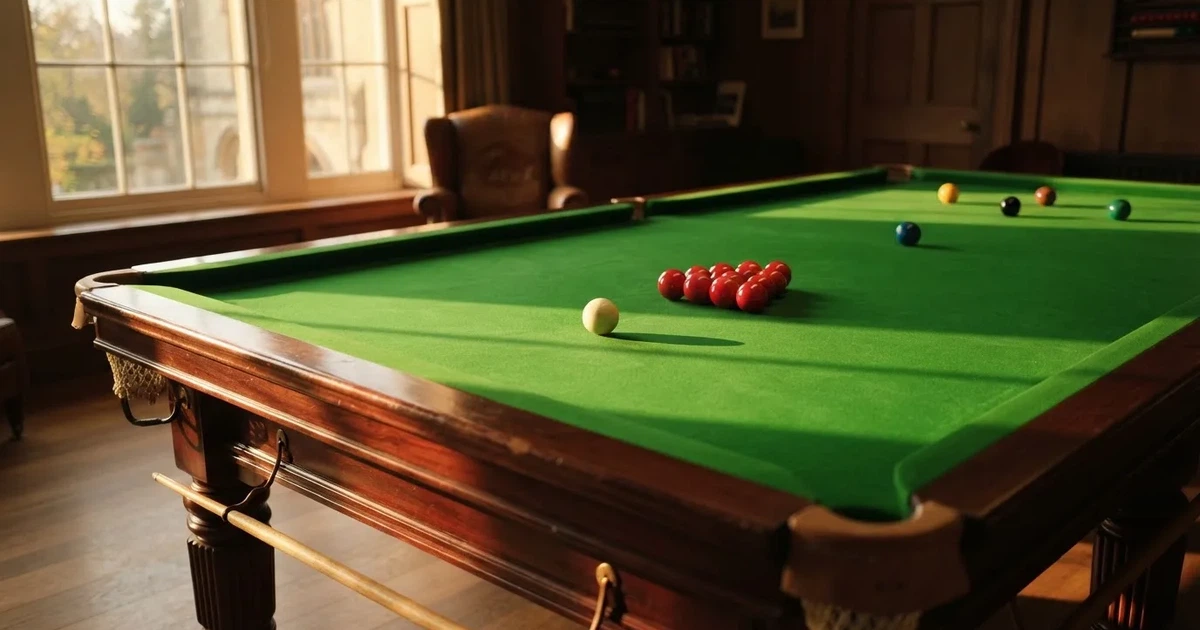
A frame is decided by potting balls in a fixed order, and the balls themselves are fixed. Fifteen reds, worth one point each. Yellow (2), green (3), brown (4), blue (5), pink (6), black (7). Twenty-two balls in total, of which one is the white cue ball that must not be potted. A player needs more points than the opponent to win the frame; in practice, the only way to clear the table is the maximum break of 147, made by potting all 15 reds with a black after each and then clearing the colours in ascending value. The structure is the reason the sport lends itself to frame betting, total-points markets and the “first to pot a colour” lines that turn up on most snooker coupons.
The frame is also short. Most professional matches are best of 7, 9 or 11 frames, which is why outright markets on tournaments settle quickly enough to be traded through the event rather than as a long-running position.
What a price is
A price is the return the bookmaker will pay per £1 staked if the selection wins. The familiar British form is fractional — 5/1, 11/4, evens — and the decimal form is the same statement in different clothes. 5/1 means a £1 stake returns £5 of profit plus the £1 stake, for a £6 return; 11/4 means £2.75 profit on a £1 stake, for a £3.75 return. Evens is 1/1, which is 2.00 in decimals. The relationship is the same for every price: decimal odds minus one is the fractional form’s top number divided by its bottom, and the return is stake multiplied by the decimal price.
On a real match outright, a player at 5/2 (3.50) and the rival at 11/8 (2.375) does not sum to 100% of the market. Adding the implied probabilities — 1 divided by each decimal price — gives more than 1, and the excess is the bookmaker’s margin. On a two-way match winner with both sides priced at 1.90 (9/10), the implied probabilities add to roughly 105.3%. The margin is the share of the stake the bookmaker keeps, calculated as the overround divided by the sum of implied probabilities, which here is about 5.0% — a figure the punter never sees on the coupon but pays on every pound staked.
Reading the margin
The cleanest way to feel a margin is to look for a market where the implied probabilities should sum to exactly 100% — a perfectly priced match, two players, no favourite. When the two prices are 1.91 and 1.91, the bookmaker’s cut is about 4.7%; when they are 1.80 and 1.80, it is roughly 11.1%. The bigger the gap above 100%, the more the bookmaker is keeping and the worse the value for the bettor. The frame winner and outright winner markets at major bookmakers usually carry the lowest margins in snooker, because liquidity is highest and the book is thinnest. Total-points lines, Asian handicaps, player specials and tournament top breaks tend to carry more, because liquidity is lower and the bookmaker’s risk needs a wider buffer.
A margin is a number on a page, but it is also a feeling: two bookmakers offering 11/8 and 6/5 on the same player in the same frame are not offering the same bet. The cheaper line costs the punter nothing at the betting slip but pays more on a win, and on every losing stake the difference is paid into the margin of whichever book wrote it.
How a combination bet multiplies the price
A single is one selection. A double is two, and its price is the product of the two legs — 2.00 and 3.00 give a double at 6.00, meaning a £1 stake returns £6 if both win. A treble is three legs, and the prices multiply again. An accumulator — “acca” to most UK punters — extends the chain; the more legs, the bigger the price, the more the bookmaker’s margin compounds into the final number, and the smaller the implied chance of it landing. The bet is paid only if every leg wins; a single loser at any point in the chain takes the whole stake with it.
Some bookmakers offer each-way accumulators on outright markets. Each-way is two bets of equal stake — one on the selection to win, one on it to place — so a £5 each-way accumulator is two £5 bets, for a £10 stake in total. The place part pays a fraction of the win price (typically a quarter or a fifth at one-third or a quarter of the field) and is what turns a long-odds outright pick into something with a small chance of returning even when the player does not win the trophy.
Where snooker can be bet on legally from Great Britain
Betting on snooker from Great Britain is legal at any operator holding the right Gambling Commission licence, and only at those operators. The framework has been the Gambling Act 2005 and its amendments since the 2014 Act closed the offshore loophole. The relevant point for a punter is not the statute itself but where the proof sits: the Commission’s public register, searchable by business name, trading name, domain or account number, is the only place that proves a brand holds a current licence.
What the licence means in practice
A Great Britain licence comes with a list of obligations a bettor feels even when they have not read them. Minimum age 18, with photo ID and a proof of address checked before the first deposit, and that check has applied even to free bets and bonuses since 2019. Credit cards cannot fund a gambling account — the ban covers credit cards directly and any e-wallet that has been topped up by one. A customer who wants to take a break from every licensed site at the same time registers with GAMSTOP, which is mandatory for every GB-licensed online operator and which, once triggered, blocks the account at every one of them for the chosen exclusion period.
The new financial vulnerability check, in force since February 2025, applies to remote betting customers whose net deposits across the rolling 30 days exceed £150: it is a public-record check, not an income check, and the operator uses it to flag the small share of accounts where money trouble is on the public record. The further “financial risk assessment” the press calls affordability checks has been announced and staged but carries no start date, and the page treats it as announced and not as in force. The deposit-limit regime has been rolling out in phases — the first since October 2025, the second announced for the end of September 2026 — and on a licensed site the customer sets the ceiling.
The honest framing of “licensed” and “unlicensed”
A licensed bookmaker offers the protections the Commission requires: GAMSTOP, the bonus wagering cap, the vulnerability check, an approved dispute-resolution route if a payout is disputed, and British consumer redress if funds are withheld. The price is friction, on account choice — verification before the first bet, source-of-funds questions at higher spend, and the credit-card ban that already removed the easiest anonymous route in. The bookmaker pays General Betting Duty on its gross profit at 15% (rising to 25% on remote bets other than UK racing from 1 April 2027); that is an operator tax and there is no player tax on winnings in Great Britain.
An unlicensed site offers no Commission protections, no GAMSTOP coverage, no British complaints route, and no recourse if funds are withheld. Providing gambling facilities in Great Britain without the required licence is an offence under section 33 of the 2005 Act. Enforcement is disruption rather than blocking: cease-and-desist notices, work with payment providers and registrars, and court-order DNS powers that have been granted or are imminent. The honest framing is that licensed means checks and limits and the bonus cap, unlicensed means none of those and possible loss of funds, and neither is the “safe” choice by default.
Northern Ireland is outside the 2005 Act and runs its own older law, so the same GB licence does not cover an account opened there — punters in Belfast or Derry need to check the local position separately.
Where the data on a licence stops being current
The Commission’s public register is updated when licences are granted, varied, surrendered or revoked. A licence number on a bookmaker’s own site is a useful cross-check but never a substitute for the register itself, because the register is what the regulator says is true on the day the punter checks. A name on a brand’s homepage is a marketing claim; the same name on the register is the licence. The punter’s rule is to use one to find the other.
Safer gambling on snooker bets
Snooker is the kind of sport that punishes inattention — long events, short frames, and a calendar dense enough that a betting account can stay active almost every week of the season. The safer-gambling toolkit exists precisely for that shape of play.
The self-exclusion path
GAMSTOP is the national multi-operator online self-exclusion scheme and a mandatory licence condition for every GB-licensed online bookmaker. A customer registers with GAMSTOP, picks a period of six months, one year, five years, or five years with auto-renewal, and the exclusion applies across every participating operator. After the minimum period, the exclusion runs for a further seven years unless the customer asks GAMSTOP to remove it. Betting shops are not covered by GAMSTOP — they run their own self-exclusion register. The new financial vulnerability check is the operator’s side of the same idea: when net deposits cross £150 over a rolling 30 days, the operator runs a public-record check and steps in where the public record flags trouble.
Help lines and clinics
GamCare runs the National Gambling Helpline. GambleAware funds treatment and research. The NHS runs gambling clinics in several cities. Gamblers Anonymous runs meetings. The links appear in the safer-gambling footer of every licensed operator’s site, and the pattern is the same across the industry because the LCCP requires it.
The account-level controls
Deposit limits are the customer’s lever. Timeouts are the short version — a 24-hour or 7-day pause. Self-exclusion is the long version. Reality checks are the gentle version, a pop-up at intervals the customer sets. The licensed operator exposes all of these on the responsible-gambling page; a bookmaker that hides them behind a footer link is signalling the wrong thing.
Where the licence stops and the choice begins
The choice is always the punter’s, and the protections are a backstop rather than a substitute. A licensed site does not protect a customer from themselves any more than a seatbelt protects a driver from speed; it only makes the consequence smaller when something goes wrong.
Cryptocurrency and anonymity in snooker betting
Crypto is a payment-method question at a snooker bookmaker, not a market question. The punter pays for a bet somehow and receives a return somehow, and the choice of rails does not change the price of the frame. What it does change is the question of who knows what about whom, and how quickly funds move.
What a crypto payment actually changes
A deposit at a licensed British bookmaker is checked against a verified account, because identity verification runs before the first deposit and that check covers a free bet or bonus too. Crypto does not change that rule. What it changes is the speed at which the funds arrive at the operator and the speed at which winnings leave — for the small set of licensed operators that actually accept it, settlement is measured in minutes rather than the working-day pacing of an open-bank-transfer withdrawal. The trade is the rail, not the licence.
The “anonymous snooker betting” idea
A licensed British site is not anonymous. The customer’s name, address and date of birth are checked before the first deposit. Source-of-funds questions at higher spend are normal under the money-laundering rules. A GB-licensed operator is the wrong place to look for anonymity in the first place. Sites marketed as “anonymous” or “no KYC” generally operate offshore and outside the British framework, which means the customer loses the protections that come with the licence and gains no enforceable anonymity, because the offshore operator’s own identity checks run on its own terms and are not audited by the Commission.
What a punter actually gets from using crypto
Speed on the way in and speed on the way out, in the small set of licensed bookmakers that accept it. The credit-card ban does not cover crypto in the same way, but the same identity rules do. The promise of privacy is mostly a marketing promise, and the promise of anonymity is a marketing promise attached to a self-exclusion hole.
Snooker betting offers, bonuses and free bets
“Get £40 in free bets” is the line most punters see first. The arithmetic behind it is what decides whether it is worth the activation.
The shape of a sports welcome offer
The Coral and Unibet welcome offers are stated by their own terms as a “bet £20, get £40 in free bets” structure for new GB customers who deposit and place a qualifying sports bet at minimum odds of 2.0 (1/1), with the free bets issued within 7 days and expiring 7 days after issue. BetMGM’s welcome offer, on its GB app listing, is four £10 free bets issued after a £10 deposit and a first sports bet within 7 days, broken into two football accumulators of four or more selections and two sports multiples of two or more, with minimum odds and an opt-in. Vbet’s welcome offer is a £10 free bet on a first losing stake of £10 or more from a new, verified customer. Each is an example of a different shape of deal and a different reading of “free”.
What a free bet actually pays
The single most important number on a free bet is whether the stake comes back. On most UK free bets the stake is not returned with the win; a £10 free bet at 3/1 pays £30 of profit and not £40. That is why the value of a free bet is calculated separately from a cash bonus. For a free bet whose stake is not returned, on a market with a payout share of 95%, the value is the free-bet amount multiplied by (odds minus 1) divided by the odds, multiplied by the market’s payout share. On a £10 free bet at 5/1 (6.00), the value is £10 × (5/1) ÷ 6.00 × 0.95, which works out to about £7.92 of expected return, not the £50 a careless reading would suggest.
The wagering requirement cap
Since 19 January 2026, wagering requirements on bonuses at GB-licensed operators are capped at 10x — a £10 bonus at 50x needed £500 of qualifying bets, and under the cap no more than £100 of turnover is required. That cap does not apply to free bets with no wagering condition, and the cap on the money value of a bonus is not set. The result is that the headline number of free bets and the cost of unlocking them are now further apart than they were before, and the calculation of value matters more.
Mixed-product promotions
Offers that require gambling on two or more product types — betting and casino together, or betting and bingo, or betting and lottery — are banned. “Bet on football to get free spins” is no longer a permitted shape. That ban changes the price of welcome offers on a sport-focused account: the snooker-only customer is not being steered into a casino spin to claim the headline, and the headline itself has to be earned on the betting side.
The accumulator insurance line
Some operators offer accumulator insurance — money back as a free bet if one leg lets down a multi-leg accumulator. The arithmetic is the same as for any free bet: the stake is not returned, the value depends on the price and the market, and the cost is the loss of the original stake.
Why the headline is rarely the value
A £40 free bet headline is worth somewhere between £25 and £35 in expected return, depending on where it is spent and on the market’s margin. A £10 free bet on a first losing stake is worth less still, because the customer must lose the qualifying bet to claim it. The honest calculation has to be done before the qualifying bet is placed, because the qualifying bet is itself a real-money wager at the operator’s price.
What to do before claiming
Read the operator’s terms page. The minimum odds for the qualifying bet, the qualifying market (some offers exclude certain sports or bet types), the expiry of the free bet, the markets on which the free bet may be used, the cap on free-bet returns, and any payment-method exclusions (Unibet’s qualifying payment methods on its welcome offer are debit card and instant bank transfer) — each is a real-world filter on the headline.
In-play snooker betting and cash out
Snooker is one of the friendlier sports for in-play betting because the frame is bounded. There is a clear start, a clear finish, a scoreline that updates on every pot, and a session break that gives the punter a moment to think.
What in-play snooker actually offers
The standard in-play market is the frame winner at the current scoreline — that is, the price of the player who is behind or ahead at the moment the bet is placed. Because the scoreline is granular, bookmakers offer prices after every frame and often between frames, with the price of the favourite shortening and the outsider drifting as the match plays out. Some operators go deeper — total points in the current frame, whether there will be a century break in the match, whether the next frame will go to a deciding ball, the colour to be potted last — but the frame winner is the market most consistently written.
What makes a frame worth live betting
The reasons to bet in-play rather than pre-match are the usual ones: the customer has watched the first two frames and has a view on form, or the price has drifted on a player who has just lost a frame, or the bookmaker has mispriced the recovery. The reasons not to are equally familiar: the in-play margin is wider than the pre-match margin because the book is shorter and the risk is real-time, and a fast finger on the phone can lock in a price that has already moved.
Cash out and bookmaker control
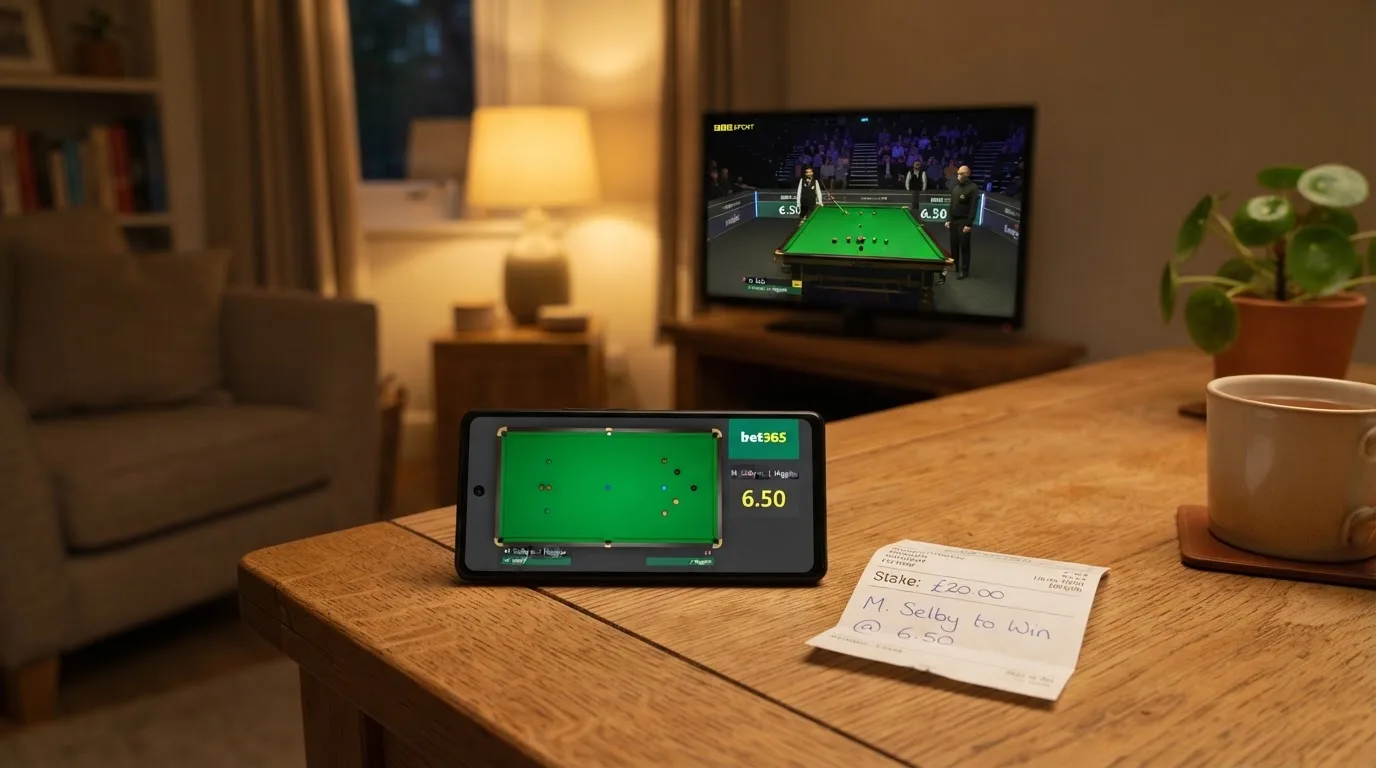
Cash out is the operator’s facility to settle a bet before the event has finished, at a price the bookmaker itself sets. On a snooker frame winner, the price moves as the match plays out, and the cash-out figure moves with it. The cash-out figure is not the true odds — it is the operator’s own bid, with the operator’s own margin inside it, and the customer is selling the bet back to the bookmaker rather than to the wider market. Midnite’s app lists in-play events, an acca builder, popular accas and price boosts with maximum-stake limits; 888sport lists Cash Out, Bet Builder, racing streams, BetFinder form tools, a live bet feed and daily boosted odds. Both are examples of operators with a built in-play product; the cash-out spread between the true price and the cash-out figure is the operator’s charge for the facility.
The bet builder question
Bet builders are the same-game-multi product that lets a punter combine several selections from one event into one accumulator: frame winner, total frames, highest break, century breaks in the match, and so on. The price is the product of the legs at the operator’s own prices, and the margin compounds into the final number. The product is convenient and the combined price is rarely the same as the price a punter would have got building the same bet leg by leg on the exchange market, because the operator is adding its margin at each leg and again at the combination.
Why the live data is the live data
Snooker data feeds are usually frame-by-frame with a small lag, and the lag is the time during which the operator has already repriced and the customer has not yet seen the change. Some operators offer a one-click delay or a “with delay” feed; the punter who wants a real read on the live market should know what the operator’s feed actually shows.
Snooker betting predictions and the limits of any system
There is no system that wins. That sentence belongs at the top of this section, because it is the one the marketing copy leaves out.
What a prediction can do
A prediction, whether from a tipster, a model or a hunch, is an opinion about which player is likelier to win a given match. The price on that player is the bookmaker’s own opinion in the same match, and the question for the bettor is whether the prediction beats the price. A model that calls the favourite at 1.50 when the bookmaker has the favourite at 1.30 is offering the punter £20 of expected value on a £30 stake — if the model is right and if the bookmaker’s price is wrong. A tipster whose record says 53% winners at average odds of 2.00 is making 6% on turnover, which compounds to a real edge over a season. A tipster whose record says 53% winners at average odds of 1.70 is making about minus 10% on turnover, which compounds to a real loss.
What a prediction cannot do
Predicting the outcome of a single frame is the practice in the dark. The bookmaker’s price already contains every team’s recent form, the head-to-head, the venue, the referee’s tendencies, the player’s history at the tournament, and the public money on either side. Beating it consistently means finding an angle the bookmaker has missed, and the bookmaker has access to more information, more compute and more liquidity than any individual punter. The honest punter knows that the edge, if any, is small, that it compounds over a season rather than a Saturday, and that a single big-priced winner does not prove an edge exists.
Where the form data lives
Wikipedia’s entry on snooker is the cleanest starting point for ball values, frame structure and tournament records; the World Snooker Tour and the WPBSA’s own site carry the schedule and the field. Betfair’s exchange price, where it is available, is the closest thing to a “true” market price against which a bookmaker’s price can be benchmarked. None of these is a prediction, and none of them is a system.
Bankroll
Bankroll is the term for the pot a punter sets aside for betting, separate from rent, food and bills. The standard advice — stake a small fixed percentage per bet, never chase, never raise the stake to recover losses — is not a system, it is the discipline that lets a system work if one exists. A punter without a system needs the discipline more than a punter with one, because the discipline is what stops a small losing run from becoming a life problem.
Why “today’s snooker betting tips” is not an answer
A tip is an opinion. The format of an opinion changes nothing about its accuracy. The honest tipster publishes a record that can be checked — open bets, closed bets, average odds, return percentage per month — and the honest punter reads that record before paying for the next selection. The dishonest tipster publishes a string of winners and no record, and the dishonest punter pays for the next selection anyway.
Snooker bet types and how each is settled
The bet types on a snooker coupon divide into three groups: outright markets on tournaments, match markets on individual contests, and frame-by-frame or in-play markets. Each is settled differently, and each settles on a different clock.
Outright markets
The outright market is the winner of the tournament. The UK Championship, the Masters, the World Championship at the Crucible, the Champion of Champions, the Players Championship and the tour events are each priced in some shape across the licensed bookmakers, and the price at the start of the tournament is rarely the price at the end. The market settles on the day the trophy is lifted. Each-way terms on outrights pay a fraction of the win price for a place; the fraction depends on the field size and the operator.
Match markets
The match market is the result of a single contest. The standard match-winner line is two-way, with the draw a possible outcome in some formats. Best-of-7 matches played to a finish mean the draw is rare but possible, and the match-winner market is the simplest read. Some bookmakers offer a “draw no bet” line, which refunds the stake if the match is tied; the price is shorter than the match-winner price because the bookmaker’s risk on the draw is removed.
Frame markets
The frame market is the result of a single frame. The price moves with the score: 5-4 in a best-of-11 is a different frame-winner price than 6-4 in the same match, because the player who is two frames from victory is closer to the win. Some operators also offer frame handicaps — a player starts the frame a number of points ahead for the purposes of the bet — and total-points lines, with the band set by the operator.
Highest break and century breaks
The “highest break” market is a player special: which player will make the highest break in the match. The price depends on the players’ century counts and on the operator’s view of the table. “Century breaks in the match” is a totals market — over or under a line. Both settle on the last ball of the match.
Frame result and colour markets
The “first to pot a colour” market is a novelty: which player will pot the first coloured ball after the last red. The “winner of the next frame” is the live in-play frame winner. Both are written on the major bookmakers’ in-play coupons and settle on a single event.
Settling rules
The settling rule for each market is in the operator’s terms, and the rule that matters most is what happens when a match is incomplete. A retirement mid-frame, a session that ends before the result is reached, a tournament match shortened by walkover — each is settled under the operator’s own rule, and the rule is usually published on the operator’s site. A punter who wants the answer before the bet is placed reads the operator’s rules.
Snooker tournaments and the calendar that drives the markets
The professional snooker calendar is run by the WPBSA, the World Professional Billiards and Snooker Association, which also owns the official rules of the sport. The IBSF runs the amateur game and feeds into the professional tour. The major ranking events — the World Championship at the Crucible, the UK Championship at the Barbican, the Masters at Alexandra Palace — anchor the season; the tour events fill the rest.
The World Championship
The World Snooker Championship has been held at the Crucible Theatre in Sheffield since 1977, a 17-day tournament that ends on the first Monday in May. The first round is best of 19 frames across three sessions, the semi-finals best of 33 across four sessions, and the final best of 35 across four sessions. The 2026 final was won 18–17 by Wu Yize over Shaun Murphy; the winner’s cheque was £500,000 from a total prize fund of £2,395,000. Stephen Hendry and Ronnie O’Sullivan each hold seven world titles in the modern era, and Joe Davis won fifteen world titles in a row from 1927 to 1946 — a record that stands at the top of the men’s professional game.
The UK Championship and the Masters
The UK Championship has been a ranking event since 1984, currently held at the Barbican in York in late November and early December. The Masters is an invitational event for the top 16 in the world, held in January at Alexandra Palace. Each offers a deep outright market and each settles quickly enough that punters can trade through the event rather than hold a position for the season.
The tour events
The ranking events beyond the Triple Crown fill the rest of the calendar — the English Open, the Scottish Open, the Welsh Open, the German Masters, the Players Championship, the Tour Championship, the Champion of Champions, the Shanghai Masters, the China Open, the International Championship, and a long tail of invitational and ranking events. The outright market for each event is priced by the major bookmakers, with the depth of the market dependent on the size of the field and the stature of the event.
Table and equipment
A full-size snooker table is 12 ft by 6 ft with six pockets. The cue ball is white and must not be potted. The frame is decided by potting balls in the fixed order: a red (one point) followed by a colour of the player’s choice, repeated until the reds are gone, and then the colours in ascending value. The colours are worth yellow 2, green 3, brown 4, blue 5, pink 6 and black 7. The maximum break is 147.
Where the calendar sets the market
The calendar sets the rhythm of the markets. The World Championship in late April and early May is the year’s biggest outright market, the UK Championship at the end of November is the second, and the Masters in January is the invitational peak. The bigger the event, the deeper the market, the tighter the margin on the match-winner and the wider the market on the specials.
The ten bookmakers compared
The list below is the set of GB-licensed remote betting brands featured on this page, drawn from the Gambling Commission’s public register. Each review carries the licence number and the relevant conditions from the operator’s own terms, in the words of those terms, on the matters that matter for a snooker punter. The table beneath the list gathers the licence facts and the headline terms in one place.
| Brand | Licence (Account No. & Holder) | Own terms on snooker and offers |
|---|---|---|
| BetMGM | 39198 (LeoVegas Gaming PLC) | Four £10 free bets on a £10 deposit and first sports bet within 7 days, split into football accumulators and sports multiples |
| Bar One Racing | 56516 (Bar-One Racing Limited) | Irish independent bookmaker rebranded as BAR 1 Betting, with horse-racing sponsorships across Ireland |
| QuinnBet | 61011 (QuinnBet (Gibraltar) Limited) | Best Odds Guaranteed on Irish and UK horse racing from 10:00 daily, capped at £150 per race |
| Coral | 54743 (LC International Limited) | £40 in free bets on a £20 qualifying bet at minimum odds of 2.0 (1/1), issued in 7 days |
| Smarkets | 39173 (Smarkets (Malta) Limited) | Instant open-bank-transfer deposits from £10 to £10,000; withdrawals processed within 6 hours |
| VBet | 44662 (SCGO Limited) | £10 free bet on a first losing stake of £10 or more for new verified customers |
| Unibet | 45322 (Platinum Gaming Limited) | £40 in free bets on a £20 qualifying bet, expiring in 7 days; debit card or instant bank transfer only |
| 888sport | 39028 (888 UK Limited) | App features pre-match and in-play betting, Cash Out, Bet Builder and BetFinder form tools |
| Tote | 54779 (TDCO Limited) | Pool-betting products alongside fixed-odds racing book |
| Kwiff | 44448 (Eaton Gate Gaming Limited) | Self-described trademark operated by Spryme Ltd; app carries 17+ App Store rating |
The set is a sample, not the whole market. Every operator above carries a current remote licence for Great Britain and is a member of GAMSTOP; the Commission’s public register lists many more brands that this page does not feature.
BetMGM
BetMGM runs under LeoVegas Gaming PLC, with licence 39198. The welcome offer is four £10 free bets for new UK customers who deposit £10 and bet within 7 days, split into football accumulators and sports multiples. The structure is heavy on football, which is a constraint for a snooker-focused bettor wanting to clear the bonus quickly. The outright and match-winner markets are priced competitively for major tournaments. Overall, the value is genuine, though tailored for football bettors rather than cue-sport specialists.
Bar One Racing
Bar One Racing, now BAR 1 Betting, is an Irish independent bookmaker with shops across Ireland and horse-racing sponsorships at Dundalk, Fairyhouse, Navan, The Curragh, Curraheen Park and Cork. The Commission’s account for the licence is 56516. The brand’s snooker offer is light relative to the racing offer — the racing markets are the brand’s centre of gravity, and the snooker outright market is written around the major ranking events rather than across the season. For a punter whose interest is racing first and snooker second, the brand fits. For a snooker-only punter, the racing-heavy balance of the coupon is a mismatch, and the brand’s specials are not its strongest card.
QuinnBet
QuinnBet runs under QuinnBet (Gibraltar) Limited, and the Commission’s account for the licence is 61011. The headline racing feature, on the operator’s own terms, is Best Odds Guaranteed on Irish and UK horse racing from 10:00am daily, on singles, multiples and system bets, with a maximum benefit of £150 per customer per race. The snooker offer is a reasonable match-writer on the World Championship and the UK Championship, with outright markets priced on most ranking events. For a punter who wants a Best Odds Guaranteed product on the racing side and a workable snooker book on the other, the brand fits. The £150 cap on the BOG benefit is the one number to know going in.
Coral
Coral operates under LC International Limited, using licence 54743. The welcome offer is a “Bet £20, Get £40 in free bets” deal for new GB customers who opt in. Coral’s snooker coupon is among the deepest on the high street, featuring outright markets across most of the ranking calendar and match-winner markets for televised events. With frame-by-frame markets available during the World Championship, the platform is well-suited for punters who follow the tour season-long.
Smarkets
Smarkets operates as a betting exchange under licence 39173 (Smarkets (Malta) Limited). As an exchange, customers back and lay selections rather than betting against a bookmaker. Instant deposits from £10 via bank transfer and 6-hour withdrawal windows are standard. Liquidity on snooker is generally lower than on horse racing, but for those seeking a true market price to benchmark against bookmaker odds, it remains the primary resource for snooker analysis.
VBet
VBet (licence 44662, SCGO Limited) offers a £10 free bet to new, verified customers if their first wager of £10 or more loses. This simple, single-bet structure differentiates it from the multi-bundle offers found elsewhere. The snooker book is solid for ranking events, covering outrights and televised match-winners consistently. It is a transparent, modest alternative for players who prefer a straightforward bonus rather than a bundle.
Unibet
Unibet (licence 45322, Platinum Gaming Limited) has operated since 1999. Their welcome bonus, “Bet £20, Get £40 in free bets,” requires a qualifying sports bet at 2.0 (1/1) or higher. Their snooker section is extensive, offering season-long outright markets and in-play coverage, alongside price boosts. Note that the welcome offer is restricted to debit card or bank transfer deposits, which may exclude e-wallet users. Broad market variety is the standout feature here.
888sport
888sport runs under licence 39028 (888 UK Limited). Their platform features pre-match and in-play betting, Cash Out, Bet Builder, and racing streams, complemented by “BetFinder” form tools and daily boosted odds. Snooker coverage is reliable, with match-winner markets on televised events and outrights on ranking tournaments. For bettors who appreciate data-driven form tools alongside standard betting markets, 888sport presents a complete and competent product.
Tote
Tote runs under TDCO Limited, and the Commission’s account for the licence is 54779. The brand’s centre of gravity is pool betting on horse racing, with the Tote’s traditional dividend-based products sitting alongside the fixed-odds book. The snooker offer is light relative to the racing offer, and the brand’s strength is the dividend products on racing rather than the snooker coupon. For a punter whose interest is racing first and snooker second, the brand fits in the way that BAR 1 Betting fits — a racing-led bookmaker with a workable snooker section rather than a snooker-led bookmaker.
Kwiff
Kwiff runs under Eaton Gate Gaming Limited, and the Commission’s account for the licence is 44448. The brand is self-described as a trademark operated by Spryme Ltd, and the app carries a 17+ App Store age rating. The brand’s angle is “surprise” pricing — the operator’s own product mechanic that boosts odds on selected bets, with the customer notified when a price has been “kwiffed”. The snooker offer covers the major ranking events on a match-winner and outright basis. For a punter who likes the boosted-odds mechanic and wants to use it on snooker, the brand fits. The verdict is that the brand’s mechanic is its distinguishing feature and the snooker book is workable rather than deep, and a punter who values the mechanic gets something the wider market does not offer.
Reading the margin on a snooker market
The margin is the only number a punter can compute from the prices alone, and the margin is the single most useful number a snooker punter can carry from the coupon into the bet.
The arithmetic
For a two-way market, the payout share is 1 divided by the sum of 1/odds for each outcome. The margin is 1 minus the payout share. On a match winner priced at 1.90 and 1.90 — the example used across this page — the implied probabilities are 1/1.90 and 1/1.90, summing to about 1.053, leaving a payout share of about 94.9% and a margin of about 5.1%. On the same market priced at 1.80 and 1.80, the implied probabilities sum to about 1.111, leaving a payout share of about 90.0% and a margin of about 10.0%. On 2.00 and 2.00, the implied probabilities sum to exactly 1, the payout share is exactly 100%, and the margin is zero — which never appears on a real coupon, because a bookmaker that offered 2.00/2.00 on a two-way market would make no money on every pound staked.
The realistic band
In practice, snooker match-winner markets at the major bookmakers price to a margin in the 5% to 8% range on the World Championship and the UK Championship, where liquidity is highest and the book is thinnest. Outright markets on the same tournaments run wider, often in the 10% to 15% range, because the field is deeper and the bookmaker’s risk on the back end of the field is larger. Frame-by-frame markets and player specials run wider still, sometimes 15% to 25%, because liquidity is lower and the bookmaker needs a wider buffer. The widest margins sit on novelty markets and on specials written for a single match.
What the band tells the punter
A punter who reads margin is reading the bookmaker’s charge for the market. A 5% margin on a frame-winner market costs the punter 5p on every £1 staked across the long run; a 15% margin on a player special costs 15p on the same £1. The punter who wants value reads the margin first and the price second, because the price already contains the margin and the margin is the only number the price does not show.
What the band does not tell the punter
The margin does not predict the outcome. A 5% margin on the wrong selection is still a losing bet, and a 15% margin on the right selection is still a winning one. The margin tells the punter what the bet costs on average across many bets; it does not tell the punter which of those bets is to land.
Where the calculation ends and the choice begins
The choice between bookmakers is not made on margin alone. It is made on the combination of margin, market depth, in-play coverage, payment speed, welcome terms and the question of whether the operator’s product fits the punter’s habits. The set of GB-licensed bookmakers above is broad enough that no single brand is the only fit for any punter, and the choice is the punter’s rather than the bookmaker’s.
Frequently asked questions
How do I bet on snooker?
Pick a licensed British bookmaker from the Commission’s public register, open and verify an account with photo ID and a proof of address, deposit by debit card or open-bank transfer (credit cards are banned for gambling in Great Britain), pick the snooker market you want from the operator’s coupon — match winner, outright, frame winner, total points, highest break, century breaks in the match — choose your stake, and confirm. The bet is settled when the event finishes, and a winning selection is paid by the operator’s own withdrawal method and timetable.
Can I bet on snooker?
Yes, at any GB-licensed bookmaker. The minimum age is 18, the bookmaker must hold a Gambling Commission licence for remote general betting standard (real events) or run as a remote betting intermediary, and the bet is placed under the operator’s own terms and the LCCP. Bets on snooker are not banned under any statute found by the regulator, and the major ranking events and tour events are priced across the licensed market.
How can I check that a bookmaker holds a Gambling Commission licence?
Use the Commission’s public register, searchable by business name, trading name, domain or account number. The account number is the unique identifier on the register and is the one piece of information that proves the licence is current. A licence number on a brand’s own homepage is a marketing claim; the same number on the register is the licence.
How is the return on a bet worked out from the stake and the odds?
The return is the stake multiplied by the decimal odds. On a £10 stake at decimal odds of 3.00, the return is £30. The profit is the return minus the stake, which is the same calculation as stake multiplied by (odds minus 1). On a £10 stake at 3.00, the profit is £20. On a combination bet with two legs at 2.00 and 3.00, the combined price is 6.00 and a £10 stake returns £60 if both legs win.
What is the bookmaker’s margin and how can it be seen in the odds?
The margin is the cut the bookmaker keeps of every pound staked on a market, expressed as a percentage of the total stake. It is computed from the prices by dividing 1 by each price to get the implied probability, summing those probabilities, and subtracting 1. On a two-way market priced at 1.90 and 1.90, the implied probabilities sum to about 105.3% and the margin is about 5.0%. The margin never appears as a line item on the coupon; it is paid on every losing bet and on the difference between true odds and the bookmaker’s odds on every winning bet.
How do fractional odds such as 5/1 convert to decimal odds such as 6.00?
The conversion is fractional’s top number divided by its bottom, plus 1. 5/1 is 5 ÷ 1 + 1 = 6.00. 11/4 is 11 ÷ 4 + 1 = 3.75. Evens is 1/1, which is 1 ÷ 1 + 1 = 2.00. The decimal odds state the total return per £1 staked, including the stake, while the fractional form states the profit per £1 staked. The two forms say the same thing in different words, and the conversion is mechanical.
Tennis, darts & cue sports – Accumulator
Content created by the «Accumulator» team
