
Horse Racing Betting in Great Britain: Ten Licensed Sites Compared
 Available in US
Anyone walking into a High Street bookmaker during Cheltenham week knows the rhythm of the trade in this country: a queue at the counter, a printed racecard, a quiet crowd working out whether the favourite is short enough. Online horse racing betting works the same way, only the queue moves faster and the racecard never runs out. The interesting question for 2026 is not whether to bet on the horses — that has been a feature of British betting for two centuries — but which of the ten licensed bookmakers in this guide deserves the stake.
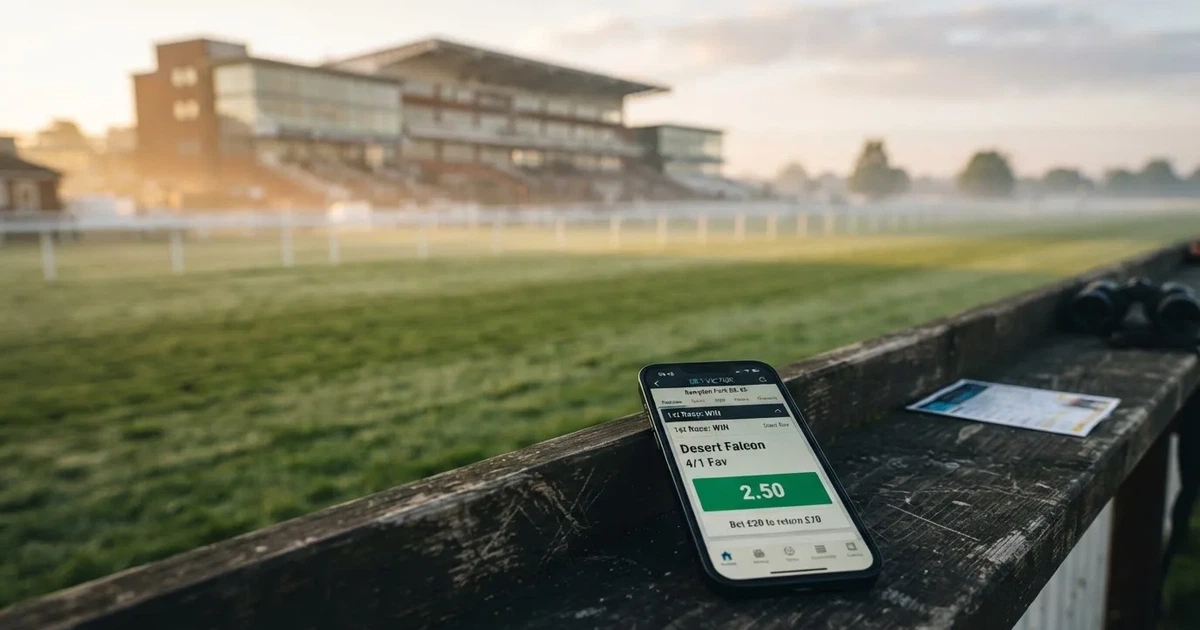
This page is built for that decision. It explains how the markets work, where the price sits once the bookmaker has taken its margin, which sites run a live stream of the racing and which only show the price, and what each welcome offer actually costs once the wagering and the time limit are honoured. The figures are current as of 26 October 2026 and were checked against the Gambling Commission’s public register.
How a Horse Racing Bet Is Built From the Odds
The horse racing market is older than the decimal point, and the way it is priced has stayed close to the form it had on the racecourse. Two formats appear side by side on every British bookmaker’s site. Fractional odds (5/1, 11/4, “evens”) say how much profit a winning pound returns. Decimal odds (6.00, 3.75, 2.00) say what a winning pound returns in total, profit included. The conversion is mechanical: a/b in fractional becomes a ÷ b + 1 in decimal, so 5/1 becomes 6.00 and 11/4 becomes 3.75.
The starting price, written SP on the slip, is the industry-wide consensus at the off and matters most when the price on the site was taken earlier in the day and the runner drifted or shortened. Best Odds Guaranteed, the BOG guarantee that has become standard among British bookmakers, pays out at the higher of the price taken and the SP on UK and Irish racing. William Hill pays BOG from 8 AM on the day of the race, on both single and multiple bets; it does not apply to ante-post, tote or pari-mutuel bets. The clause costs the bookmaker, not the punter, and is one of the few price-side promises a British customer can rely on without reading the small print twice.
A single bet is a bet on one selection. A multiple combines two or more selections — a double (two), a treble (three), an accumulator or “acca” (four or more) — and pays only if every leg wins. The price of an accumulator is the product of the leg prices, so three runners at 3.00, 2.50 and 2.00 combine into one price of 15.00; the risk is that the failure of any one leg wipes out the stake. Combination bets such as the Trixie (four bets on three selections), the Patent (seven bets on three), the Yankee (eleven bets on four), the Lucky 15 (fifteen bets on four), the Canadian or Super Yankee (twenty-six bets on five), the Heinz (fifty-seven bets on six) and the Goliath (two hundred and forty-seven bets on seven) cover several combinations of the same selections in one stake. The total stake of a Lucky 15 at a £1 unit is £15 — one in, fifteen bets, fifteen pounds out before the first race has begun.
What an Each-Way Bet Actually Costs
An each-way bet is two bets of equal stake — a win bet and a place bet — so the stake is doubled. A £5 each-way bet costs £10: £5 on the win, £5 on the place. The place part pays at a fraction of the win odds, called the place terms, and the fraction depends on the type of race and the number of runners. In Great Britain the customary scale is: handicaps with more than fifteen runners pay 1/4 odds for 4 places; twelve to fifteen runners pay 1/4 for 3 places; other races with more than seven runners pay 1/5 for 3 places; five to seven runners pay 1/4 for 2 places; fewer than five runners pay the win part only.
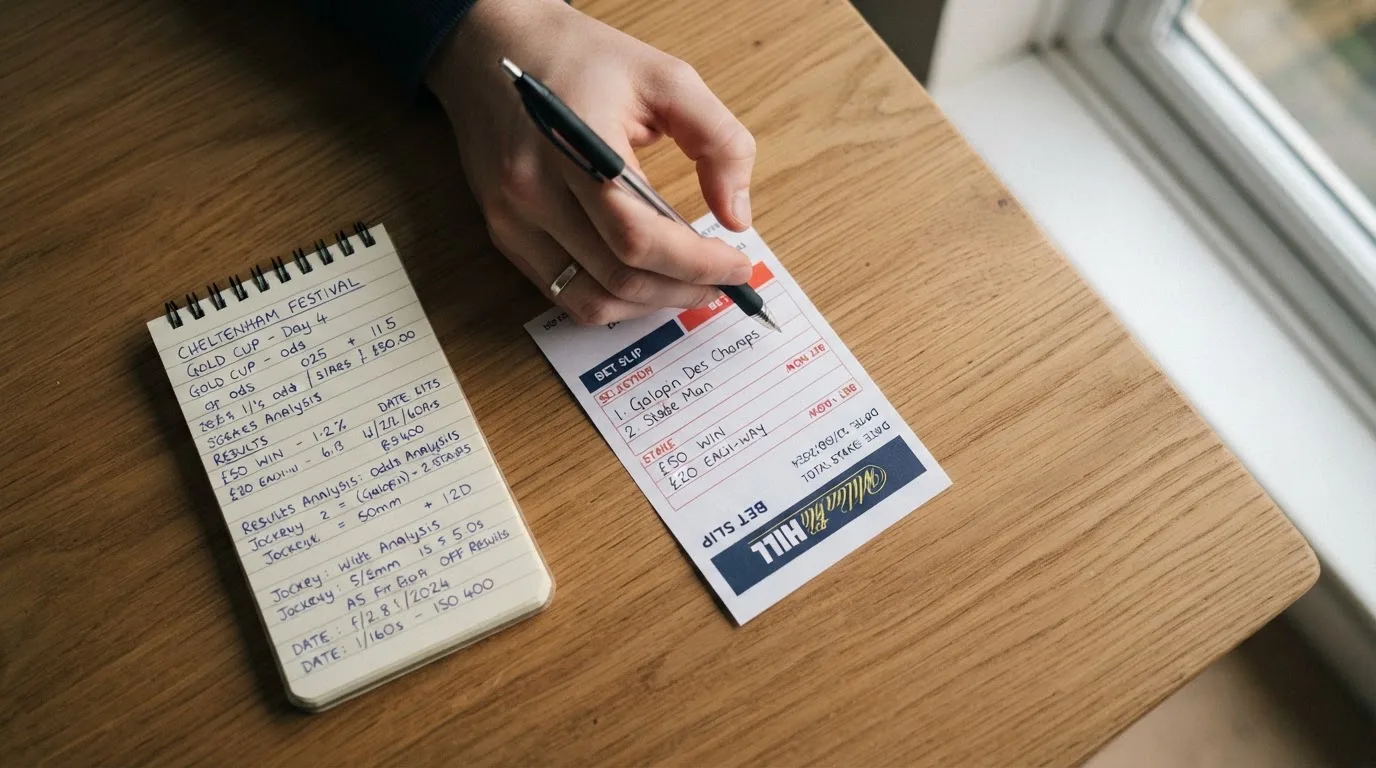
A worked example makes the arithmetic plain. A £10 each-way bet at 1/4 place terms (three places) on a 10/1 horse costs £20 in total. If the horse wins, the win part returns £110 (£10 × 10 plus the £10 stake), and the place part returns £35 (£10 × 10 × 1/4 plus the £10 place stake), so the total return is £145. If the horse only places, the win part is lost and the place part returns £35 — a small profit against the £20 stake but a real one. Each-way bets exist because the place market is the one place on the racecard where a long-priced horse pays out without a win.
The Bet Builder and the Live Price
A bet builder, sometimes called a same-game multi, combines several markets from the same race or match into one priced bet. In football the building blocks are goals, corners, cards and player markets; in horse racing a builder may combine finishing position, distance and running style markets where the bookmaker offers them. The price is built by the bookmaker, not by the customer, and the margin inside that price is harder to read than the margin on a single win market. A bettor who builds accas regularly should treat the builder’s quoted price as a starting offer and check it against the same legs priced separately.
Live betting, written “in-play” or “in running”, takes the price off the board before the off and re-prices it as the race unfolds. The picture is the same one the trader sees on the betting floor, with a digital lag of one to two seconds. In-play betting on horse racing is offered by most British bookmakers, and the controls are the operator’s licence conditions and customer-protection duties — there is no statutory prohibition, and no rule that says in-play is unrestricted. Cash out, where the bookmaker offers to buy the bet back before the result, is a related facility: useful when the leading horse has come off the bridle two out, less useful when the bookmaker’s buy-back price is built from a model that knew the horse was tiring before the punter did. The rule of thumb is the same as for any market: read the price before the off, take the cash out only when the value to the bettor is real.
Horse Racing in Great Britain: Fixtures, Distances and the Three Big Races
Horse racing in Great Britain runs on two tracks. Flat racing is run between two points around a straight or oval course, on level ground, with no obstacles. Jump racing — steeplechases over fences and hurdles — is called National Hunt racing in Great Britain and Ireland. The two seasons sit on top of each other, with the flat season running roughly from April to November and the National Hunt season taking over from late autumn through to the spring.
Flat races range from 440 yards (400 m) at the sprint end to more than four miles (6.4 km) at the staying end, with five to twelve furlongs (1.0 to 2.4 km) the most common distances. National Hunt races run further, with three miles the standard championship distance. The shape of a race matters to the betting: a five-furlong sprint favours horses with early pace and produces more photo finishes than a two-mile Flat event, where the field tends to spread out and a place market pays more often than the win market suggests.
Weight is the silent form. In handicap races each horse carries a different weight, allocated by a handicapper whose job is to give every horse, in theory, an equal chance. In conditions races the weights are set by the race conditions rather than by the handicapper, with allowances for younger horses and for fillies and mares against colts. Handicaps are the bread and butter of British betting — most weekday runners are handicappers — and the place market on a handicap is where the each-way terms bite most clearly, because fifteen-runner handicaps pay 1/4 odds for four places.
The British Triple Crown — the 2000 Guineas at Newmarket in early May, the Derby at Epsom in early June, the St Leger at Doncaster in September — is the country’s oldest flat racing series and one of three recognised Triple Crowns worldwide. The Irish Triple Crown (2000 Guineas, Derby, St Leger) runs in parallel at the Curragh and Leopardstown. The National Hunt equivalent runs through the Cheltenham Festival in March, with the Gold Cup the headline event, and the Grand National at Aintree in April.
How a Meeting Becomes a Betting Card
A British race meeting produces a card with six to twelve races, each race carrying a field of five to thirty runners depending on the type of race and the time of year. The betting market opens at the same moment the card is published — usually the day before — and the price moves with each bet the bookmaker takes and each piece of stable information that reaches the market (a withdrawal, a jockey change, a rain shower that softens the ground). The starting price is fixed at the off and reconciles the early market with the late market.
Ante-post betting is betting on a race before the final declarations are made — weeks or months in advance for the major festivals. The price is longer because the field is wider and the ground and going are unknown. The risk is the non-runner rule: if the horse is declared a non-runner after the bet is struck, the stake is returned, but if the horse is withdrawn at the final declaration stage the rule varies by bookmaker. Ante-post is the route into the long-odds future bets that pay handsomely on a hunch, and the route into the void tickets that pay nothing at all when the horse comes out three days before the race.
The Ten Licensed Bookmakers, Ranked by What They Offer
The table below covers the ten brands that take a remote betting licence in Great Britain and feature in this comparison. Three columns matter: the Gambling Commission licence number (the whole test of who holds a licence), the licence holder (the company named on the register), and what the operator’s own terms state on the subject of the key. The licence number is the one any reader can check on the Commission’s public register by business name, trading name, domain or account number.
| Brand | Gambling Commission licence | Licence holder | Horse racing offer on the operator’s own terms |
|---|---|---|---|
| Tote | 054779-R-331321-008 | TDCO Limited | Pool betting on UK and Irish racing; tote products differ from fixed-odds bookmaking |
| Star Sports | 009177-R-104555-019 | Star Racing Limited | UK and Irish racing fixed-odds; phone trading desk on 08000 521 321 for account opening and queries |
| Fitzdares | 000400-R-103839-030 | Fitzdares Limited | Cash out, accumulators, Lucky 15s, antepost markets on horse racing with in-play live odds |
| London Bet | 066162-R-340278-004 | Thistle Bet Limited | Sports betting on horse racing alongside football, tennis, golf and other sports |
| Betboro | 044181-R-324363-007 | Webmedia Development N.V. | Sportsbook with horse racing markets; first-bet matched free bet offer, stake £5–£25, three or more selections at 3/5 (1.60) or higher |
| Kalooki Sportsbook | 057730-R-333396-005 | Kalooki Sportsbook Limited | Horse racing and greyhound markets; GAMSTOP member, identity verified before first deposit |
| Paddy Power | 039439-R-319330-013 | PPB Counterparty Services Limited | Money-back specials on racing, acca insurance on selected football markets, in-play and Best Odds Guaranteed |
| BoyleSports | 039469-R-319383-025 | Boylesports Enterprise | UK and Irish racing fixed-odds; £20 in free bets on a £10 qualifying bet for UK customers |
| Octobet | 062545-R-337248-006 | Octopus Game Limited | Sportsbook with racing markets; 50% back as a free bet up to £50 plus a £10 casino bonus |
| Matchbook | 039504-R-319407-024 | Triplebet Limited | Betting exchange, peer-to-peer back and lay; live streaming of horse racing and greyhounds |
The columns are not interchangeable. A betting exchange such as Matchbook runs on a peer-to-peer commission model rather than a fixed margin; Tote’s pool product pays a dividend on each race rather than a fixed-odds payout; a traditional bookmaker such as Paddy Power or BoyleSports prices the runner, accepts bets and pays out at the price taken. The licence number is what unites them, and it is what the register was written to publish.
What the Margin on a Two-Way Market Actually Looks Like
The bookmaker’s margin is the slice of every pound bet on a market that the bookmaker keeps, on average, across all outcomes. The easiest way to see it is a two-way market with two equally likely outcomes priced at the same decimal odds — a coin toss priced at 1.90 and 1.90, for instance, rather than at 2.00 and 2.00. The bookmaker’s payout share on a market with decimal odds of o₁ and o₂ on every outcome is 1 ÷ (1/o₁ + 1/o₂ + … + 1/oₙ), and the margin is 1 minus that payout share.
For a market at 1.90 and 1.90 the calculation is straightforward. The implied probability of each outcome is 1 ÷ 1.90, or roughly 52.6%, and the sum of the two implied probabilities is 105.3%. The bookmaker’s payout share is 1 ÷ 1.053, or about 95%, and the margin is the remaining 5%. The 5% is what the bookmaker keeps of every pound bet, on average, on this market. Tighten the odds to 1.95 and the margin falls to about 2.5%; loosen them to 1.80 and the margin rises to about 11%. The market is the same in every case — two outcomes of equal chance — and what changes is the slice the bookmaker takes from the punter’s stake.
The honest reading of a horse racing price is not the single number on the screen. The overround, the sum of the implied probabilities on the win market, is the working figure: an overround of 115% on a twelve-runner race gives the bookmaker a margin of about 15%, and that 15% is what the punter pays for the convenience of a single transaction with one bookmaker. The place and each-way markets carry their own overrounds, sometimes lower than the win market because more runners pay out, sometimes higher because the place market is where the in-house trading model adds the most fat. The page that ships without an overround discussion ships a picture of the price without the cost of looking at it.
Is Online Horse Racing Betting Legal in Great Britain?
Online betting on horse racing is legal in Great Britain under the Gambling Act 2005, and the route into legality is a licence from the Gambling Commission, a non-departmental public body sponsored by the Department for Culture, Media and Sport. Since the Gambling (Licensing and Advertising) Act 2014 an operator whose remote facilities are used in Great Britain needs a Commission licence wherever it is based; a Curaçao, Maltese or Gibraltar licence is not a substitute, and a customer using a site licensed only in one of those jurisdictions has no British consumer protection.
Northern Ireland is outside the Gambling Act 2005 and operates under its own older law. A “Great Britain licence” or “GB-licensed” describes exactly that — the Commission licence for the territory the Act covers (England, Scotland and Wales). Nothing in this guide addresses the Northern Ireland market, and the Commission’s public register lists licences for Great Britain only.
There is no statutory list of permitted sports or markets. The Commission issues licences by category — remote general betting standard (real events), remote general betting standard (virtual events), remote general betting limited, remote pool betting and remote betting intermediary (the licence for betting exchanges) — and each operator offers the markets its licence category covers. In-play betting on horse racing is offered by GB bookmakers and is not separately restricted by statute; the controls are the operator’s licence conditions and customer-protection duties. Betting exchanges run under a betting intermediary licence, and the rates and rules specific to exchanges come from the exchange’s own terms. Financial spread betting, where the contract is on the movement of a price rather than on an outcome, is regulated by the Financial Conduct Authority rather than the Commission — Spreadex is one such operator, regulated by the FCA for spread betting and by the Commission for fixed-odds betting, with the caveat that spread betting losses can exceed the deposit.
The minimum age is 18, and the rules on identity are strict. Since 7 May 2019 every licensed remote operator must verify the customer’s name, address and date of birth before the customer can deposit or gamble, including with a free bet or bonus. A deposit made under a false name is a breach of the operator’s licence condition, and a customer who passes verification at one operator does not pass it at the next: each site runs its own check. The consequence is that anonymous play is impossible at a licensed site, and that the verification step is not the obstacle it looks — most customers complete it in a few minutes with a passport and a recent utility bill.
What Happens When a Customer Bets With an Unlicensed Site
A bookmaker serving customers in Great Britain without the licence the Act requires commits an offence under section 33 of the Gambling Act 2005 — on summary conviction up to 51 weeks’ imprisonment, a fine up to level 5, or both (six months in Scotland). The offence is aimed at the operator, not at the customer who merely bets on the unlicensed site, and no offence aimed at the customer was found. The honest framing is not “legal to use” but “unprotected to use”: the customer has no GAMSTOP coverage (the operator is not in the scheme), no Commission complaints route, no approved dispute-resolution body, and no British consumer redress if funds are withheld. The £150 financial vulnerability check, the 10x wagering cap on bonuses, the source-of-funds checks at higher spend — none of those apply.
Enforcement is disruption rather than blocking: cease-and-desist notices, search-engine referrals, work with registrars, hosts and payment providers, and court-order DNS blocking powers the Commission has been given or is about to receive. The honest framing for a reader comparing choices is this: licensed means checks, limits, GAMSTOP, the bonus cap, and verification before the first bet; unlicensed means none of those protections and the possibility of funds being withheld without recourse. Neither is “the safe choice” by default, because in either case the bet is the bettor’s.
Safer Gambling: Limits, Self-Exclusion and the Help That Exists
The British licensing framework treats safer gambling as a condition of holding a licence, not as a marketing slogan. The Commission publishes a Social Responsibility Code, and the LCCP (Licence Conditions and Codes of Practice) sets out what a licensed operator must do in the way of customer protection. The headline mechanisms are GAMSTOP, the financial vulnerability check, deposit limits, and the customer-led controls every operator runs in its account settings.
GAMSTOP is the national multi-operator online self-exclusion scheme and a mandatory licence condition for every online operator since 31 March 2020. A customer registering with GAMSTOP excludes themselves from every GB-licensed online site for a chosen period — six months, one year, five years, or five years with auto-renewal — and after the minimum period the exclusion stays in place for a further seven years unless the customer asks GAMSTOP to remove it. The scheme covers online sites and apps; betting shops use a separate service. A Betting operator excluded under GAMSTOP cannot open a new account with any licensed online bookmaker for the duration of the exclusion, and a customer who tries to register with a different name or address is in breach of the GAMSTOP terms. Kalooki Sportsbook states on its home page that it is a GAMSTOP member, which is the position every licensed operator holds.
The financial vulnerability check (LCCP condition 3.4.4, in force since 30 August 2024) is a public-record check applied to licensed remote betting when a customer’s deposits minus withdrawals exceed £150 in a rolling 30 days (since 28 February 2025). It is not an income check and not a credit reference check — the operator checks public records such as the bankruptcy register and county court judgments. The “affordability checks” the press describes are financial risk assessments that have been announced in a staged plan (Commission article of 7 July 2026) without a published start date. The honest framing for a reader is “announced, staged, no start date”, not “in force”.
Deposit limits are set by the customer in the account settings. The Commission’s Remote Technical Standards require operators to offer a gross deposit limit on a fixed time frame — the first changes have applied since 31 October 2025, a second phase was postponed to 30 September 2026, and whether the second phase is live is not established. There is no state-set deposit or loss ceiling for betting: limits are the customer’s choice. Fitzwilliam Sports, a brand not in this comparison but operating on similar terms, offers instant deposits, fast withdrawals, timeouts and deposit limits on its own site, with links to GambleAware, GamStop and Gamblers Anonymous — the customer-led controls that a licensed operator is expected to provide.
The help that exists outside the operator is the help that matters most when the controls inside the operator have failed. GamCare runs the National Gambling Helpline. GambleAware funds treatment and research. The NHS runs gambling clinics in several regions. Gamblers Anonymous runs meetings. A reader who finds that the betting has stopped being a choice should reach one of these before reaching another bookmaker.
Crypto and Anonymity: What a British Licence Allows and Disallows
Cryptocurrency and horse racing betting sit at the seam between two licensing regimes. In Great Britain there is no statutory rule for or against cryptocurrency deposits at licensed operators — a British named-account rule, a state list of permitted payment methods and any rule against crypto deposits at licensed operators are not established. The actual constraint is the identity check: since 7 May 2019 every licensed remote operator must verify the customer’s name, address and date of birth before the customer can deposit or gamble, which means anonymous play is impossible at a licensed site regardless of the payment rail.
The flow on a licensed site is the familiar one. The customer deposits in pounds sterling through a debit card or a bank transfer, the operator records the transaction against the verified name, and the winnings are paid back to the same account. A customer who wants to bet in Bitcoin is using a different rail entirely — one that the licensed operators in this comparison do not publish on their home pages, and one that the Commission’s licence conditions do not contemplate. The honest framing is that crypto betting on British horse racing is a separate market from the licensed market in this guide, and a reader who chooses the unlicensed crypto route loses the protections of a GB licence without gaining any from the crypto rail.
The corollary is the credit card ban. Since 14 April 2020 (LCCP condition 6.1.2) credit cards are banned for gambling in Great Britain, including credit-card-funded payments through an e-wallet. Debit cards and bank-based payments are not covered by that ban. A customer who funds a deposit through a credit card, or through an e-wallet that drew on a credit card, is in breach of the operator’s licence condition, and the operator’s job is to refuse the deposit. The rule is one of the cleanest examples of the British framework deciding that a payment rail is the wrong one for gambling, and it is the reason every licensed operator in this comparison asks for a debit card or a bank transfer rather than a credit card at the deposit step.
Bonuses and Free Bets: What the Welcome Offer Really Costs
A welcome offer is the most expensive sentence on a betting site. The marketing writes “free bet” or “risk-free bet” or “100% bonus”, and the small print turns the same offer into a wagering requirement, a minimum price, a deadline and a cap on the winnings. The Commission’s promotion rules in force since 19 January 2026 cap wagering requirements on bonuses at 10x — a £10 bonus at 50x needs £500 of bets, and under the cap no more than £100. Mixed-product promotions, an offer that requires gambling on two or more product types such as betting, casino, bingo and lottery (for example “bet on football to get free spins”), are banned. Whether the cap applies to free bets with no wagering condition, and any cap on the money value of a bonus, are not established.
The cleanest worked example in the comparison is BoyleSports: a £10 qualifying bet earns £20 in free bets for UK customers, with Irish customers getting €30 in free bets for a €10 bet. The qualifying bet is a real-money bet at the customer’s usual margin; the free bets are credited on settlement; and the free bets themselves are paid as stake-not-returned (the stake is not given back with a win, only the profit). The £20 free bet on a 5/1 winner returns £100 of profit — £20 × 5 — not £120. The marketing word “free” is doing less work than it looks, and the 10x cap on any wagering attached to a bonus keeps the requirement inside a known band.
Betboro’s sports welcome offer works the other way: a 100% matched free bet of up to £25 on the first qualifying wager, requiring a debit card deposit of at least £10 and a first bet of £5 to £25 with at least three selections each at 3/5 (1.60) or higher. The qualifying bet is a real-money multiple with three legs, each at fractional odds of 3/5 (decimal 1.60) or higher, and the matched amount is the value of the qualifying bet up to the £25 ceiling. The free bet pays stake-not-returned. Octobet’s sportsbook welcome offer returns 50% back as a free bet up to £50, plus a £10 casino bonus for new customers — the casino bonus is the part of the package that mixed-product rules now restrict, and the free bet on the sports side pays stake-not-returned in the usual way.
The wagering rule of thumb is the same in every case. The free bet is a credit, not a cash balance; the stake is not returned; the wagering attached to any bonus is capped at 10x; the minimum price filters out the close-to-even-money selections that would clear the bonus fastest; and the deadline — usually seven or thirty days from credit — turns a slow market into a forced one. A reader who treats the welcome offer as the price of admission rather than as a freebie will read the small print before claiming, and will look at the £10 qualifying bet as a real-money bet rather than as a formality.
Mobile and App: What the Phone Adds to the Racing Form
The British betting app is one of the most heavily downloaded categories in the country. bet365 is the official global betting partner of the UEFA Champions League and its app is described as the most downloaded sports betting app in the UK. Paddy Power’s sports betting app, published by Paddy Power PLC, covers football, horse racing, boxing, rugby, tennis, golf, darts, snooker and F1. The racing product on each is the same product that runs on the desktop site, with the same BOG rules, the same in-play markets and the same withdrawal times — what changes is the form factor and the immediacy of the in-play bet.
Fitzdares’ app offers cash out, accumulators, Lucky 15s, specials and antepost markets on horse racing, football, tennis, rugby, cricket, golf and American football, with in-play live odds. London.bet’s app combines sports betting on football, tennis, horse racing, greyhounds, darts, golf, cricket, NFL, NBA, MLB and snooker with Pragmatic Play casino slots and live in-play betting — the casino product sits beside the racing product rather than behind it, which is a feature of the modern British betting app rather than a quirk of London.bet. Matchbook’s app runs as a betting exchange with Bet Builder, multiples, in-play betting and live streaming of horse racing and greyhounds — the live stream is the part of the offer that the racing-only bookmakers tend to charge for, and the part that an exchange offers without a fixed-odds margin on top.
Lottoland UK’s app combines casino, lottery betting, sports betting and scratchcards, and states it is licensed by the Gambling Commission for customers in Great Britain — the four-product combination is the one the new promotion rules restrict, because a single offer that mixes products is the kind of package the Commission banned in 2026. BoyleSports’ app runs the same racing product as the retail chain, with the welcome offer credited on the first qualifying bet. The phone is now the primary screen for British betting, and the racing product is built for the phone: the bet slip in three taps, the in-play price in two, the cash-out button beside the bet rather than at the end of a menu.
Live Betting, Cash Out and the In-Running Market
Live betting on horse racing in Great Britain runs through every bookmaker in this comparison. The market is the same as the pre-off market with one difference: the price updates with the running of the race, and the bookmaker can suspend the market at any time — at the start, at the first fence in a National Hunt race, at any point where a model triggers a hold. Cash out, where the bookmaker offers to buy the bet back before the result, is the related facility, and the price is built from the same model that prices the in-play market.
The honest framing is that cash out is a tool, not a gift. The bookmaker’s buy-back price on a leading horse at the second-last fence is built from the probability of the horse holding on, and that probability is the same probability that priced the bet in the first place — the bookmaker is offering to take the bet off the punter at the same model price the punter took the bet on. The value to the punter is the certainty: a green cash-out button before the home turn is worth more than a 2.00 in-play price on a horse that may fall at the last. The value to the bookmaker is the spread between the cash-out price and the model’s fair price, which is where the cash-out margin lives.
Live streaming is the third leg of the in-running offer. Matchbook streams horse racing and greyhounds on its exchange; several fixed-odds bookmakers stream UK and Irish racing on the in-play page when the customer has a funded account or has placed a bet within the last 24 hours; the others show the in-play price without the stream and rely on the broadcaster’s pictures. A useful exchange is not the same as a useful live-streaming offer — the exchange carries the commission on net winnings rather than a margin on every bet, and the live stream sits on top of the commission model rather than as a separate charge.
Predictions, Tips and the Honest Framing of a Betting System
A horse racing tip is a forecast, not a result. A tipster service is a business that sells forecasts, and the honest framing is that no tipster can know which horse will win a race in advance, and no betting system can overcome the bookmaker’s margin over a series of bets. The Commission’s licence framework does not require a tipster to hold a licence — a tipster selling picks is publishing an opinion, not taking bets — but a tipster taking payment for picks and promoting a bookmaker is in the affiliate-marketing space, with all the consumer-protection implications that follow.
The framing that holds up is the framing that respects the reader’s wallet. A staking plan — a fixed unit, a Kelly fraction, a bank divided into a hundred points — is a discipline, not a system: it controls the variance and the drawdown, and it does not change the expected value of the bets. A betting system that promises to beat the book is selling certainty that does not exist; the bettor who follows one is paying for the tipster’s marketing rather than for the tipster’s picks. The arithmetic on a horse racing bet is the arithmetic on any other bet: the bookmaker’s margin is in the price, and the punter pays it on every bet.
What the reader can do, honestly, is read the form, watch the market, and pick the price rather than the horse. A horse that drifts from 5/1 to 10/1 between the declaration and the off is a horse the market has cooled on; a horse that shortens from 10/1 to 5/1 is the opposite. The starting price is the market’s last word, and the Best Odds Guaranteed guarantee pays out at the higher of the price taken and the SP. The punter who reads the drift and takes the early price is reading the market rather than fighting it, and the BOG guarantee is the safety net that makes the early price worth taking.
Tote: Pool Betting on UK and Irish Racing
Tote runs the pool-betting model that is the oldest continuous form of horse racing betting in Britain. The licence holder is TDCO Limited, and the Gambling Commission remote licence is 054779-R-331321-008 (account 54779) — the figure any reader can enter on the Commission’s public register to verify the licence. The product is not a fixed-odds book: every pound bet on a horse goes into a pool, the pool is divided by the number of winning tickets after a deduction for the operator and the levy, and the dividend is published at the off. The price is not known until the pool closes, and the punter who backs a 10/1 shot with a tote bet is taking the dividend rather than the price.
The trade-off is the same one that defines the pool-versus-book debate. The pool returns the same dividend to every winning ticket at the off, regardless of the early price taken; the bookmaker pays the price taken (or the SP under BOG). The pool is the route into a bet where the punter is not paying a bookmaker’s margin on top of the market’s view, and the cost is the deduction the operator takes from the pool. Tote is the British bookmaker whose offer is genuinely different in kind, and a reader who has only bet with fixed-odds bookmakers before will read the dividend rather than the odds.
Star Sports: A Phone Trading Desk and a Racing-First Book
Star Sports runs a racing-first book with a phone trading desk. The licence holder is Star Racing Limited, the Gambling Commission remote licence is 009177-R-104555-019 (account 9177), and customers can speak to a trader directly on 08000 521 321 to open an account, place bets or ask customer queries — a service that sits between the digital bookmaker and the High Street chain. The phone service is also available at [email protected].
The offer on the racing side is UK and Irish racing fixed-odds, with the same BOG and the same in-play markets as the larger bookmakers, and the phone desk is the route into the kind of bets that need a quick word — a large each-way, a matched bet, an ante-post position that needs a price rather than a screen. A reader who bets at scale, or who bets the kind of positions a screen takes a minute to price, will find the phone desk worth the call. A reader who bets small singles on the day will find the digital book just as fast.
Fitzdares: Premium Betting with the Racing Form in Front
Fitzdares runs a premium betting product on a Gambling Commission remote licence (000400-R-103839-030, account 400) under the licence holder Fitzdares Limited. The app offers cash out, accumulators, Lucky 15s, specials and antepost markets on horse racing, football, tennis, rugby, cricket, golf and American football, with in-play live odds. The premium positioning is the part of the brand’s offer that does not show on a price comparison: a customer service line that picks up, a market on the bigger meetings that runs deeper than the standard book, and the kind of trading that respects a position rather than closing it.
The trade-off is the price. A premium bookmaker earns the margin on the price rather than on the volume, and the punter who wants the deepest market on a Saturday at Cheltenham will pay for it. The reader who wants the premium service and the deep market will find it here; the reader who wants the cheapest line on a winner will find it elsewhere in the comparison.
London Bet: Racing on the Same Site as the Casino
London Bet runs a sportsbook and a casino on the same app, under a Gambling Commission remote licence (066162-R-340278-004, account 66162) held by Thistle Bet Limited. The sports side covers football, tennis, horse racing, greyhounds, darts, golf, cricket, NFL, NBA, MLB and snooker; the casino side runs Pragmatic Play slots. The combination is the standard UK mobile betting product rather than a quirk, and the live in-play product sits on both sides of the app.
The trade-off is the kind of reader who wants a single app for the racing and the slots. The promotion rules in force since 19 January 2026 restrict mixed-product offers, but the underlying licences for sports and casino remain separate and the customer-led limits on the sports side apply only to the sports wallet. A reader who wants to keep the racing wallet and the casino wallet in separate boxes will find the structure at London Bet on this page.
Betboro: Sportsbook Welcome Offer with a Racing Market Behind
Betboro runs a sportsbook under a Gambling Commission remote licence (044181-R-324363-007, account 44181) held by Webmedia Development N.V. The sports welcome offer is a 100% matched free bet of up to £25 on the first qualifying wager, requiring a debit card deposit of at least £10 and a first bet of £5 to £25 with at least three selections each at 3/5 (1.60) or higher. The free bet pays stake-not-returned; the qualifying bet is a real-money multiple with three legs at fractional odds of 3/5 or higher.
The racing market behind the welcome offer is the same racing market the rest of the comparison runs on, with the same BOG and the same in-play product on the bigger meetings. The trade-off is the welcome offer’s qualifying bet: three legs at 1.60 or higher, which is a price floor that filters out the close-to-even-money selections that would clear the wagering fastest. A reader who treats the qualifying bet as a real-money bet rather than a formality will read the small print before claiming; a reader who already bets multiples at the right price will find the offer a credit on the first bet.
Kalooki Sportsbook: Horse Racing, Greyhounds and a Clean Identity Check
Kalooki Sportsbook runs under a Gambling Commission remote licence (057730-R-333396-005, account 57730) held by Kalooki Sportsbook Limited. The company number is 12938274, and the site states it is a GAMSTOP member — the position every licensed online operator holds. The verification step is the same one every licensed operator runs: name, address and date of birth before the first deposit, including on a free bet or bonus.
The offer is horse racing and greyhound markets, and the trade-off is the scale of the book. A smaller bookmaker earns less margin on the same race and runs a thinner market on the second-tier meetings, but pays out faster and runs a tighter customer service operation. A reader who wants the bigger meetings and the deeper market will find the bigger bookmakers; a reader who wants a clean racing-focused product and the customer service to match will find it here.
Paddy Power: Money-Back Specials and a Racing Heritage
Paddy Power runs a sportsbook and a racing product under a Gambling Commission remote licence (039439-R-319330-013, account 39439) held by PPB Counterparty Services Limited. The app covers football, horse racing, boxing, rugby, tennis, golf, darts, snooker and F1. The racing product runs money-back specials on selected races — a refund as a free bet if the favourite wins, or if a named horse finishes second — and acca insurance on selected football markets.
The trade-off is the specials. The refund-as-free-bet structure is the cleanest example on the page of an offer that is “money-back” in the marketing and free-bet-credit in the small print: the refund is paid as a free bet whose stake is not returned with a win, so a £10 stake refunded as a £10 free bet returns the winnings on the next bet, not the stake. A reader who treats the refund as a free bet credit rather than as cash will read the small print; a reader who already bets the specials will find the offer a credit on the position.
BoyleSports: £20 in Free Bets on a £10 Qualifying Bet
BoyleSports runs a sportsbook and a retail chain under a Gambling Commission remote licence (039469-R-319383-025, account 39469) held by Boylesports Enterprise. The sports welcome offer for UK players is £20 in free bets when a £10 bet is placed; Irish players get €30 in free bets for a €10 bet. The free bet pays stake-not-returned, the qualifying bet is a real-money bet at the customer’s usual margin, and the deadline on the free bet credit is the usual seven to thirty days.
The trade-off is the geography. BoyleSports is one of the larger retail chains in Ireland and in the UK, and the app carries the racing product from both markets. A reader who bets UK and Irish racing will find the depth of the book worth the deposit; a reader who bets only the UK top meetings will find the welcome offer a useful credit on the first bet and the rest of the product comparable to the rest of the comparison.
Octobet: 50% Back as a Free Bet and a Casino Bonus
Octobet runs a sportsbook under a Gambling Commission remote licence (062545-R-337248-006, account 62545) held by Octopus Game Limited. The sportsbook welcome offer is 50% back as a free bet up to £50, plus a £10 casino bonus for new customers. The free bet pays stake-not-returned; the casino bonus is the part of the package that mixed-product promotion rules now restrict, and a reader who claims it should read the wagering attached.
The offer is the same shape as the rest of the comparison: a free bet on a real-money qualifying bet, a minimum price filter, a deadline. The 50% structure rather than 100% is a smaller credit for a smaller qualifying bet, and a reader who wants the largest credit on the first bet will look at the 100% offer elsewhere in the comparison. The trade-off is the offer’s size rather than its kind.
Matchbook: A Betting Exchange with a Racing Stream
Matchbook is a betting exchange rather than a fixed-odds bookmaker. The Gambling Commission remote licence is 039504-R-319407-024 (account 39504), held by Triplebet Limited, and the licence category includes remote betting intermediary — the licence for exchanges. Customers bet against other users: a back bet is matched against a lay bet at the price taken, and the exchange earns a commission on net winnings rather than a margin on every bet.
The app offers Bet Builder, multiples, in-play betting and live streaming of horse racing and greyhounds. The live stream is the part of the offer the fixed-odds bookmakers tend to charge for, and the part of the exchange that earns its keep. A reader who wants to back and lay the same horse at the same price will find the exchange model; a reader who wants the convenience of a single price from a bookmaker will find the rest of the comparison. The trade-off is the model rather than the price.
The Reader’s Choice: Matching a Bookmaker to the Bet
The honest answer to “which is the best horse racing bookmaker” is “which one suits the bet”. A punter who bets singles on the bigger meetings will want the deepest market and the strongest BOG guarantee, and Paddy Power, BoyleSports and William Hill (not in this comparison) are the natural fits. A punter who bets each-way on the handicaps will want the tightest place terms on the field size in question, and every bookmaker in this comparison runs the standard 1/4 or 1/5 place terms on the right race. A punter who builds accas will want the bet builder and the multiple-bet insurance, and bet365, Fitzdares and Paddy Power are the natural fits.
A punter who wants to back and lay the same horse at the same price will use Matchbook. A punter who wants the pool dividend rather than the fixed-odds price will use Tote. A punter who wants the phone service and the racing-first book will use Star Sports. A punter who wants the racing-focused product with the clean identity check will use Kalooki Sportsbook. A punter who wants the sportsbook-and-casino combination will use London Bet or Octobet. A punter who wants the welcome offer’s credit on the first bet will read the small print at Betboro, BoyleSports or Octobet.
The framework for the choice is the licence, the regulation, and the small print. The licence number is the first filter: every brand in this comparison holds a Gambling Commission remote licence for Great Britain, and the licence number is the one a reader can check on the Commission’s public register. The regulation is the second filter: every brand is bound by the LCCP, the GAMSTOP condition, the 10x bonus cap, the £150 financial vulnerability check, and the credit card ban. The small print is the third filter: the wagering, the minimum price, the deadline, the cap on free-bet winnings, the place terms on the each-way market. Read the small print before claiming, read the licence number before depositing, and read the LCCP before assuming the offer is what the marketing says it is.
A Glossary of the British Racing Bookmaker
The terms in this glossary are the terms a reader of a British racing form meets, in the form the British racing form uses them. Ante-post: a bet placed before the final declarations are known; the price is longer, the non-runner rule varies. Best Odds Guaranteed (BOG): the bookmaker pays the higher of the price taken and the SP on UK and Irish racing; the standard guarantee at the major British bookmakers. Each-way: two bets of equal stake (a win bet and a place bet); the stake is doubled. Non-runner: a horse withdrawn from a race; the rule on an ante-post bet varies by bookmaker, the rule on a market bet is the return of the stake. Place terms: the fraction of the win odds paid on the place part of an each-way bet, and the number of places that pay; varies by race and by bookmaker. Rule 4: a deduction from a winning bet when a horse is withdrawn from a race after the market is formed, leaving the field short. SP: the starting price, the market’s last word on a horse at the off. Starting price: see SP. Tote: pool betting on UK and Irish racing, where every pound goes into a pool and the dividend is published at the off; the licence holder in this comparison is TDCO Limited. Betting exchange: a peer-to-peer market where customers back and lay against each other; the licence category is remote betting intermediary; the only exchange in this comparison is Matchbook.
What the Margin on a Real Market Looks Like
The worked example above used a coin-toss market at 1.90 and 1.90 to put a number on the bookmaker’s margin. The honest framing on a horse racing market is that the margin is wider, because the overround on a twelve-runner field is built from twelve implied probabilities that add up to more than 100%. A win market with an overround of 115% on a typical handicap gives the bookmaker a margin of about 15%, and the punter pays that margin on every pound bet on the race.
The corollary is the place market. A place market with three places and 1/4 odds on a twelve-runner field has its own overround, often lower than the win market because the place market pays on three runners rather than one. The each-way bet, which combines a win bet and a place bet at the same stake, pays the bookmaker’s margin on both legs. The punter who bets each-way is paying for the cover on the place part, and the cover costs what the place market’s overround costs. Read the overround before reading the price; the price is the headline, the overround is the cost of the headline.
Frequently Asked Questions on Horse Racing Betting
How do you bet on horse racing?
Place a single bet on one runner, an each-way bet (a win and a place at the same stake, doubling the stake), or a multiple (a double, treble, accumulator or a named combination such as a Lucky 15). Take the price on the betting slip or at the SP; the bookmaker pays the higher of the two under Best Odds Guaranteed on UK and Irish racing. Settle the bet on the result: win for first place, place for the place part of an each-way.
How do you work out horse racing bets?
Multiply the stake by the decimal odds for the return on a single bet, or by the leg prices for an accumulator. For the place part of an each-way bet, multiply the stake by the decimal odds and by the place fraction (a quarter or a fifth), then add the place stake back. The worked example on a £10 each-way at 1/4 place terms on a 10/1 horse: total stake £20, returns £110 on the win part and £35 on the place part if the horse wins, £145 in total.
How do betting odds work in horse racing?
Fractional odds (5/1, 11/4, evens) state the profit per £1 staked; decimal odds (6.00, 3.75, 2.00) state the total return per £1 staked, profit included. The conversion is a/b → a ÷ b + 1 in decimal. The bookmaker’s margin is the slice of every pound the bookmaker keeps, on average, across all outcomes, and it shows in the overround on the win market — the sum of the implied probabilities on every runner.
How do you check that a bookmaker holds a Gambling Commission licence?
Search the Commission’s public register by business name, trading name, domain or account number. The register lists the licence number, the licence holder and the categories covered (remote general betting standard, remote betting intermediary and so on). The licence number is the one a reader can check; the rest of the marketing is the operator’s own claim until the register says otherwise.
How is the return on a bet worked out from the stake and the odds?
For decimal odds o and stake s, return = s × o (profit = s × (o − 1)). For fractional odds a/b, profit on the win part = s × a ÷ b, and return = s + (s × a ÷ b). For a combination bet, multiply the leg prices into one price before applying the formula. For an each-way bet, apply the formula to the win part and again to the place part at the place fraction, and add the place stake back to the place part’s return.
Horse racing & greyhounds – Accumulator
Content created by the «Accumulator» team
