
The 2UP early payout and the bookmakers who actually pay it
 Available in US
Data current as of 26 October 2026, verified against the Gambling Commission’s public register and each operator’s own terms page.
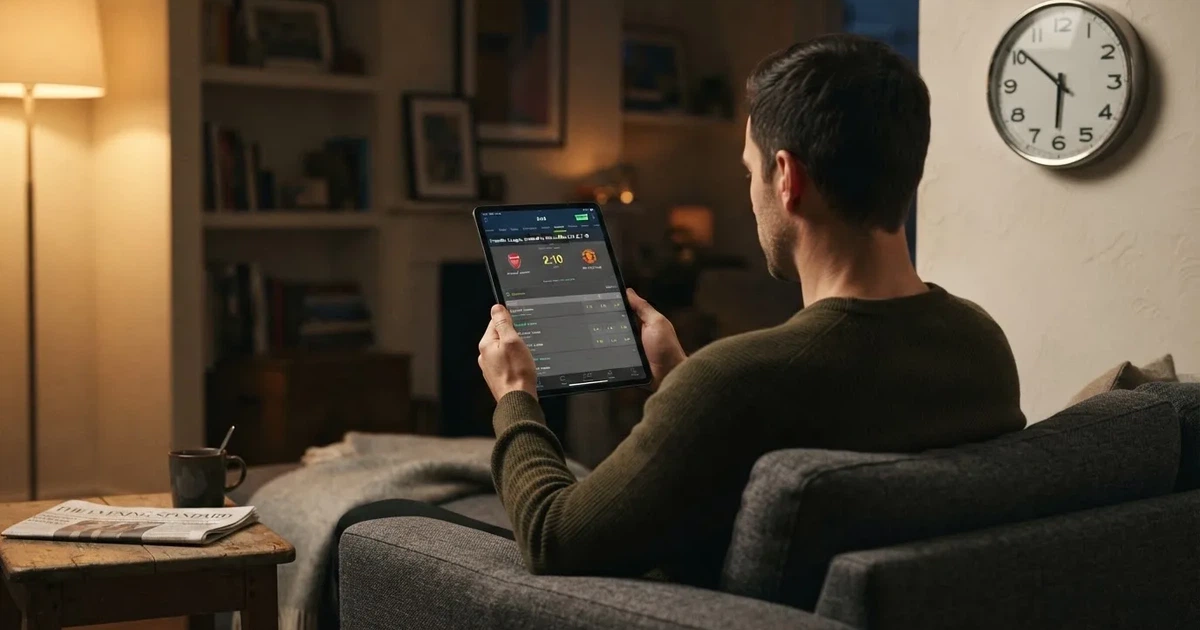
A 2UP offer pays out a football bet as a winner the moment the backed side goes two goals ahead. The full-time score can then do whatever it likes — a 2-1 squeaker, a 4-3 collapse, a stoppage-time equaliser — and the bet still settles as a win at the price taken. It sounds like insurance against the wobble every accumulator punter has lived through. The catch lives elsewhere: it is a separate market that has to be selected, ordinary Full Time Result bets do not qualify, and it only counts goals scored in regular time. Understanding the difference between a 2UP market and a “we’ll pay you early” promise is the difference between a useful tool and a marketing line that quietly never triggers.
This page walks through what a 2UP offer actually does, what it does not, who in the licensed British market is offering one, and what the surrounding terms — wagering caps, minimum odds, free-bet expiry, stake return — cost a real punter. The angle is honest arithmetic: every offer below is read against the bonus cap the Gambling Commission brought in on 19 January 2026, and against the bookmaker’s margin, because that is where the marketing word meets the balance sheet.
What a 2UP early payout actually is
The mechanic is straightforward once the words are separated. “2UP” describes the state of the match: one team is two goals ahead. “Early payout” describes what the bookmaker does in that state: it settles the bet as a winner before the final whistle. The bet does not wait for full time. It does not depend on the team holding the lead. The two-goal cushion is the trigger and the bet is closed at that instant.
That is also where the misconceptions start. A 2UP offer is not a refund if your team throws away a 2-0 lead. Nothing is paid back; the original bet wins. It is also not a separate promotion layered on top of a normal bet. It is a market of its own, named on the coupon, with its own price. Picking Full Time Result in the ordinary way does not carry the 2UP early payout with it.
Three rules from a bookmaker’s own rules hub make the shape of the offer concrete. First, a 2UP market is a separate market that has to be bet on; ordinary Full Time Result bets do not qualify for the 2UP early payout. Second, 2UP applies to regular time only: goals scored in extra time do not count towards the offer. Third, a fully cashed-out bet is not eligible for 2UP early payout; for a partially cashed-out bet, settlement uses the remaining active stake. Each of those lines is a quiet restriction that decides whether a punt ever actually triggers the payout, and they are the lines a marketing banner never quotes. The headline says “paid early if two up”. The rules say “on this market, in normal time, before you touch the cash-out button”.
The offer also only applies to football and only to matches where a two-goal lead is a realistic scoreline — league football, cup football, internationals. There is no equivalent on tennis, horse racing, or basketball, and “two goals up” has no literal meaning on a sport that scores in ones. Some bookmakers extend a similar early-payout mechanic to other sports (a tennis set lead, a baseball run margin) under their own naming, and the page makes no claim about those.
How a 2UP offer sits inside a coupon
A coupon splits into three layers a punter can confuse. The first is the outright Full Time Result: home, draw, away. The second is the 2UP market: home 2UP, draw 2UP, away 2UP, where the bet wins if the chosen side takes a two-goal lead at any point. The third is a promotional 2UP early payout attached to selected outright bets, which settles as a winner once the lead reaches two — without the punter having to find the 2UP market separately.

The third is the version most marketing copy describes. It is the one a “best 2UP bookmakers” page is usually selling. The first two are the version the operator’s small print quietly covers. The choice between them is the choice between a built-in feature and a market the punter has to remember to take. A bookmaker that promotes 2UP on every Premier League match has not necessarily built 2UP into the Full Time Result market; in most cases it has put it next to it. Treating those two as the same product is the cheap mistake this page is built to prevent.
The price on a 2UP selection will be shorter than the same selection on the outright. The bookmaker is paying out early, and that certainty costs the price. On a heavy home favourite at 1.30 on the Full Time Result, the same selection on the 2UP market might be 1.10 or shorter. The discount is the cost of the insurance — and on most matches the cushion never arrives, so the shorter price is the more frequent payer.
What the offer is worth in plain numbers
A free bet is a separate question from a 2UP payout, but it sits next to it on almost every welcome page, and the arithmetic is the same shape. Take a £10 free bet at decimal odds of 1.90 on an illustrative two-way market priced at 1.90 / 1.90. The bet is paid only as winnings: the £10 stake is not returned. The expected return, before the bookmaker’s margin, is £10 multiplied by the odds minus one, divided by the odds — that is £10 × 0.90 ÷ 1.90, or roughly £4.74. After the margin is taken into account, the realised value of that free bet lands a little lower.
Stated as a result rather than a procedure: a £10 free bet at 1.90 carries a realised value of roughly £4.40 to £4.75, depending on the margin the bookmaker actually runs on the chosen market. The condition that produces this band is the same condition that produces every free-bet figure on this page: the stake is not returned, the price is fixed at placement, and the market’s margin sits inside the price. A £20 free bet at the same odds roughly doubles that band to £8.80 to £9.50. A £40 free bet at the same odds roughly doubles it again. The point is not the headline number — it is that the headline number is roughly half the nominal value, and the “free” word in the offer is doing work the small print quietly undoes.
For a 2UP market itself the equivalent exercise is a margin question rather than a free-bet question. At decimal odds of 1.90 / 1.90, the implied probability across both outcomes is 1 ÷ 1.90 + 1 ÷ 1.90, or 105.3%. The 5.3% above 100% is the bookmaker’s margin — the slice of every pound staked that the bookmaker keeps on average across that market. A 2UP market typically runs a wider margin than the outright because the bookmaker is taking on extra settlement risk by paying out early; the price is shorter and the margin wider. The punter paying for the early payout pays it through a wider margin, not through a separate fee.
The bonus cap that landed on 19 January 2026
On 19 January 2026 the Gambling Commission’s promotion rules took their current shape. Two pieces matter for any bookmaker on this page. First, wagering requirements on bonuses are capped at 10x: a £10 bonus with a 50x wagering requirement would need £500 of qualifying bets; under the cap, no more than £100 of qualifying bets are required on the same £10. Second, mixed-product promotions are banned — an offer that asks the customer to gamble on two or more product types, such as a sports bet unlocking casino free spins, can no longer be marketed to British customers.
What the cap does not settle is also worth stating. Whether the 10x cap applies to free bets with no wagering condition remains unclear. Any cap on the money value of a bonus is also not established. The Commission has not published a single maximum bonus figure; it has capped the work the bonus takes, not the size of the bonus itself. The headline price on a welcome page is therefore not the regulated number. The regulated number is the work the headline asks of the punter, and the cap is a ceiling on that work.
The cap is also aimed at the operator, not at the punter. A bookmaker offering a 50x wagering bonus on £10 is breaking a licence condition; the punter who has already taken the offer has no protection from it. Reading the offer before claiming it is the only defence, and the small print on every welcome page is where that defence lives.
What the offer on each bookmaker actually costs
Reading the small print is the page’s whole purpose, so each operator below is read against four numbers: the headline, the qualifying condition, the expiry, and what happens to the stake. Where a figure is missing or the offer is structured in a way the spec does not cover, the gap is left empty in the table and explained in the prose beside it.
Unibet runs a Get £40 in Free Bets when you bet £20 sports welcome offer: a deposit and a sports bet of £20 or more at minimum odds of 2.0 (1/1), with the £40 in free bets expiring within 7 days of issue, for new GB customers using a debit card or instant bank transfer. The qualifying price is the first number to read — 2.0 in decimals is 1/1 in fractions, the price at which a winning £20 returns £40, including stake. Anything shorter than evens is not enough. The free bets themselves carry no separate wagering condition on the operator’s published welcome page, but the stake is not returned on a win, and the seven-day expiry is short against the 30-day window some rivals run. The headline of £40 in free bets reads as generous until the maths in the section above is applied: at 1.90 the realised value lands roughly between £17.60 and £19.00. The Commission cap does not bite here because there is no wagering multiple to cap; the value lives entirely in the price the free bet is spent at. Unibet’s wider shop is one of the longer-established names in the European licensed market, and its UK operation has run by the same licensee since 1999, which makes the offer’s terms stable rather than new.
Kalooki Sportsbook sits in a different slot. Its licence is held by Kalooki Sports Book Ltd, with Commission account 57730; the brand is a GAMSTOP member and the verification regime that runs before a first deposit is the standard GB one. The shop advertises instant withdrawals by bank transfer within minutes, Best Odds Guaranteed on UK and Irish horse racing, in-play betting, daily boosts and extra place races. The welcome page in the data carries a sportsbook headline without the same £X in free bets framing as the larger names, and the welcome offer is not specified in the same terms as the bigger brands. Reading the betting site’s own promotions page before depositing is the right move. For a 2UP-shaped product, the same rule applies: it has to be selected as a separate market on the coupon, and it has to be a market the brand is actually running. The cost a punter pays for instant withdrawals is mainly a smaller market depth — Kalooki is a smaller book than Unibet, and some coupons are thinner.
Ladbrokes runs an odds-boost pattern on horse and greyhound bets, Best Odds Guaranteed on UK and Irish horse races, in-play betting and Acca Boosts across the shop. The brand sits under the same parent licence as Coral — LC International Limited holds both — so reading the small print on one tells a punter roughly what the other will say. Where Ladbrokes differs from Coral is in the welcome offer framing: the headline sportsbook welcome page in the data carries the same Get £40 in Free Bets when you bet £20 shape as Coral, but with the brand’s own minimum-odds rules. The qualifying bet at minimum odds 2.0 (1/1) is the entry condition; the free bets expire within 7 days; the stake is not returned on a win. Ladbrokes’ wider product is built around horse racing and football, and Best Odds Guaranteed on UK and Irish racing is a meaningful feature for a punter who takes an early price on a horse — the bookmaker pays out at SP if SP is higher. The 2UP shape sits inside the football product rather than the racing one, and the same separate-market rule applies.
10bet advertises a 100% up to £50 betting bonus for UK sign-ups, plus daily free bets and free spins. This is a different shape from a free-bet offer: it is a deposit-match in cash bonus form, with the bonus amount matched to the deposit up to £50. A deposit-match carries a wagering requirement by definition — the bonus is not “free” in the same way a free bet is — and the wagering requirement is the number the Commission’s 10x cap now bounds. The qualifying price and the expiry window are not in the public summary and should be checked before depositing, because they decide how much betting the bonus takes. A £50 bonus at the 10x cap is £500 of qualifying bets; a £50 bonus at a 3x multiple is £150; the difference between the two is the cost of taking the offer. Daily free bets on top are an additional layer, and the same stake-not-returned rule applies.
Star Sports runs pre-event and in-play markets with Bet Boosts, Daily Specials and Weekend Enhanced Boosts, plus in-play betting on football, horse racing, golf and US sports. The shop is smaller than the high-street names in coupon depth but trades on the boost pattern: enhanced odds on named selections, daily specials on the day’s racing, and weekend boosts across the football coupon. For a punter whose betting pattern is a Saturday acca with one or two enhanced selections, Star Sports is a different kind of value than for a punter whose pattern is a Tuesday-night single on the Spanish league. A 2UP offer on Star Sports’ football coupon runs under the same separate-market rule as everywhere else: it has to be selected on the coupon, it triggers only in regular time, and a fully cashed-out bet does not qualify.
Midnite carries a sports welcome offer of new customers who bet £5 or more on pre-match odds of EVS (2.0) or greater within 14 days of sign-up receive £25 in free bets and 50 free spins, valid for 7 days. The shape is different from the standard £40-in-free-bets pattern: a lower qualifying stake, a 14-day qualification window (longer than the seven-day figure some rivals run), and a free-spins component on top. The free-spins element is the part that the Commission’s mixed-product rule now blocks — a free-spins layer attached to a sportsbook sign-up is a cross-product promotion, and on a GB-licensed site that promotion cannot be marketed after 19 January 2026. Reading the current Midnite promotions page is the right move before claiming: the offer in the public data was framed before the rule came into force, and what the site actually offers now is a tighter version. Midnite’s licence account is 101839, the site is in the GB licensed set, and the bookmaker’s wider product is acca builders, in-play, and price boosts with maximum-stake limits.
Lottoland sits oddly in a 2UP context. Its current app welcome offer is casino-based: a £20 stake on selected slots earns 100 free spins on Fishin’ Frenzy Even Bigger Fish with no wagering and a 30-day expiry, running until 14 February 2027. Lottoland holds a Commission remote general betting licence for real events and is therefore licensed to take football bets, but its welcome offer is on slots, not on the sportsbook. The Commission’s 19 January 2026 rule on mixed-product promotions is the structural reason: an offer that asks the punter to deposit on the sportsbook to unlock a casino bonus is now banned, and Lottoland’s offer pivots cleanly to casino to stay inside the rule. The relevant number for a punter evaluating the brand on a 2UP-shaped product is whether Lottoland’s sportsbook actually carries a 2UP market at all — many licensed brands hold a sportsbook licence but run a thin football coupon. Checking the Lottoland football coupon before depositing is the correct step; the welcome offer’s headline is not the place to look.
BetGoodwin runs a sports welcome offer of Bet £10 & Get £15 in Free Bets, made up of a £5 sports bet, a £5 acca and a £5 Sub-Cover bet. This is the multi-part free-bet shape: three free bets of £5 each, totalling £15, rather than a single £15 free bet. Each part carries its own conditions, and the realised value of each £5 free bet follows the same arithmetic as the £10 case in the section above: at 1.90, roughly £2.20 to £2.40 each, or £6.60 to £7.20 across the three. Sub-Cover is a BetGoodwin-specific market — a substitute-coverage product where the punter is refunded if a named player does not start — and reading its terms before claiming is necessary because the refund is in free-bet form, not in cash. The £5 acca free bet carries the same minimum-odds and stake-not-returned conditions as the rest.
Betmaster is operated by BM Solutions GB Ltd, registered in Malta, and holds Commission account 65699. The licence is GB; the operating company is Maltese. This is a normal licensed shape — many GB-licensed operators are run from outside the UK — but it is a shape that costs the punter nothing different and protects them through the same Commission route as a UK-incorporated operator. The brand’s sports welcome offer is not specified in the public data in the same headline form as the larger names, and the welcome page should be checked before depositing. For a 2UP-shaped product, the same separate-market rule applies.
NetBet offers Daily Boosts, Profit Boosts and free bet offers, a Bet Builder with instant dynamic odds, and sports stats for major leagues. The brand’s wider product is built around the boost pattern — short-term price enhancements on named selections — and a Bet Builder that combines markets from one event into a single bet, available pre-match and in-play. The bet-builder product sits next to a 2UP market in a way that punter pricing should read carefully: a bet builder combining a 2UP selection with another leg is a combination bet, and the 2UP leg settles under the 2UP rules while the rest settles under the bet-builder’s own. Reading the small print on a Bet Builder that includes a 2UP leg is necessary because the combination bet’s rules are not always the same as the single-market rules.
Reading the table
The table below carries the four numbers the prose above has been circling: the licence account, the licence holder, and what the operator’s own terms state on the 2UP-shaped offer. Where a term is not specified in the public data, the cell carries the no-data marker rather than a guess. The table is a read of each brand’s own terms page, not a comparison written by this page.
| Brand | Gambling Commission remote licence (account) | Licence holder | Operator’s own terms on the 2UP-shaped offer |
|---|---|---|---|
| Unibet | 45322 | Platinum Gaming Limited | Get £40 in Free Bets when you bet £20; qualifying bet at minimum odds 2.0; free bets expire within 7 days; stake not returned |
| Kalooki Sportsbook | 57730 | Kalooki Sportsbook Limited | Welcome offer not specified in the public data; check the brand’s promotions page before depositing |
| Ladbrokes | 54743 | LC International Limited | Get £40 in Free Bets when you bet £20; qualifying bet at minimum odds 2.0; free bets expire within 7 days; stake not returned |
| 10bet | 43173 | Blue Star Planet Limited | 100% up to £50 betting bonus; check wagering multiple, qualifying odds and expiry on the brand’s terms before depositing |
| Star Sports | 9177 | Star Racing Limited | Bet Boosts, Daily Specials and Weekend Enhanced Boosts on football coupon; no standalone 2UP product specified in the public data |
| Midnite | 101839 | Midnite Limited | £25 in free bets and 50 free spins on £5 qualifying bet at EVS or greater within 14 days; current GB offer is post-19 January 2026 and the free-spins component should be checked against the mixed-product ban |
| Lottoland | 38991 | EU Lotto Limited | Welcome offer is casino-based (£20 on slots, 100 free spins, no wagering, 30-day expiry until 14 February 2027); sportsbook 2UP product not specified |
| BetGoodwin | 2927 | Goodwin Racing Limited | Bet £10 & Get £15 in Free Bets (£5 sports + £5 acca + £5 Sub-Cover); check each leg’s terms |
| Betmaster | 65699 | BM Solutions GB Ltd | Sports welcome offer not specified in the public data; check the brand’s promotions page before depositing |
| NetBet | 39170 | Netbet Enterprises Limited | Daily Boosts, Profit Boosts, free bet offers and Bet Builder with instant dynamic odds; no standalone 2UP product specified in the public data |
What the licence actually buys a punter
A Gambling Commission remote licence is the whole test of whether a brand may take a football bet from a customer in Great Britain. The Commission’s public register can be searched by business name, trading name, domain, or account number; every brand in the table above is listed there against the licence number shown. The register is the document to check before depositing with any licensed bookmaker, and the data in the table is read against it as of the verification date on the first page.
The licence buys four practical protections. First, identity verification runs before the first deposit: name, address and date of birth are checked, including on a free bet or bonus, and there is no anonymous play at a licensed site. Second, GAMSTOP coverage is mandatory for online operators — periods of six months, one year, five years, or five years with auto-renewal — and a customer who has self-excluded through GAMSTOP cannot deposit with a GB-licensed bookmaker during the exclusion period. Third, the Commission’s complaints route is open to GB-licensed customers, alongside any approved alternative dispute resolution service the operator uses. Fourth, the bonus cap, the credit-card ban and the marketing rules apply, and the LCCP’s social responsibility code is enforceable.
The licence also buys the financial-vulnerability check that took its current shape on 28 February 2025: a public-record check (bankruptcy, county court judgments) once a customer’s deposits minus withdrawals exceed £150 in a rolling 30 days. It is not an income check and not a credit reference check. A separate financial risk assessment has been announced in a staged plan with no start date as of the data on this page. None of this is the operator choosing to check; it is the licence requiring it. For a punter it means that the first £150 of net deposits in a rolling 30-day window is the threshold above which the check is triggered, and the check is a public-record one rather than a deeper affordability review.
A British punt also taxes the bookmaker, not the punter. General Betting Duty is paid by the operator on gross profits at 15%; from 1 April 2027 a new remote betting rate of 25% applies within General Betting Duty, while remote bets on UK horse racing, bets on self-service betting terminals in licensed premises, pool betting and in-person betting stay at 15%. Until 1 April 2027 the remote rate stays at 15%, and whether operators pass duty on through odds is not established. Punters pay no tax on betting winnings in Great Britain; the duty is the operator’s, not the customer’s.
The protection a non-licensed site does not offer
The contrast is worth stating plainly. A site without a GB remote licence may still take a bet from a customer in Great Britain; the offence under section 33 of the Gambling Act 2005 sits with the operator, not with the customer. No offence aimed at a customer who merely bets on an unlicensed site was found. What the customer loses is the layer of protection the licence requires: no GAMSTOP coverage, no Commission complaints route, no approved dispute-resolution body, no British consumer redress if funds are withheld, no 10x bonus cap, no £150 vulnerability check, no credit-card ban enforcement, no LCCP marketing rules.
Enforcement against the unlicensed operator is disruption rather than blocking: cease-and-desist notices, search-engine referrals, work with registrars, hosts and payment providers, and the court-order DNS blocking powers the Commission has been given or is about to receive. None of that is a guarantee the punter’s funds are recoverable. The honest framing is that licensed means checks, limits, GAMSTOP, the bonus cap and identity verification, but also a regulated framework if a dispute arises; unlicensed means none of them and the loss of funds is a real outcome. Neither is “the safe choice” by default, and the choice is the punter’s.
Responsible gambling at a licensed bookmaker
The safer-gambling toolkit at a GB-licensed bookmaker is built from three pieces. The first is GAMSTOP, the national multi-operator online self-exclusion scheme, available to any customer and a mandatory licence condition for online operators since 31 March 2020. Periods are six months, one year, five years, or five years with auto-renewal, and after the minimum period the exclusion stays in place for a further seven years unless the customer asks GAMSTOP to remove it. GAMSTOP covers online sites and apps; betting shops use a separate service.
The second is the operator’s own deposit limit, required under the Commission’s Remote Technical Standards (RTS 12) since 31 October 2025, with a second phase postponed to 30 September 2026. The first phase applies the operator’s gross deposit limit on a fixed time frame; the second phase was announced and then postponed. Whether the second phase is live remains unclear. There is no state-set deposit or loss ceiling for betting in Great Britain: limits are the customer’s choice, and the operator’s job is to provide the tool.
The third is the help that sits outside the operator: GamCare (the National Gambling Helpline), GambleAware, the NHS gambling clinics network, and Gamblers Anonymous. None of them is the operator’s; all of them are reachable from a licensed bookmaker’s safer-gambling page. The right framing for a punter is that GAMSTOP is the multi-operator off-switch, the deposit limit is the per-operator budget tool, and the help lines are what they say they are.
The advertising rules frame the marketing a punter sees. The CAP Code section 16 keeps marketing socially responsible, away from under-18s, and away from anyone who is or seems to be under 25 in a featured role (with an exception for marketing placed where a bet can be made directly). That rule concerns who may appear in the advertisement, not who may bet. “Whistle-to-whistle” is an industry code rather than law: since 1 August 2019 betting advertisements have not been shown on TV from five minutes before a live sporting event to five minutes after it, before the 9pm watershed, with horse and greyhound racing excluded. The Premier League clubs’ withdrawal of gambling sponsorship from the front of matchday shirts from the 2026/27 season is voluntary rather than legal. None of this is the punter’s choice; it is the market’s.
How the 2UP offer pays out — the practical sequence
A punt on a 2UP selection follows a short practical sequence. The punter opens the football coupon, finds the match, and looks for a market labelled 2UP rather than Full Time Result. The price on the 2UP selection is shorter than on the outright. The punter places the bet from the bet slip and the bookmaker takes the stake. The match kicks off. If the backed side goes two goals ahead at any point in regular time, the bookmaker settles the bet as a winner — the bet slip turns green, the winnings are credited, and the bet is closed.
What happens next decides whether the offer has actually been used well. The punter cannot cash the bet out during the match and expect the 2UP payout to still apply; a fully cashed-out bet does not qualify. A partially cashed-out bet settles on the remaining active stake, not on the original full stake. If the match goes to extra time, the extra-time goals do not count: 2UP applies to regular time only. If the original Full Time Result bet was placed instead of the 2UP market selection, the early payout does not trigger at all, regardless of the two-goal lead — the bet waits for full time.
The practical implication is that a 2UP offer is a market selection, not an insurance policy bolted onto the Full Time Result. The punter pays a shorter price for the certainty of an early payout, and the certainty is real — the bet is closed at the moment of the two-goal lead. The price is the cost. Reading the coupon carefully before placing the bet is what makes the cost a known one.
Picking a bookmaker from the table
The table above carries the four columns the spec required; the choice between the brands is not the table’s job. The choice is the punter’s, and it depends on what matters most in the betting pattern. For a punter taking a welcome offer once, the highest nominal free-bet value is not the highest realised value: at 1.90, a £40 free-bet offer at one brand is roughly £17.60 to £19.00 of realised value, while a £25 free-bet offer at another is roughly £11.00 to £11.85. The difference is the £15 headline price, not the £15 realised value.
For a punter whose pattern is horse racing rather than football, Best Odds Guaranteed on UK and Irish racing is the feature to weight heavily: it converts an early-price punt into SP-or-better, and over a season of ante-post bets the difference is meaningful. For a punter whose pattern is football accumulators, an Acca Boost or an acca insurance product is the feature to read. For a punter whose pattern is in-play singles, the depth of the in-play coupon is the feature, and the smaller shops trade depth for sharper prices on the matches they do cover.
For a punter sensitive to bonus terms, the wagering multiple is the number to weight: a brand running a 3x multiple on a £50 deposit-match is asking for £150 of qualifying bets, and under the Commission’s 10x cap that is the kind of shape the cap was written for. A brand running a 10x multiple on a £10 bonus is at the cap. A brand running a 20x multiple on a £10 bonus would now be breaking the licence condition, and the Commission’s enforcement is the layer that catches it.
For a punter sensitive to verification, every GB-licensed brand is the same: identity verified before the first deposit, GAMSTOP coverage, and the £150 net-deposit threshold for the vulnerability check. The difference between brands on verification is the surface — how many documents the punter is asked for, how long the first withdrawal takes, whether the brand runs source-of-funds questions at higher spend — rather than the underlying regime.
What to read before claiming any offer
Three reads before any welcome claim. First, the operator’s own terms page for the specific offer being claimed: minimum odds, expiry, whether the stake is returned, whether the bet is restricted to singles or covers multiples, whether virtuals are excluded. Second, the operator’s general bonus terms for any condition that runs across promotions: maximum stake while a bonus is being cleared, whether cash-out voids the bonus, whether the bonus is forfeit on withdrawal. Third, the Commission’s register entry for the brand: licence account, licence holder, the categories on the register, and any condition attached to that specific licence.
A 2UP-shaped claim adds a fourth read: the operator’s football rules hub, where the rules on early payout, regular time, and cash-out live. The rules hub is the document that says whether the early payout applies to the bet being placed and how it interacts with the other conditions on the bet slip.
A bonus that breaks the 10x cap, a welcome offer that mixes products, a free-bet expiry shorter than the punter’s betting pattern — each of these is a condition a careful read surfaces and an unread claim absorbs. The page’s whole purpose is to put the read in plain language before the punter’s deposit, not after.
Frequently asked questions
What does 2UP mean in betting?
2UP is the state of a football match in which one team is two goals ahead of the other. A 2UP early payout is a bookmaker offer that settles a bet as a winner the moment the chosen team reaches a two-goal lead, regardless of the full-time result. The lead does not have to be held; the trigger is the cushion, not the win.
What is 2UP in betting?
It is a market of its own on the football coupon — home 2UP, draw 2UP or away 2UP — with its own price, separate from the Full Time Result. Some bookmakers also attach a 2UP early payout to selected outright bets as a built-in feature. In both cases the offer only counts goals scored in regular time; extra-time goals do not count towards the trigger.
What is a 2UP bet?
A 2UP bet is a single bet placed on the 2UP market of a football match. The bet wins if the chosen team takes a two-goal lead at any point in regular time. A fully cashed-out bet is not eligible for the early payout; a partially cashed-out bet settles on the remaining active stake. The price is shorter than the equivalent Full Time Result selection because the bookmaker is paying out early.
What is the maximum wagering requirement on a betting bonus in Great Britain?
Since 19 January 2026 the Gambling Commission has capped wagering requirements on bonuses at 10x. A £10 bonus with a 50x wagering requirement would need £500 of qualifying bets; under the cap no more than £100 of qualifying bets are required on the same £10 bonus. The cap applies to the work the bonus takes, not to the size of the bonus itself. Whether the cap applies to free bets with no wagering condition is not established in the public data.
What do minimum odds and the wagering requirement mean in a sign-up offer?
The minimum odds are the shortest price at which the qualifying bet counts towards the offer. A “bet £20 at minimum odds 2.0” requirement means the qualifying bet must be placed at decimal odds of 2.0 (1/1 in fractional form) or longer; anything shorter does not qualify. The wagering requirement is the multiple of the bonus that must be turned over in qualifying bets before the bonus and any winnings from it become withdrawable. Under the Commission’s 19 January 2026 cap, that multiple is no more than 10x.
Free bets & offers – Accumulator
Content created by the «Accumulator» team
