
Padel betting odds across ten UK-licensed bookmakers — the price, the margin and what each offer really costs
 Available in US
Data current as of 26 October 2026 and checked against the Gambling Commission’s public register for each operator named below.

Premier Padel runs a unified global tour from the 2024 season onwards, after Qatar Sports Investments took over the old World Padel Tour in 2023. Padel is usually played as doubles on a 10 m by 20 m court with walls and fencing, a net 88 cm high at the centre, and tennis-style scoring. The International Padel Federation puts the active player base at more than 35 million across 150-plus countries as of 2025. None of that turns it into a major betting sport by British volume, which is precisely why padel betting odds deserve a closer read than football prices do: thinner markets mean bigger margins, and a punter who does not check the overround pays for it on every stake.
How this page ranks ten licensed bookmakers — and what the price tag actually says
The ten operators below hold a remote betting licence from the Gambling Commission for customers in Great Britain. None of them is the only licensed one; many more brands sit on the same register. A slot in a comparison is not a licence, and a brand missing from this list is not unlicensed for it. What sets a slot apart, on this page, is what the padel price tag costs a punter once the marketing gloss is stripped back: the margin baked into the odds, the qualifying rules of any offer the operator markets to padel bettors, the speed at which a withdrawal lands, and the friction in getting verified before a first deposit lands.

| Brand | Gambling Commission remote licence and licensee | What the operator’s own terms state on padel |
|---|---|---|
| BetMGM | 039198-R-319450-029 · LeoVegas Gaming PLC | Welcome package is four £10 free bets (two acca tokens on football, two multiples tokens on sports), valid 7 days, minimum-odds and opt-in rules apply |
| Octobet | 062545-R-337248-006 · Octopus Game Limited | Sports welcome is 50 % back as a free bet up to £50, plus a £10 casino bonus |
| Smarkets | 039173-R-319366-011 · Smarkets (Malta) Limited | Exchange model: bank transfer deposits from £10 to £10,000 are instant; withdrawals processed within 6 hours up to £100,000 |
| LiveScore Bet | 056859-R-332720-005 · LiveScore Betting and Gaming (Gibraltar) Limited | Bet Builder takes up to 10 selections covering match result, both teams to score, corners, total goals, player scoring and cards |
| Betboro | 044181-R-324363-007 · Webmedia Development N.V. | 100 % matched free bet up to £25 on the first qualifying wager; first bet must be £5 to £25 on at least three legs, each at 3/5 (1.60) or higher |
| Bar One Racing | 056516-R-332750-007 · Bar-One Racing Limited | Irish independent bookmaker rebranded as BAR 1 Betting; race sponsorships at Dundalk, Fairyhouse, Navan, The Curragh, Curraheen Park and Cork |
| VBet | 044662-R-324273-022 · SCGO Limited | £10 free bet if a new, verified customer’s first-ever losing bet stakes £10 or more |
| Bet Ahoy | 100094-R-341742-003 · Bet Ahoy Ltd | Welcome is a £10 bundle split into a £5 sports bet and a £5 acca token |
| Midnite | 101839-R-342850-001 · Midnite Limited | Welcome is £25 in free bets and 50 free spins for a £5+ pre-match stake at EVS (2.00) or greater within 14 days; free bets valid 7 days |
| Fitzdares | 000400-R-103839-030 · Fitzdares Limited | App package covers cash out, accumulators, Lucky 15s, specials, antepost and in-play on horse racing, football, tennis, rugby, cricket, golf and American football |
Padel coverage itself is not in every row of the right-hand column, and that is the first thing a British punter notices: not every operator on the Commission’s register publishes a deep padel book. The right column carries what each operator’s own terms state on its welcome package, its staking mechanics and its in-play or builder features — the things a customer encounters before a padel price is even seen. The licence column is the test of whether the brand can lawfully serve customers in Great Britain at all, and a punter who skips it is betting on a name with no proof of being who it says it is.
The ten brands, in turn
BetMGM — thick welcome package, lots of moving parts
LeoVegas Gaming PLC runs BetMGM in Great Britain under licence 039198-R-319450-029. The sports welcome package for new UK customers who deposit £10 or more and place a sports bet within 7 days is four £10 free bets — two football acca tokens on four-or-more-leg multiples, two sports multiples tokens on two-or-more-leg bets — each valid 7 days, with minimum-odds and opt-in rules in the small print. The headline reads as a £40 bundle; the conditional structure reads as four bets that each have to clear their own hurdles inside a week.
For a padel punter, BetMGM is at its best on mainstream football and US sports where the multiple legs are easy to source, not on a Premier Padel match list that the operator’s own acca tokens may not always cover. The four-bundle shape rewards a punter who already has a sport to multiply; on a single-padel-punter profile the four £10 tokens fragment a small staking plan across four qualification windows.
Worth it, when a punter’s staking week plans four accas anyway and can meet each token’s leg count on its own sport.
Octobet — half-back free bet, modest ceiling
Octopus Game Limited operates Octobet under licence 062545-R-337248-006. The sports welcome is 50 % back as a free bet up to £50, plus a £10 casino bonus. That is a refund-on-loss shape rather than a deposit match; a punter who loses a first qualifying stake gets half of it back in free-bet form, capped at fifty pounds.
For padel, the operator’s own product layout is the more interesting line than the welcome: thinner markets mean a refund-of-50 % makes more sense than a 100 % match because the marketing cost of equal-money match-ups at 1.90 odds would be punishing. The casino bonus on top is the giveaway that this is a bundled-everything operator; padel bettors with no casino interest get a token they will not use.
The half-back shape suits a padel punter happy to leave the casino token on the table and treat the offer as a discount on first loss.
Smarkets — exchange model, different math
Smarkets (Malta) Limited runs the exchange under licence 039173-R-319366-011, in the betting intermediary category — a different licence shape from the fixed-odds houses on the rest of the list. Open-bank deposits are instant from £10 to £10,000; debit-card deposits are instant from £10 to £15,000; withdrawals are processed within 6 hours up to £100,000. The pricing model is a commission on net winnings, not an overround on every market, so the padel price a backer takes is closer to the true probability than any traditional book on this list.
For padel, an exchange is the place to look when the fixed-odds houses’ margins bite on a thin event. The trade-off is liquidity: Premier Padel majors draw money; the FIP tour’s lower-ranked weeks may not. A punter who can stomach backing at the available price and laying later finds a profit path that no high-margin book matches.
Worth it when liquidity is there, which it usually is on Premier Padel majors and usually isn’t on the rest of the calendar.
LiveScore Bet — Bet Builder’s reach
LiveScore Betting and Gaming (Gibraltar) Limited holds licence 056859-R-332720-005. The Bet Builder takes up to ten selections covering match result, both teams to score, corners, total goals, player scoring and cards. Bet builders bundle several markets from one event into one price, and the deeper the builder’s catalogue, the closer the punter can get to a padel fixture the same way they treat a Premier League game.
Padel-specific customisation is the test; the corner and cards markets most Premier League builders reward are absent on a four-player doubles court. The builder’s reach on padel depends on which markets LiveScore Bet itself turns on for Premier Padel, and a punter should check the builder on a specific match before assuming the ten-selections headline applies on both sports.
Best for a punter who lives in the Bet Builder on football and wants to try the same workflow on padel, with the caveat that padel’s market list is shorter.
Betboro — three-leg minimum, 1.60 short-price floor
Webmedia Development N.V. runs Betboro under licence 044181-R-324363-007. The sports welcome is a 100 % matched free bet up to £25, granted on the first qualifying wager — debit-card deposit of £10 or more, first bet of £5 to £25, on at least three selections each priced at 3/5 (1.60) or higher. The minimum-price floor at 1.60 is the kind of detail a marketing line does not announce.
For padel, a three-leg acca at 1.60 minimum per leg is a buildable shape: a Premier Padel match winner combined with overs on total games or a set betting line runs into 1.60 territory easily. The ceiling is low (£25) but the qualifying hurdle is realistic, and unlike football-heavy welcome offers the three-leg minimum does not exclude padel.
Worth it for a padel bettor who can pick two more short-price selections to ride alongside a Premier Padel match winner.
Bar One Racing — race-led shop, padel-thin
Bar-One Racing Limited operates Bar One Racing under licence 056516-R-332750-007, rebranded as BAR 1 Betting. The independent Irish bookmaker’s sponsorship portfolio — Dundalk, Fairyhouse, Navan, The Curragh, Curraheen Park and Cork — tells a punt-to-punter what the brand’s spine is: horse racing is the offer, with shop-side infrastructure behind it.
Padel coverage on a racing-led independent is unlikely to be deep. A punter looking for the BAR 1 welcome package on padel reads the operator’s terms before staking; the licence is solid, the shop footprint is real, and the padel book is the variable.
Useful for a punter who wants the shop-side experience on racing and treats a padel bet as a side bet checked first on the app.
VBet — simple £10 free bet on a loss
SCGO Limited runs VBet under licence 044662-R-324273-022. The sports welcome is a £10 free bet if a new, verified customer stakes £10 or more on a first-ever bet that loses. The mechanic is the simplest on this list: one bet, lose it, get a free bet. No minimum-odds floor in the marketing line.
For padel, the simplicity is the point. A £10 first bet on a Premier Padel match winner either wins (no bonus) or loses (a £10 free bet, stake not returned on win). The free bet’s true value depends on what the punter prices it at next, and the calculation further down this page sets out the conversion factor.
Worth it for a punter happy to take one shot on a padel match and ride the refund token if it loses.
Bet Ahoy — split £5 sports + £5 acca
Bet Ahoy Ltd operates Bet Ahoy under licence 100094-R-341742-003. The welcome is a £10 bundle split into a £5 sports bet and a £5 acca. A 50-50 split between a single and an accumulator is unusual; the headline reads like a standard £10 free bet, the detail is two tokens of half the headline value each.
For padel, the £5 acca needs multiple legs at minimum price to qualify; a padel punter picking one match winner and two short-priced sides from other sports makes the token work. The £5 single is more straightforward and lands cleanly on a Premier Padel match.
A modest welcome for a padel punter who wants to spread their first free bets rather than roll one token up.
Midnite — free bets plus free spins, EVS minimum
Midnite Limited runs Midnite under licence 101839-R-342850-001. The sports welcome is £25 in free bets and 50 free spins for a £5+ pre-match stake at EVS (2.00) or greater within 14 days; free bets valid 7 days. The minimum price at even-money and the 14-day window are the real terms — the marketing line leans on the £25 figure.
Padel is mentioned by Midnite’s site among its in-play and acca builder coverage. For a padel punter, EVS minimum on a pre-match padel bet is workable on most top-tier Premier Padel matches where the favourite goes off shorter than evens but the outsider touches it.
Worth it for a padel punter happy to stake at evens or longer pre-match, free spins carrying less interest if casino is not the plan.
Fitzdares — premium app, broad sport list
Fitzdares Limited operates Fitzdares under licence 000400-R-103839-030. The app package covers cash out, accumulators, Lucky 15s, specials, antepost and in-play on horse racing, football, tennis, rugby, cricket, golf and American football. Padel is not in the named list on the iOS App Store copy, which is the gap a punter has to check on the operator’s own site before staking.
For padel, the brand’s positioning as a premium punter-facing app matters more than its welcome offer. A punter who wants the cash-out and Lucky-15 mechanics of a racing-led app on a four-player sport will find the welcome is a smaller factor than the running-account mechanics.
A premium-app option for a punter happy to read the padel markets on the Fitzdares site before staking, rather than expecting them on the App Store copy.
Padel fundamentals for a punter who has never watched it
Padel is usually played as doubles on a 10 m by 20 m court enclosed by walls and fencing, with a net 88 cm high at the centre. Scoring follows tennis, with the wrinkle that major tournaments may use a golden point at deuce rather than advantage scoring. The court is smaller than a tennis court; the rallies involve the walls. That shape of play is what a punter pricing a padel match prices, and the betting markets that work on tennis — match winner, set winner, total games, set betting — translate, with the golden point collapsing a deuce market that does not exist on a tennis court.
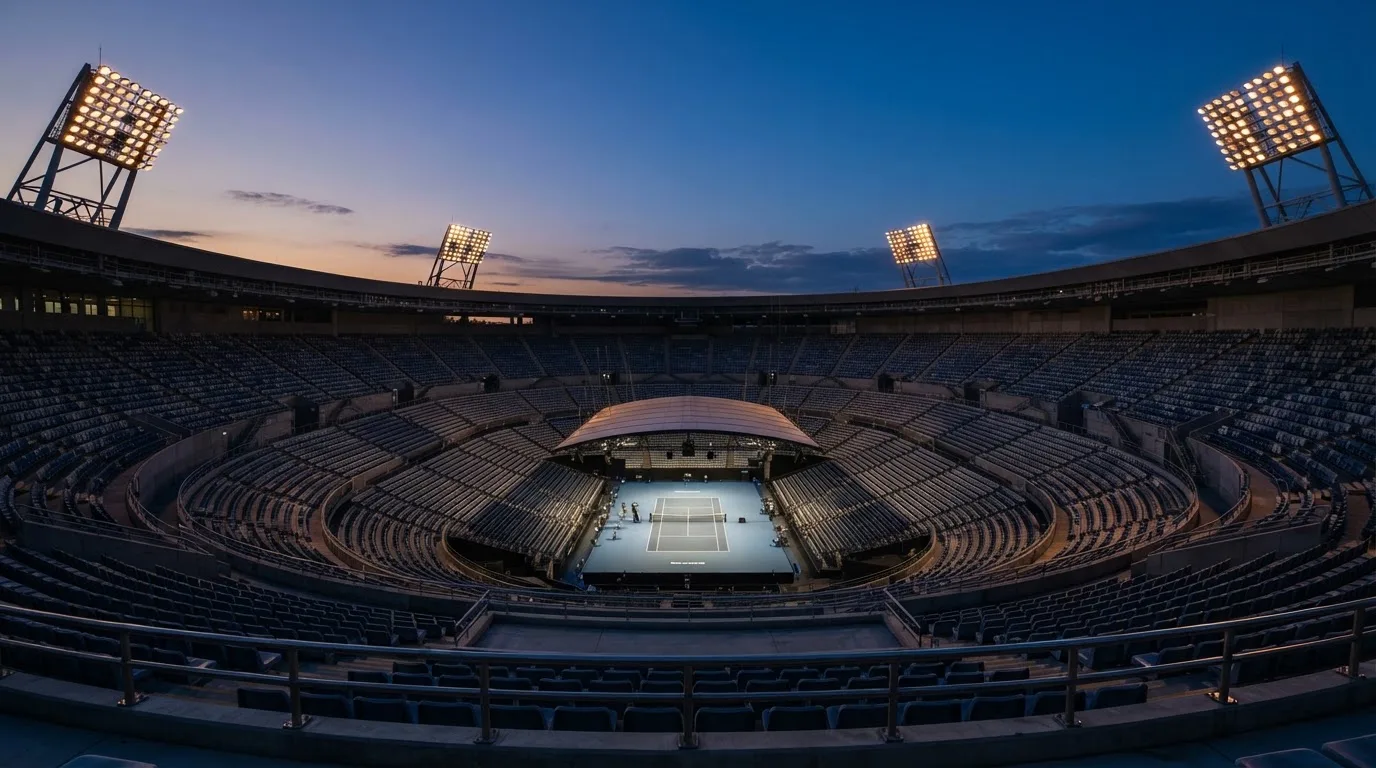
The active player base crosses 35 million across 150-plus countries as of 2025 according to the International Padel Federation, and the professional tour is the Premier Padel circuit from the 2024 season onwards. Qatar Sports Investments acquired the World Padel Tour in 2023 and folded it into Premier Padel, which now organises the sport’s elite calendar alongside the FIP’s own ranking tournaments. The result for a punter is a clearer top tier of fixtures than the WPT/FIP split used to support, and a longer tail of regional events underneath that does not get the same coverage on every British bookmaker’s site.
Where padel fits in British betting law
The Gambling Commission licenses commercial betting in Great Britain under the Gambling Act 2005, and Northern Ireland sits outside that Act under its own older regime, so a GB-licensed operator covers England, Scotland and Wales and not Northern Ireland. Since the Gambling (Licensing and Advertising) Act 2014 an operator whose remote facilities are used in Great Britain needs a Commission licence wherever it is based — a Curaçao, Maltese or Gibraltar licence by itself is not a substitute, although it is a route to holding a Commission licence on top.
The relevant remote licence categories for padel betting are remote general betting standard (real events) for fixed-odds books, and remote betting intermediary for exchanges. There is no statutory list of permitted sports or markets: a bookmaker licensed under one of those categories offers what its own commercial decision and LCCP duties permit, and padel sits inside “real events” because the matches are real fixtures played by licensed professionals. The Commission’s public register is the whole test of whether a brand holds a licence, searchable by business name, trading name, domain or account number, and a punter who has not checked a brand against the register has not checked it.
What may be bet on is wider than football, narrower than novelty. The Commission’s framework does not list permitted sports in the Act itself; the scope is determined by the operator’s licence category and its own commercial decision. In-play is offered by GB bookmakers and the controls are operator-side licence conditions — never write that in-play is unrestricted as a legal conclusion, because the controls are real, just not a statute. Esports are treated as standard events; virtual events are a separate licence category. Politics, TV and novelty markets sit on the menu at some GB-licensed books and no statutory prohibition closes that door.
Identity verification is the rule a padel punter hits before the first deposit. Since 7 May 2019 name, address and date of birth are verified before a customer can deposit or gamble at a GB-licensed remote bookmaker, including with a free bet or bonus. That rule pre-dates the padel boom and applies to every sport equally. Credit cards are banned for gambling in Great Britain since 14 April 2020, including credit-card-funded e-wallet payments; debit cards and bank-based payments are not covered.
Player protection — the rules that already bite on a padel bettor
GAMSTOP is the national multi-operator online self-exclusion scheme and a mandatory licence condition for online operators since 31 March 2020. Periods are six months, one year, five years, or five years with auto-renewal, and after the minimum period the exclusion stays in place for a further seven years unless the customer asks GAMSTOP to remove it. GAMSTOP covers online sites and apps, not betting shops, which use a separate service. Every brand on this list is a GAMSTOP member.
A financial vulnerability check has applied since 30 August 2024 and reaches a betting customer when deposits minus withdrawals exceed £150 in a rolling 30 days, since 28 February 2025. It is a public-record check such as a bankruptcy or county court judgment, not an income check and not a credit reference check. Financial risk assessments — the affordability checks of the press — have been announced in a staged plan with no start date, so the framed truth is “announced, staged, no start date”, never “in force”. Deposit limits are a Commission rule: gross deposit limits on a fixed time frame, with the first changes applied since 31 October 2025 and a second phase postponed to 30 September 2026. Whether that second phase is live is not established.
There is no state-set deposit or loss ceiling for betting in Great Britain. The limit is the customer’s choice, and the operator’s job is to surface the tools that let the customer set one. The help outside the operators is GamCare (the National Gambling Helpline), GambleAware, the NHS gambling clinics and Gamblers Anonymous.
Bonus terms have moved under Commission rules in force since 19 January 2026. Wagering requirements on bonuses are capped at 10x: a £10 bonus at 50x needed £500 of bets, and under the cap no more than £100. Mixed-product promotions — an offer that requires gambling on two or more product types such as betting, casino, bingo and lottery, for example “bet on football to get free spins” — are banned. Whether the 10x cap applies to free bets with no wagering condition, and any cap on the money value of a bonus, are not established.
The marketing code on advertising sets its own constraints. CAP Code section 16 says marketing must be socially responsible, must not be of strong appeal to under-18s, and no one who is or seems to be under 25 may be featured gambling or play a significant role — with an exception for marketing placed where a bet can be made directly. That is a rule on who appears in an advert, not on who may bet. The minimum age to bet is 18.
Sports and tournaments a padel punter prices
The professional tour a padel punter prices is the Premier Padel circuit from the 2024 season. The takeover by Qatar Sports Investments in 2023 folded the old World Padel Tour into Premier Padel, leaving the FIP circuit underneath running the international ranking tournaments. The schedule a British bookmaker carries will be the Premier Padel majors at the top end — Dubai, Qatar, Italy, Spain, Argentina — and an FIP-rated layer below that on some operators.
The market menu a padel punter should expect on a bookmaker covering the sport:
- Match winner — the head-to-head result of a singles or doubles match (doubles being the format at professional level).
- Set betting — the scoreline in sets, again tennis-shaped.
- Total games — over/under on combined games across the match, where the golden-point rule cuts the long deuce games the equivalent tennis market runs into.
- Handicap — game or set handicap, mirroring tennis markets in shape.
- In-play — set-by-set pricing once the match is underway.
The thin-market warning travels with padel into every one of those markets. A Premier Padel final carries some liquidity on the major operators; an FIP-ranked early-round match carries much less. The price a punter sees on the smaller events carries a wider margin than the equivalent football line, and the next section sets out why.
What the price tag actually says — margin and the overround
Every decimal odds line a bookmaker publishes hides a margin. The margin is what the bookmaker keeps of every unit bet on a market, and the way to see it is the payout-share formula: payout share = 1 ÷ (1/odds₁ + 1/odds₂ + … + 1/odds_n) over every outcome of one market, with the margin the gap to 100 %.
Take an illustrative two-way padel match at 1.90 / 1.90 (the equivalent fractional price is 9/10). The payout share is 1 ÷ (1/1.90 + 1/1.90) = 1 ÷ (0.5263 + 0.5263) = 1 ÷ 1.0526 = 0.95, or 95 %. The margin is 1 − 0.95 = 0.05, or 5 %. That is the bookmaker’s edge on every stake: 5 pence of every £1 the market takes, before any operator-side cost or duty.
Move the prices to 1.85 / 1.85 on the same two-way padel match and the math becomes 1 ÷ (1/1.85 + 1/1.85) = 1 ÷ (0.5405 + 0.5405) = 1 ÷ 1.0811 = 0.925, or 92.5 %, and the margin climbs to 7.5 %. A bookmaker that quotes 1.85 takes 7.5 pence of every £1; one that quotes 1.90 takes 5 pence. Premier League match-winner markets routinely print at 1.90 / 1.90 / 1.90 for a 1X2 with three outcomes, giving a margin closer to 5.4 %, and the deeper liquidity is what lets the books run a tighter overround. Padel does not have that liquidity, and the 7.5 % margin is closer to what a padel punter pays than the 5 % football line.
Two facts follow from the margin.
- The same bet at 1.90 pays back 1.90 × stake; the same bet at 1.85 pays back 1.85 × stake. The price difference on the betting slip is what the margin is, in pence.
- A bonus that requires a turnover of, say, 5x the bonus on a margin of 7.5 % costs 5 × 7.5 % = 37.5 % of the bonus in expected loss before any of it returns. That calculation lives in the bonus economics of the operator’s terms and is what a punt-to-punter is buying when they take the headline.
The same logic applies to combinations: a four-leg padel acca at 1.60 / 1.60 / 1.60 / 1.60 multiplies the odds into 6.55, but each leg carries its own margin, and the cumulative overround on the combined bet is the gap between 6.55 and the fair-value equivalent of the four legs’ probabilities. The free bet sections further on carry that.
What a winning bet returns
The payout formula is the simplest line in this article. For a single bet at decimal odds, return = stake × odds, and net profit = stake × (odds − 1). A £10 stake at 1.90 returns £19 — £10 stake plus £9 profit. A £10 stake at 5.00 returns £50 — £10 stake plus £40 profit. The decimal odds include the stake; the fractional odds do not.
For a combination bet the odds of each leg multiply into one price, and a four-leg acca at 1.60 / 1.60 / 1.60 / 1.60 multiplies into 6.5536, which a bookmaker rounds to 6.55 or 6.54 depending on its policy. The accumulated margin is the reason a four-leg 6.55 is rarely the fair price the four legs would imply independently.
What a free bet is worth
A free bet whose stake is not paid back with a win is worth less than its face value, by the formula value = free-bet amount × (odds − 1) ÷ odds × payout share of the market priced. For a £10 free bet on a 1.90 / 1.90 market at 1.90, the value is £10 × (1.90 − 1) / 1.90 × 0.95 = £10 × 0.4737 × 0.95 = £4.50. The headline “£10 free bet” is worth about £4.50 on average at 1.90 odds, never £10, never what it wins on a single occasion.
The higher the price, the closer to face value the free bet gets. At 5.00 the same £10 free bet is worth £10 × (5.00 − 1) / 5.00 × 0.95 = £7.60. At 10.00 it is £10 × (10.00 − 1) / 10.00 × 0.95 = £8.55. The market still takes its share — the 0.95 payout share on a 1.90 / 1.90 market, the equivalent on a deeper-price market.
Bonus economics in one paragraph
A bonus with a 5x wagering requirement means £50 of qualifying bets on a £10 bonus. If the qualifying bets are placed on a single market at 7.5 % margin, the expected cost is £50 × 7.5 % = £3.75. The punter expected to lose £3.75 of the £10 bonus in the act of clearing it, leaving about £6.25 of bonus value retained on average before any of it returns. The Commission’s 10x cap that took effect on 19 January 2026 is a ceiling on that multiplier: a £10 bonus at 50x needed £500 of bets, and under the cap no more than £100. The cap is an upper bound on what the clearing costs, not a reduction in expected cost to zero.
Responsible gambling for a padel punter
The tools a GB-licensed bookmaker must offer are the customer-side deposit limit, time-out, reality checks, self-exclusion via GAMSTOP and access to help lines. The deposit limit is the customer’s choice — the operator’s job is to surface the setting — and there is no state-set ceiling. Time-outs are short pauses of days to weeks; GAMSTOP self-exclusion is the longer mechanism, on a six-month to five-year plan, plus the seven-year tail after the minimum period.
The financial vulnerability check on the deposit-minus-withdrawal threshold is the operator’s own responsibility, not the punter’s. The punter’s job is to read the operator’s terms on the trigger and on what the public-record check involves, because the check happens when the threshold trips and the punter is the one it runs against.
Help outside the operators sits at GamCare (the National Gambling Helpline on 0808 8020 133), GambleAware, the NHS gambling clinics and Gamblers Anonymous. A punter who has crossed one of the thresholds and felt the squeeze of the verification or the check has the same routes to help as a punter on any other sport.
What to check before the first padel stake at any of these ten
Three checks a padel punter should run before settling on one of the ten brands.
- Licence. Search the Commission’s public register by domain or business name; every operator above sits on it, and a domain proves nothing by itself because licensed operators use both
.comand.co.uk. - Padel coverage. Not every operator publishes the same depth of padel book. The market menu the operator carried the last time a Premier Padel event ran is the leading indicator of what it will carry the next.
- Welcome offer mechanics. The headline is the deposit match, free-bet bundle or refund shape; the small print is the minimum odds, the qualifying window and the wagering requirement capped at 10x since 19 January 2026. A £25 free bet at 1.60 minimum and 7-day validity is a different bet from a £25 free bet at 1.50 minimum and 30-day validity.
Two further rules that are not headline-worthy but matter on a padel bet specifically: each-way betting doubles the stake because it is two bets at equal unit, and the place terms vary by race for horse racing but for padel are operator-defined; a Rule 4 deduction is a horse-racing rule, not a padel one. The padel bettor’s vocabulary is match winner, set betting, total games, handicap, in-play.
A note on the numbers above
The licence numbers and licensee names are taken from the Gambling Commission’s public register at the access date named in the data-stamp at the top of this page. The welcome-offer mechanics are taken from each operator’s own terms and App Store copy at the same access date. Offers change, so any operator’s headline on the day a punt-to-punter lands there may already differ — the value of the check against the register is that it does not change.
The odds used in the margin calculation above are illustrative, not quoted. A two-way padel match at 1.90 / 1.90 gives a 5 % margin on a payout share of 95 %; a 1.85 / 1.85 gives a 7.5 % margin on 92.5 %. The transition between those bands is what the price the punter sees moves through as they move from a major Premier Padel event to the FIP tail, and the value of the margin calculation is that it puts a number on that movement. No specific live padel price is recorded on this page, because nothing in the inputs supported a snapshot for one event at one bookmaker at one moment; the calculation is what that snapshot would tell a punter if they took it.
Frequently asked questions
Can you bet on padel in Great Britain?
Yes, at operators holding a Gambling Commission remote licence for real-events betting, with Premier Padel majors the most reliably priced events. Padel sits inside the licence category as a real sport — there is no statutory list of permitted sports, but the Commission’s framework treats the professional tour as real events. Not every licensed bookmaker publishes a deep padel book; the leading-indicator metric is the market menu the operator carried the last time a Premier Padel event ran.
How is the return on a bet worked out from the stake and the odds?
For a single bet at decimal odds the return is stake × odds, and the net profit is stake × (odds − 1). A £10 stake at 1.90 returns £19: £10 stake plus £9 profit. The decimal odds include the stake; fractional odds such as 5/1 (read “five to one”) exclude the stake. For a combination bet the odds of each leg multiply into one price.
What is the bookmaker’s margin and how is it seen in the odds?
The margin is what the bookmaker keeps of every unit bet on a market. The way to see it is to back-calculate the “true” probabilities from the odds across every outcome of the market, add the implied percentages, and subtract from 100. For a two-way market at 1.90 / 1.90 the implied probabilities sum to 105.3 %, the margin is 5 %, and the punter loses 5 pence of every £1 the market takes in expected value.
How do fractional odds such as 5/1 convert to decimal odds such as 6.00?
The conversion is decimal = a ÷ b + 1, where a/b is the fractional form. For 5/1 the decimal is 5 ÷ 1 + 1 = 6.00. For 9/10 (odds-on, “nine to ten”) the decimal is 9 ÷ 10 + 1 = 0.9 + 1 = 1.90. Evens (1/1) is decimal 2.00. Decimal odds include the stake; fractional odds do not.
Which tools for controlling play does a licensed bookmaker have to offer?
The customer-side tools on a GB-licensed remote bookmaker include deposit limits on a customer-set frame, time-outs for short pauses, reality checks during play, GAMSTOP for self-exclusion on a six-month to five-year plan, and pointers to GamCare, GambleAware and the NHS gambling clinics. The Commission’s deposit-limit framework has applied in stages since 31 October 2025 with a second phase postponed to 30 September 2026; whether that second phase is live is not established.
Tennis, darts & cue sports – Accumulator
Content created by the «Accumulator» team
